
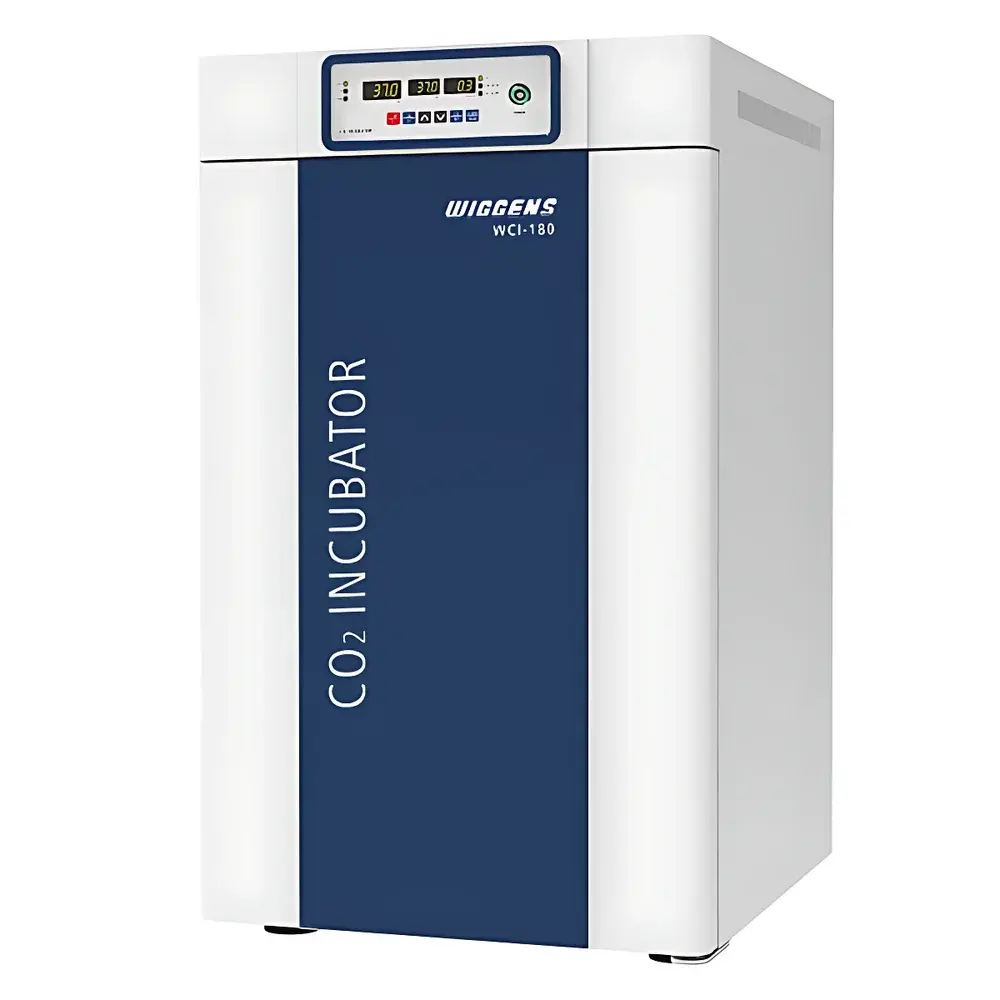
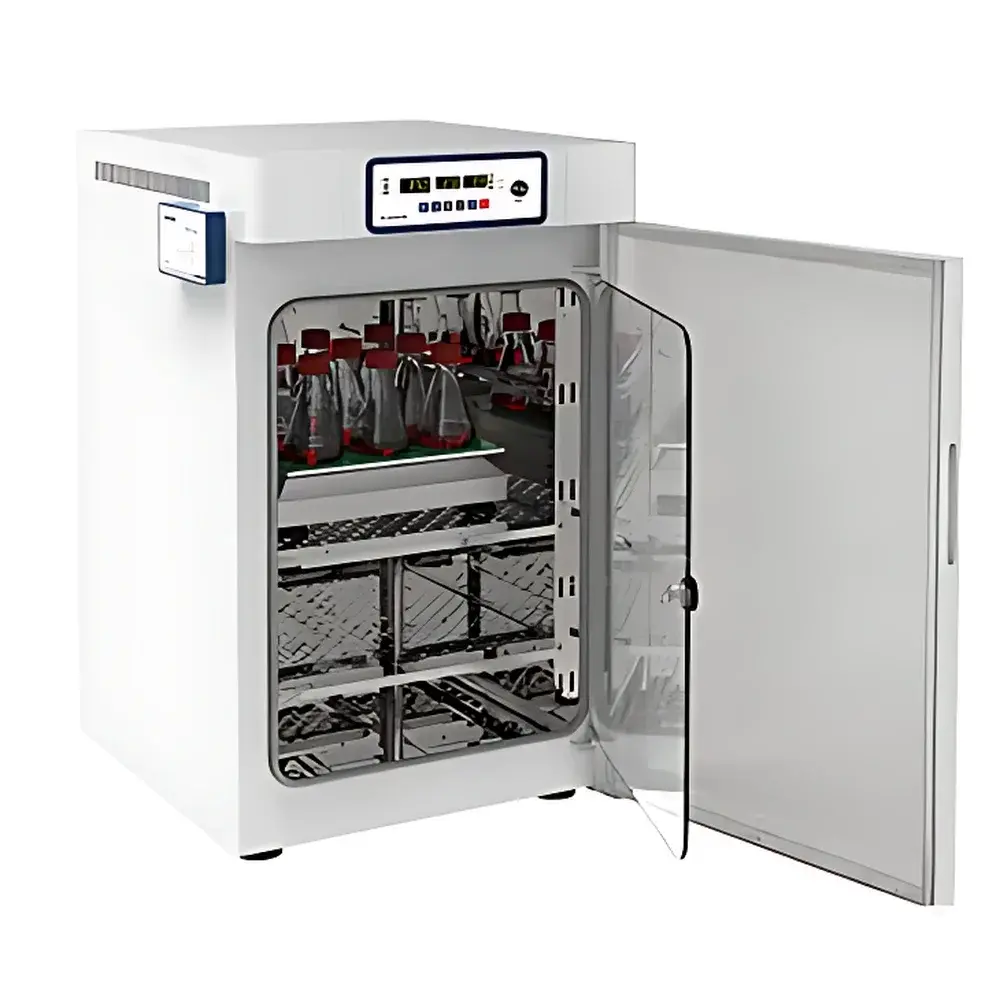
WIGGENS WCI-180 Carbon Dioxide Incubator
| Brand | WIGGENS |
|---|---|
| Origin | Germany |
| Instrument Type | Air-jacketed CO₂ Incubator |
| Model | WCI-180 |
| Temperature Range | Ambient +5°C to 60°C |
| Temperature Uniformity | ±0.3°C (at 37°C / ambient 20°C) |
| Humidity Range | 20–80% RH |
| Chamber Volume | 180 L |
| External Dimensions | 560 × 620 × 945 mm |
| CO₂ Measurement Accuracy | ±0.1% (at 5% CO₂, 37°C) |
| CO₂ Sensor | Dual-beam infrared |
| Heating System | Six-sided air-jacketed heating with independent temperature sensors per zone |
| Chamber Material | AISI 304 stainless steel |
| Control System | Microprocessor-based PID control with LED display and dual-channel keypad |
| Sterilization Option | Dry-heat up to 125°C (optional) |
Overview
The WIGGENS WCI-180 Carbon Dioxide Incubator is an air-jacketed, microprocessor-controlled environmental chamber engineered for precise, reproducible maintenance of mammalian cell cultures, primary isolates, stem cells, and sensitive microbial strains under physiologically relevant conditions. It operates on the principle of stable CO₂ partial pressure regulation (0–20% v/v) combined with tightly controlled temperature (ambient +5°C to 60°C) and relative humidity (20–80% RH), replicating the in vivo extracellular environment required for optimal proliferation and metabolic activity. The incubator’s six-sided air-jacketed heating architecture—comprising independently calibrated thermal zones—ensures rapid thermal recovery (<10 min after door opening at 37°C) and exceptional spatial uniformity (±0.3°C at 37°C), critical for longitudinal experiments and multi-well assay consistency. Its design complies with fundamental requirements of GLP-compliant cell culture workflows and supports ISO 13485-aligned quality systems when integrated into regulated bioprocessing environments.
Key Features
- Six-sided air-jacketed heating system with three thermally isolated zones, each monitored by a dedicated, factory-calibrated Pt100 sensor for real-time gradient compensation
- Dual-beam infrared CO₂ sensor with temperature- and humidity-compensated signal processing—providing ±0.1% accuracy at 5% CO₂ and 37°C without drift or cross-sensitivity
- Integrated HEPA-filtered air supply (≥99.99% @ 0.3 µm) maintaining ISO Class 5-equivalent internal air purity during continuous operation
- Active humidity control via bottom-mounted water pan heater and high-efficiency axial fan circulation—achieving <5% RH deviation across full chamber volume
- Heated glass observation window and perimeter frame design eliminating condensation under standard operating conditions (37°C, 5% CO₂, 95% RH)
- Microprocessor PID controller with independent setpoint management for CO₂, temperature, and alarm thresholds; LED display with dual-channel membrane keypad for tactile, glove-compatible operation
- Over-temperature cut-off protection: automatic power disconnection if any sensor exceeds user-defined safety limit, safeguarding both samples and equipment integrity
- Rounded interior corners and seamless AISI 304 stainless-steel chamber construction enabling effective cleaning and validation per ATP bioluminescence or microbial swab protocols
Sample Compatibility & Compliance
The WCI-180 accommodates standard T-flasks (up to 225 cm²), multi-well plates (6–96-well), Petri dishes, roller bottles, and tissue culture inserts. Its uniform thermal field and low-vibration platform support long-term adherent and suspension cultures—including hybridoma, CHO, HEK293, and iPSC lines—without compromising viability or differentiation status. The incubator meets essential performance criteria referenced in ASTM E1755-22 (Standard Practice for Validation of CO₂ Incubators), aligns with USP recommendations for cell culture environment monitoring, and supports audit readiness for FDA 21 CFR Part 11 when paired with optional data logging modules. Optional dry-heat sterilization (125°C, 6 h) enables depyrogenation and biocontamination mitigation between campaigns—validated per ISO 14644-1 Class 5 cleanroom standards.
Software & Data Management
While the base WCI-180 operates via embedded firmware without external software dependency, it supports analog output (0–10 V DC) for temperature and CO₂ signals, enabling integration into centralized building management systems (BMS) or SCADA networks. Optional RS-485 Modbus RTU interface allows connection to third-party data acquisition platforms for automated log generation compliant with 21 CFR Part 11 Annex 11 requirements—including electronic signatures, audit trails, and user-level access control. All parameter changes, alarm events, and door-open durations are timestamped and stored in non-volatile memory for ≥30 days—facilitating root cause analysis during process deviations or regulatory inspections.
Applications
- Mammalian cell line expansion for monoclonal antibody production and vaccine development
- Embryonic and induced pluripotent stem cell maintenance and directed differentiation
- Primary neuron and organoid culture requiring stringent O₂/CO₂/humidity stability
- Microbial cultivation of fastidious pathogens (e.g., Helicobacter pylori, Neisseria gonorrhoeae) under capnophilic conditions
- Plant tissue culture and callus propagation under elevated CO₂ for enhanced photosynthetic efficiency
- Long-duration toxicity screening assays where thermal or gaseous perturbation must remain below ±0.2°C and ±0.05% CO₂
FAQ
What is the recommended calibration frequency for the CO₂ sensor?
Annual verification against NIST-traceable gas standards is advised; field zeroing using ambient air (0.04% CO₂) and span calibration at 5% CO₂ are supported via service menu.
Can the WCI-180 be used for hypoxic studies?
No—it is optimized for normoxic CO₂ regulation (0–20%). For O₂ control, consider WIGGENS’ tri-gas incubator series (e.g., WCI-180-TG) with integrated oxygen sensors and nitrogen mixing capability.
Is the chamber suitable for sterility testing per USP ?
Yes—when operated with HEPA filtration and validated dry-heat cycles, it satisfies environmental control requirements for ISO 14644-1 Class 5 areas supporting aseptic processing.
Does the incubator support remote monitoring via Ethernet or Wi-Fi?
Not natively; however, the RS-485 interface permits integration with industrial gateways for cloud-based telemetry using MQTT or OPC UA protocols.
What maintenance is required for the humidity system?
The stainless-steel water pan requires weekly cleaning with deionized water and quarterly descaling using 10% citric acid solution—no consumable filters or replacement cartridges are needed.





