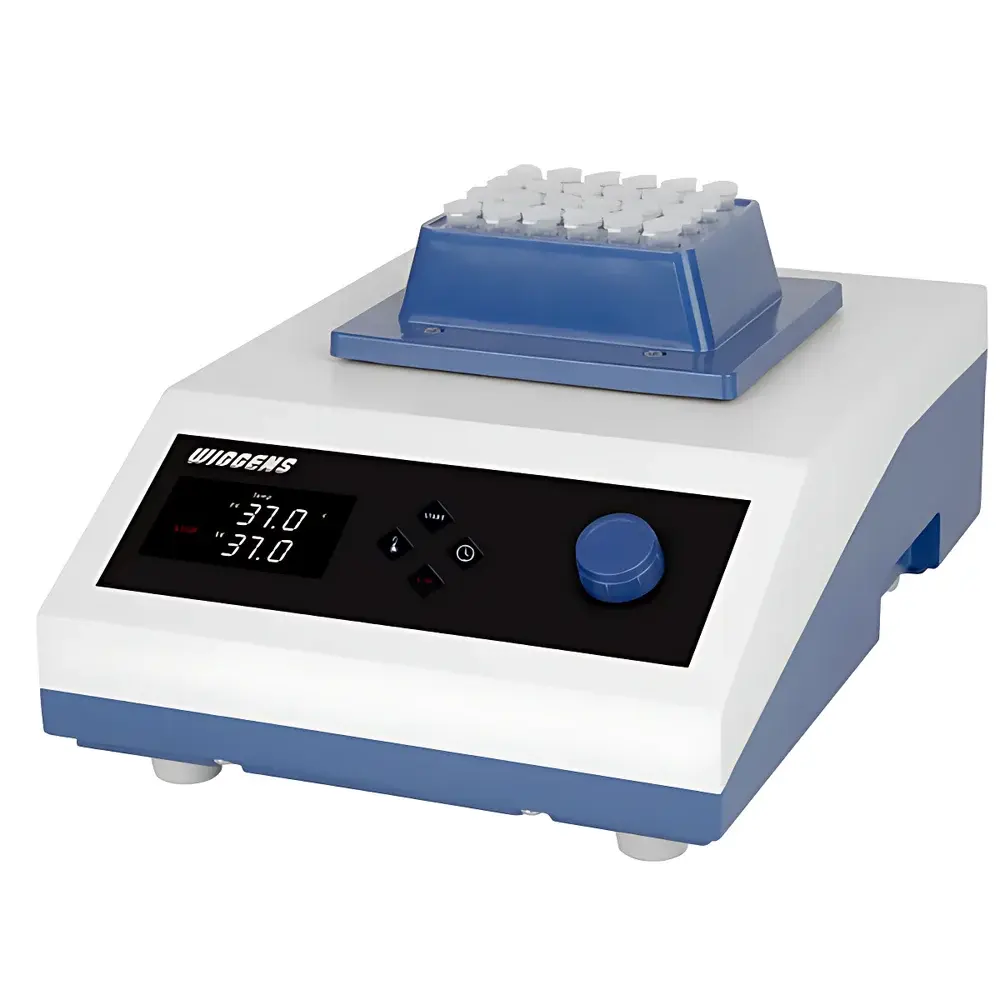
WIGGENS WS-350B Heated Microplate Shaker
| Brand | WIGGENS |
|---|---|
| Origin | Germany |
| Model | WS-350B |
| Temperature Range | Ambient +5°C to 100°C |
| Temperature Uniformity at 80°C | ±0.3°C |
| Temperature Accuracy (Gradient) at 80°C | ±0.7°C |
| Oscillation Mode | Orbital |
| Amplitude | 2 mm |
| Speed Range (dependent on module) | 150–1500 rpm (96-well plate), 150–1000 rpm (1.5 mL tubes), 150–800 rpm (50 mL tubes) |
| Heating Power | 360 W |
| Display | VFD |
| Programmability | 10 user-defined programs, each with up to 10 steps |
| Timer Options | Delay start (after temperature stabilization) or immediate start |
| Dimensions (W×D×H) | 276 × 334 × 170 mm |
| Net Weight | 8.3 kg |
| Power Supply | 230 V, 50/60 Hz, 1.7 A |
| Environmental Operating Conditions | 5–40°C, ≤80% RH |
| Safety Features | Overtemperature protection, PCB current limiting, thermal cutoff |
Overview
The WIGGENS WS-350B Heated Microplate Shaker is an engineered solution for precise, thermally controlled orbital agitation in life science laboratories. Designed for applications requiring simultaneous temperature regulation and reproducible mixing—such as enzyme kinetics, cell-based assays, immunoassays (ELISA), nucleic acid hybridization, and bacterial culture resuspension—the instrument employs a PID-controlled heating system coupled with a brushless DC motor drive to deliver stable rotational motion across a wide speed range. Its orbital shaking mechanism generates uniform, low-shear fluid dynamics ideal for maintaining sample integrity in microtiter plates and small-volume tubes. The unit’s compact footprint and modular platform architecture support seamless integration into biosafety cabinets, cold rooms, and automated workstations without compromising thermal stability or mechanical consistency.
Key Features
- PID feedback temperature control with up to 9-point calibration capability ensures high thermal accuracy and repeatability across the full operating range (ambient +5°C to 100°C).
- VFD display with tactile membrane keys provides real-time visibility of setpoints and operational status—including temperature, speed, elapsed time, and remaining program duration.
- Programmable multi-step operation: Store up to 10 independent protocols, each comprising up to 10 sequential stages with adjustable temperature, speed, duration, and pause intervals.
- Interval mixing function enables programmable oscillation pauses—critical for time-resolved binding assays or heat-sensitive incubation steps where transient cessation of motion improves assay fidelity.
- Corrosion-resistant polypropylene housing offers chemical resistance to common laboratory solvents and facilitates rapid decontamination between runs.
- Low-vibration rubber foot design minimizes transmission of mechanical energy to adjacent instrumentation, supporting use on shared lab benches or vibration-sensitive platforms.
- Modular interchangeability allows rapid adaptation to diverse vessel formats—including 96-well PCR plates, 0.5 mL, 1.5 mL, and 50 mL conical tubes—without tooling or recalibration.
Sample Compatibility & Compliance
The WS-350B accommodates standard ANSI/SLAS-compliant microplates (e.g., 96-well, 384-well) and common tube formats via optional accessories (W5012451–W5012453). All modules feature integrated lids to reduce evaporation during extended incubations. The instrument meets IEC 61010-1:2010 safety requirements for laboratory electrical equipment and complies with electromagnetic compatibility standards EN 61326-1:2013. While not certified for GMP environments per se, its programmable audit trail (via external logging), consistent thermal profiles, and repeatable motion parameters make it suitable for GLP-aligned workflows. Temperature and speed data can be exported for inclusion in SOP documentation and regulatory submissions under FDA 21 CFR Part 11 when paired with compliant third-party data acquisition software.
Software & Data Management
The WS-350B operates autonomously via onboard firmware; no proprietary PC software is required for basic operation. However, analog output signals (0–5 V or 4–20 mA) are available upon request for integration into centralized Lab Information Management Systems (LIMS) or SCADA networks. Users may log temperature and speed values externally using calibrated dataloggers compatible with USB or RS-232 interfaces. All stored programs retain non-volatile memory through power cycles, and parameter changes are timestamped internally for traceability. For quality-critical applications, manual recording of program IDs, calibration dates, and maintenance logs satisfies ISO/IEC 17025 documentation expectations.
Applications
- Enzyme-linked immunosorbent assay (ELISA) plate washing and incubation steps.
- Thermal denaturation and renaturation studies of DNA/RNA in 96-well format.
- Cell suspension and reagent homogenization prior to flow cytometry or plate reader analysis.
- Microbial growth curve monitoring under controlled thermal-agitation conditions.
- Antibody-antigen binding optimization in high-throughput screening platforms.
- Pre-analytical sample preparation for mass spectrometry or HPLC workflows requiring consistent mixing prior to extraction.
FAQ
What is the maximum load capacity for the 96-well plate module?
The standard 96-well plate module supports one full ANSI/SLAS-compliant plate (up to 200 µL/well), with total weight not exceeding 1.2 kg.
Can the WS-350B be used inside a CO₂ incubator?
No—the instrument is rated for ambient operation only (5–40°C, ≤80% RH) and lacks environmental sealing for humidified or CO₂-enriched atmospheres.
Is temperature calibration traceable to NIST standards?
Calibration is performed using internal reference sensors; users may perform field verification with external NIST-traceable thermometers placed directly on the aluminum heating plate surface.
Does the unit support continuous operation beyond 24 hours?
Yes—no duty-cycle limitations are imposed by hardware design, though routine inspection of thermal interface integrity and module fasteners is recommended for extended unattended use.
Are replacement modules available with autoclavable materials?
All optional modules are constructed from medical-grade anodized aluminum and PTFE-coated components, compatible with standard laboratory autoclaving protocols (121°C, 20 min, gravity cycle).