
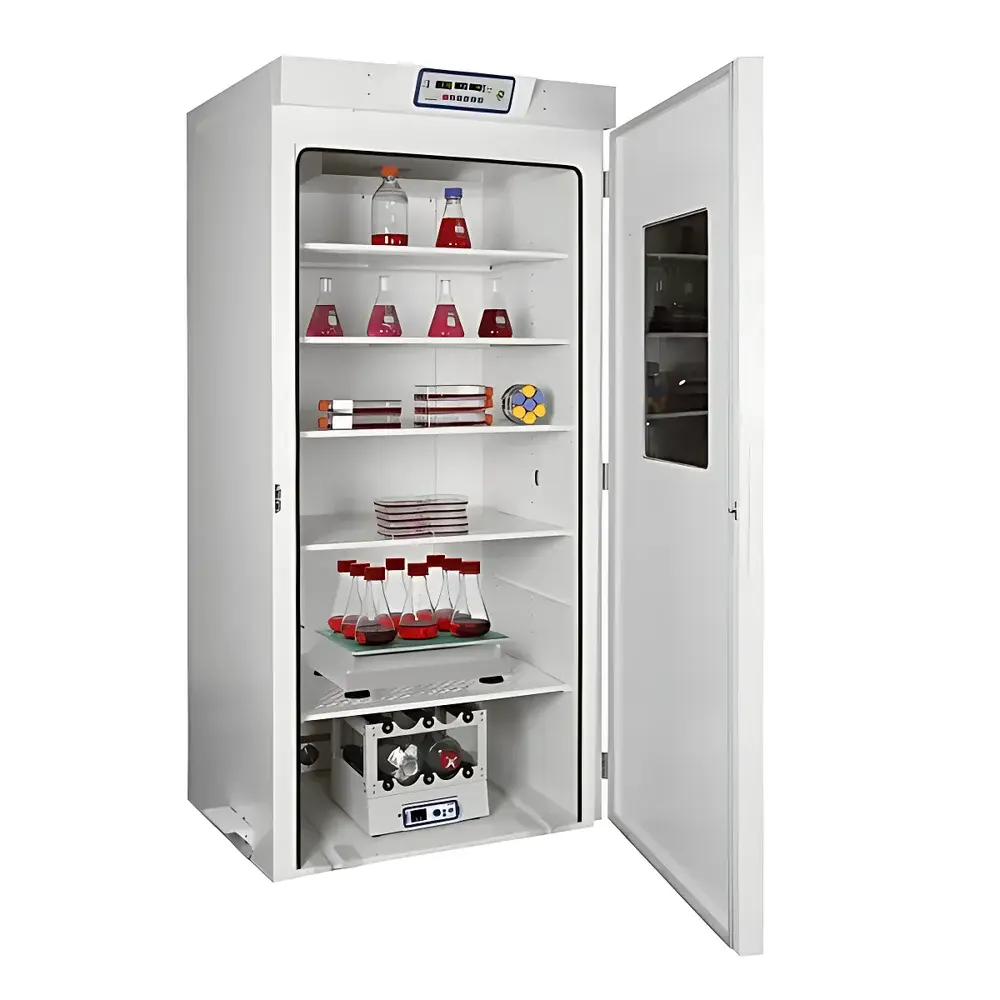
WIGGENS WCI-1200 Ultra-Large Capacity CO₂ Incubator
| Brand | WIGGENS |
|---|---|
| Origin | Germany |
| Model | WCI-1200 |
| Instrument Type | Air-Jacketed CO₂ Incubator |
| Temperature Range | RT + 7°C to +60°C (at 25°C ambient) |
| Temperature Uniformity | ±0.5°C at 37°C (25°C ambient) |
| Humidity Control | Natural evaporation via heated water pan with forced-air distribution |
| Chamber Volume | 1204 L |
| External Dimensions (W×D×H) | 990 × 855 × 2123 mm |
| Internal Dimensions (W×D×H) | 868 × 720 × 1927 mm |
| Chamber Material | AISI 304 Stainless Steel |
| CO₂ Sensing | Dual-Beam Infrared Sensor (0–20% range, ±0.1% accuracy at 5% CO₂, 37°C) |
| Power Supply | 220 V, 50/60 Hz |
| Heating Power | 1600 W |
| Weight | 323 kg |
| Safety Features | Independent overtemperature cut-off, door-heating anti-condensation system, audible alarm for CO₂ deviation and temperature excursion |
| Compliance | Designed to support GLP-compliant cell culture workflows |
Overview
The WIGGENS WCI-1200 Ultra-Large Capacity CO₂ Incubator is an engineered solution for high-throughput, long-term mammalian cell culture, reproductive biology studies, and tissue engineering applications requiring stringent environmental control. Utilizing a five-sided air-jacketed heating architecture—where heating elements are embedded between the stainless steel chamber wall and outer insulation layer—the system achieves rapid thermal recovery (<12 minutes after a 5-minute door opening at 37°C) and exceptional temperature stability. Unlike water-jacketed alternatives, this design eliminates fluid maintenance while minimizing thermal inertia and energy loss. The chamber maintains a tightly regulated CO₂ concentration (0–20% range) via a dual-beam infrared sensor, which delivers drift-free, humidity- and temperature-compensated measurements independent of condensation or airflow fluctuations. Integrated HEPA filtration (≥99.99% efficiency at 0.3 µm) ensures continuous delivery of particle-free gas to the culture environment—a critical requirement for stem cell expansion, primary neuron culture, and clinical-grade bioproduction.
Key Features
- Five-sided direct air-jacket heating with independent PID-controlled zones and three calibrated platinum resistance thermometers (PT100) for real-time spatial monitoring
- Dual-beam non-dispersive infrared (NDIR) CO₂ sensor with automatic baseline correction, certified for ±0.1% accuracy at 5% CO₂ under standard incubation conditions (37°C, 95% RH)
- Heated anti-condensation glass door and perimeter frame design preventing moisture accumulation on observation surfaces and internal walls
- Forced-air humidity distribution system: stainless steel water pan heated from below, coupled with four rear-mounted axial fans ensuring uniform RH distribution without localized saturation
- Microprocessor-based dual-channel PID controller with LED display (5-digit resolution), enabling simultaneous setpoint management for temperature (0.1°C resolution) and CO₂ (0.1% resolution)
- Independent hardware-level overtemperature protection circuitry—automatically disconnects power if any sensor exceeds user-defined safety threshold, meeting IEC 61010-1 functional safety requirements
- Rounded internal corners and seamless AISI 304 stainless steel chamber construction facilitating ISO 14644-1 Class 5-compatible cleaning protocols and autoclave-safe component compatibility
Sample Compatibility & Compliance
The WCI-1200 supports diverse biological sample formats including T-flasks, roller bottles, multiwell plates (up to 6-well), and custom bioreactor vessels. Its 1204 L working volume accommodates up to 35 standard-sized shelves (optional configuration), with perforated stainless steel decks promoting laminar airflow across all levels. The system complies with core regulatory expectations for cell culture infrastructure: HEPA filtration meets ISO 14644-1 Class 5 air cleanliness standards when operated in controlled environments; CO₂ control performance aligns with ASTM E2912–22 guidelines for incubator verification; temperature uniformity data satisfies USP criteria for mammalian cell culture systems. Optional dry-heat decontamination (≤100°C) enables periodic microbial load reduction without chemical residues—supporting FDA 21 CFR Part 11–aligned validation documentation packages.
Software & Data Management
While the WCI-1200 operates via standalone microcontroller interface, it provides analog and digital output ports (0–10 V / 4–20 mA) compatible with third-party building management systems (BMS) and laboratory information management systems (LIMS). Real-time temperature and CO₂ values can be logged externally using configurable sampling intervals. All alarm events—including door-open duration, CO₂ deviation >±0.3%, and thermal excursion beyond ±1.0°C—are timestamped and stored in non-volatile memory for audit trail generation. Optional RS-485 Modbus RTU integration enables remote parameter readout and alarm acknowledgment in GxP-regulated facilities requiring electronic record integrity per ALCOA+ principles.
Applications
- High-density adherent cell culture (e.g., CHO, HEK293, iPSCs) in biomanufacturing pilot lines
- Embryology labs performing IVF embryo incubation under stable 5% CO₂ and 37°C conditions
- Tissue engineering scaffolds requiring extended static culture periods (>72 h) with minimal environmental perturbation
- Mycobacterial and fastidious pathogen cultivation where precise CO₂ modulation enhances growth kinetics
- Plant tissue culture and seed germination studies requiring broad temperature flexibility (RT+7°C to 60°C)
- Environmental stress modeling experiments involving controlled thermal ramping and gas composition shifts
FAQ
What is the recovery time after door opening?
After a 5-minute door opening at 37°C, the chamber re-stabilizes to ±0.3°C within 12 minutes, verified per ISO 13408-4 Annex B methodology.
Does the incubator support automated decontamination cycles?
Yes—dry-heat decontamination up to 100°C is available as a factory-configured option, validated for ≥3-log reduction of Bacillus atrophaeus spores.
How is humidity maintained without ultrasonic misting?
Humidity is generated passively via a bottom-mounted stainless steel water reservoir heated to 60–70°C, with convective distribution driven by four independently controlled axial fans.
Is the CO₂ sensor field-replaceable without recalibration?
The dual-beam NDIR sensor is pre-calibrated at the factory and includes on-board zero-point verification; replacement requires only mechanical installation—no user calibration is needed.
Can the incubator be integrated into a central lab monitoring network?
Yes—via optional RS-485 Modbus RTU interface or analog signal outputs, supporting connection to SCADA, BMS, or custom Python-based logging platforms.
Related Products




