
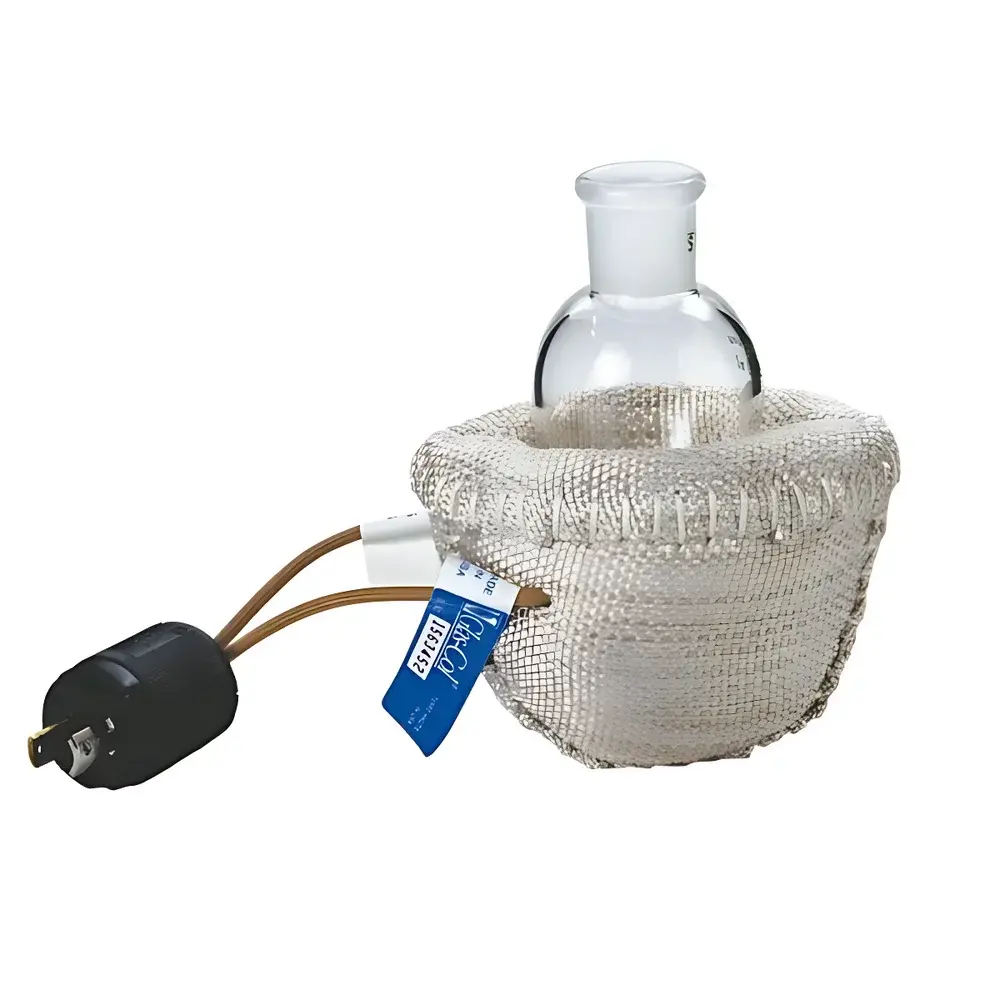
WIGGENS MIC/MICP Series Micro Flask Electric Heating Mantles
| Brand | WIGGENS |
|---|---|
| Origin | Germany |
| Model | MIC/MICP |
| Voltage Options | 30 V, 60 V, 115 V (max) |
| Max Internal Temperature | 450 °C |
| Construction | Dual-layer flexible woven fabric |
| Application | Precision heating of micro flasks (spherical & pear-shaped), including multi-neck, bottom-pierced, or side-port configurations |
| Compliance | Designed for lab environments requiring stable thermal control under GLP-aligned workflows |
Overview
The WIGGENS MIC/MICP Series Micro Flask Electric Heating Mantles are engineered for precise, uniform, and controllable thermal delivery to small-volume glass reaction vessels—specifically spherical and pear-shaped micro flasks ranging from 5 mL to 250 mL capacity. Unlike standard heating mantles, the MIC/MICP series employs a dual-layer flexible woven architecture: an outer insulating layer minimizes heat loss and footprint, while the inner contact layer conforms gently to curved glass surfaces, mitigating thermal shock during rapid temperature transitions. These mantles operate on low-voltage DC or AC supplies (30 V, 60 V, or 115 V max), necessitating integration with an external temperature controller (e.g., WIGGENS WTH-100 or equivalent PID-regulated unit) to achieve stable setpoint accuracy within ±2 °C under typical ambient conditions. The design supports specialized flask configurations—including those with bottom ports, side observation windows, or central thermowell penetrations—making them suitable for inert-atmosphere synthesis, fractional distillation of trace analytes, and high-value purification workflows where sample volume is constrained and thermal reproducibility is critical.
Key Features
- Dual-layer flexible woven construction: Outer layer provides thermal containment and mechanical durability; inner layer ensures conformal, low-stress contact with delicate glassware.
- Maximum internal operating temperature of 450 °C—compatible with solvent reflux, melt-phase reactions, and low-pressure evaporation protocols.
- Custom-fit geometry: Available in 15 standardized configurations across two families—MIC (spherical flasks) and MICP (pear-shaped flasks)—each specified by nominal volume, maximum diameter, depth, and external dimensions.
- Low-voltage operation enhances electrical safety in proximity to sensitive instrumentation and reduces electromagnetic interference in analytical labs.
- Integrated 3-ft (0.9 m), two-conductor cable with locking plug ensures secure connection and simplifies routing in crowded fume hoods or modular reactor setups.
- Modular compatibility: Designed for seamless integration with WIGGENS digital temperature controllers supporting ramp/soak programming, data logging, and RS-232/USB output per ASTM E2877-22 guidelines for thermal validation.
Sample Compatibility & Compliance
The MIC/MICP mantles accommodate standardized micro flasks manufactured to ISO 3585 (borosilicate glass 3.3) specifications. Spherical models (MIC) align with common round-bottom flask geometries (e.g., Kimble Chase, Wheaton, or Duran); pear-shaped variants (MICP) match industry-standard Kugelrohr or short-path distillation flask profiles. All units are CE-marked and comply with IEC 61010-1:2010 for laboratory electrical equipment safety. While not intrinsically rated for hazardous locations, their low-voltage architecture supports use in Class I, Division 2 environments when paired with appropriate controller isolation. Documentation packages include dimensional drawings, voltage–power–temperature correlation curves, and material declarations (RoHS 2011/65/EU, REACH SVHC-free), facilitating audit readiness for GLP and GMP-aligned quality systems.
Software & Data Management
These mantles are analog thermal actuators and do not incorporate embedded firmware or onboard software. However, they are fully interoperable with third-party temperature controllers supporting FDA 21 CFR Part 11-compliant audit trails—such as the WIGGENS WTC-2000 series—enabling electronic record generation for calibration logs, batch heating profiles, and deviation reporting. When connected to a validated controller, the system supports export of time-stamped .csv datasets compliant with ISO/IEC 17025:2017 clause 7.7 (result reporting) and ALCOA+ data integrity principles. No proprietary drivers or cloud services are required; all communication occurs via standard serial or USB virtual COM port protocols.
Applications
- Microscale organic synthesis requiring precise thermal control in <10 mL reaction volumes.
- High-boiling-point solvent removal from nanogram-to-milligram isolates in natural product purification.
- Thermal conditioning of calibration standards prior to GC-MS or HPLC analysis.
- Controlled decomposition studies of thermolabile compounds using programmed heating ramps.
- Supporting Kugelrohr short-path distillation assemblies under reduced pressure (≤1 mbar).
- Heating of custom-fabricated microreactors with integrated optical viewports or gas inlet stems.
FAQ
Do MIC/MICP mantles include built-in temperature sensing or control?
No. These are resistive heating elements only. A separate temperature controller with external PT100 or thermocouple input is mandatory for closed-loop regulation.
Can I use a MICP mantle on a spherical flask?
Not recommended. Dimensional mismatch may cause uneven heating, mechanical stress on the flask, or insufficient coverage of the heating zone. Always match mantle type (MIC vs. MICP) to flask geometry.
What is the expected service life under continuous operation at 300 °C?
Based on accelerated aging tests per IEC 60512-5-1, the woven insulation retains >92% thermal efficiency after 5,000 hours at 300 °C when operated within rated voltage and free-air convection conditions.
Are replacement cables or custom-length leads available?
Yes. WIGGENS offers OEM-specified 2-conductor silicone-jacketed cables (up to 3 m) with UL-certified locking connectors (NEMA L6-15P compatible) under part numbers CBL-MIC-XX.
Does the mantle require grounding via the controller or power supply?
Yes. The controller must provide functional grounding per IEC 61000-6-3. The mantle itself has no earth terminal; grounding is achieved through the controller’s chassis ground connection.



