
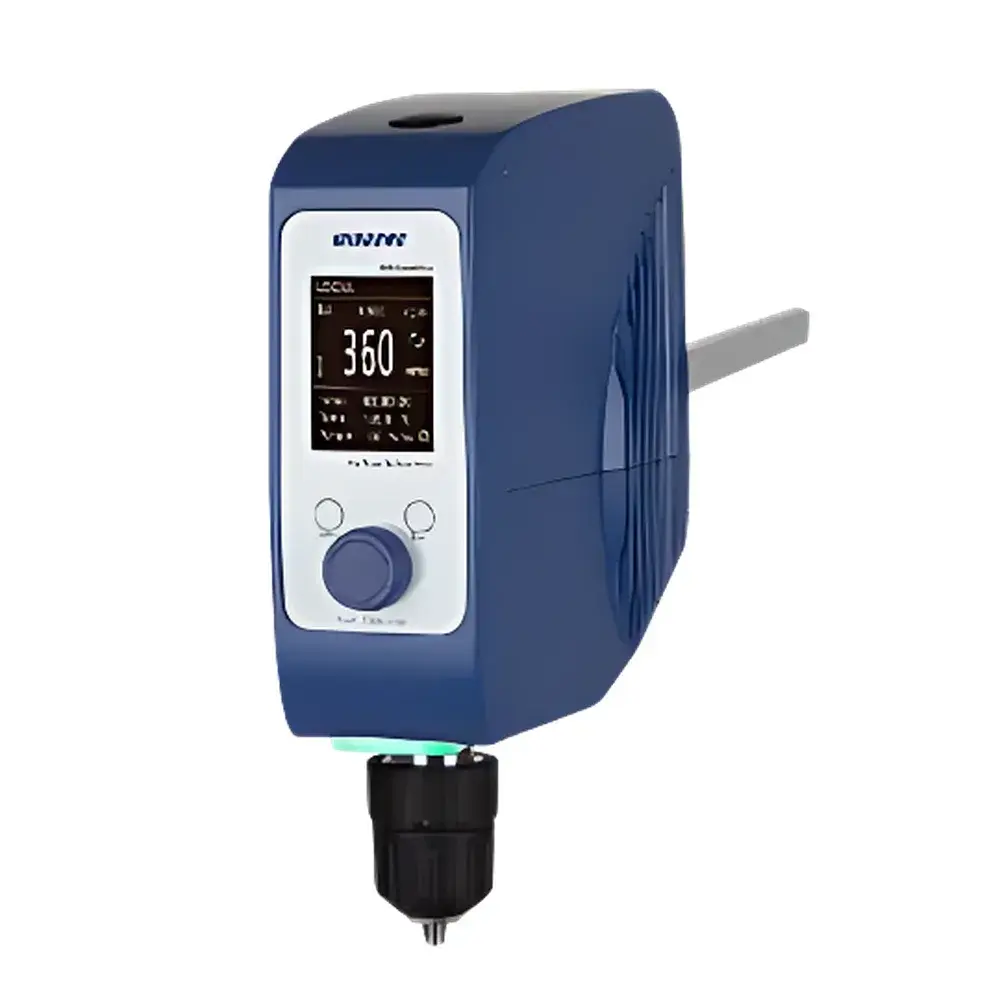
WIGGENS WOHS-400pro High-Torque Laboratory Stirrer
| Brand | WIGGENS |
|---|---|
| Origin | Germany |
| Model | WOHS-400pro |
| Maximum Stirring Volume | 40 L |
| Speed Range | 20–1800 rpm (Dual-Range: I: 20–360 rpm, II: 361–1800 rpm) |
| Torque Output | 565 N·cm (Low-Speed Range), 113 N·cm (High-Speed Range) |
| Torque Display | Current-to-torque conversion for real-time load monitoring |
| Viscosity Handling | ≥150,000 cP |
| Speed Accuracy | ±3% (n > 300 rpm) |
| Step Resolution | ≤1 rpm |
| Temperature Measurement Range | −10 to 350 °C |
| Temp. Resolution | 0.1 °C |
| Power Input | 100–240 VAC, 50/60 Hz |
| Motor Type | Brushless DC Motor |
| Clamp Type | Self-locking, tool-free chuck |
| Shaft Bore Diameter | 10.2 mm (hollow shaft) |
| Chuck Capacity | 0.5–10 mm |
| Power Consumption | 150 W |
| Status Indicators | Standby (blue), Running (green), Alarm (red) |
| Timer Range | 0–99 h 59 min |
| Control Interface | TFT display with touch keys + rotary encoder |
Overview
The WIGGENS WOHS-400pro High-Torque Laboratory Stirrer is an engineered solution for demanding mixing and dispersion tasks in research and quality control laboratories. Designed around a brushless DC motor architecture, it delivers stable rotational motion across two distinct speed-torque regimes—optimized for either high-viscosity batch processing or high-shear dispersion at elevated speeds. Its core operational principle relies on precise electromagnetic commutation and closed-loop current feedback to maintain consistent torque delivery under variable load conditions. Unlike conventional brushed motors, the absence of carbon brushes eliminates wear-related drift and ensures long-term reproducibility during extended operation—critical for GLP-compliant synthesis, API crystallization, or polymer solution homogenization where mechanical consistency directly impacts product uniformity.
Key Features
- Dual-range speed control (20–360 rpm and 361–1800 rpm) with torque output up to 565 N·cm in low-speed mode—enabling effective agitation of highly viscous media such as silicone elastomers, hydrogels, or molten polymers.
- Real-time torque monitoring via analog current-to-torque conversion, providing visual trend indication of motor load changes—useful for detecting phase transitions, gelation onset, or particle agglomeration during stirring.
- TFT graphical display with intuitive touch-key and rotary encoder interface for simultaneous adjustment of speed, timer, and temperature parameters—designed to minimize operator error and support audit-ready parameter logging.
- Self-locking, tool-free chuck system accommodating stirrer shafts from 0.5 mm to 10 mm diameter; hollow 10.2 mm shaft design allows integration with temperature probes or pH electrodes without obstructing axial insertion.
- Robust power management architecture rated for continuous 150 W operation at ambient temperatures between −10 °C and 350 °C—validated for compatibility with heating mantles, cryostats, and jacketed reactors.
- Compliance-ready status indicators (blue standby, green run, red alarm) aligned with ISO/IEC 17025 laboratory infrastructure requirements for equipment state traceability.
Sample Compatibility & Compliance
The WOHS-400pro supports heterogeneous systems including suspensions, emulsions, pastes, and non-Newtonian fluids with viscosities exceeding 150,000 cP. Its torque profile enables reliable mixing of 40 L aqueous solutions or equivalent-volume viscous batches in standard glass or stainless-steel vessels. The instrument meets IEC 61010-1 safety standards for laboratory electrical equipment and incorporates EMI shielding conforming to EN 61326-1 for electromagnetic compatibility in shared analytical environments. While not intrinsically rated for hazardous area use, its brushless motor design inherently reduces spark risk—making it suitable for solvent-based chemistry workflows when deployed outside classified zones. All firmware operations retain timestamped event logs compatible with FDA 21 CFR Part 11 Annex 11 expectations for electronic record integrity.
Software & Data Management
Although standalone in operation, the WOHS-400pro’s digital interface supports external data capture through optional RS-232 or USB-to-serial adapters. Timestamped speed, torque, temperature, and runtime values can be exported in CSV format for integration into LIMS or ELN platforms. The internal timer supports programmable ramp-and-hold sequences up to 99 hours 59 minutes, with automatic shutdown and alarm triggering upon deviation beyond preset thresholds. Firmware updates are performed via secure bootloader protocol—ensuring version control and traceability per ISO/IEC 17025 clause 5.9.2 on software validation.
Applications
- Chemical synthesis: Controlled addition and mixing during exothermic Grignard or lithiation reactions requiring stable low-RPM agitation.
- Pharmaceutical development: Homogenization of semi-solid dosage forms (e.g., ointments, gels) and suspension stabilization studies per USP <1059>.
- Materials science: Dispersion of nanofillers in polymer melts or prepolymer matrices prior to rheological characterization.
- Food & cosmetics R&D: Emulsion formation and viscosity profiling of creams, sauces, and functional beverages.
- Biotechnology: Gentle resuspension of cell pellets or agarose gels without shear-induced lysis.
FAQ
What is the maximum recommended vessel size for optimal torque transfer?
For consistent performance at rated torque (565 N·cm), use cylindrical vessels with internal diameters between 120 mm and 300 mm—ensuring impeller tip clearance ≥15% of vessel diameter.
Can the WOHS-400pro be integrated with third-party temperature controllers?
Yes—the device outputs analog voltage signals corresponding to measured temperature and accepts external 0–10 V setpoint inputs via optional interface modules.
Is calibration documentation provided with the unit?
Each unit ships with a factory-verified calibration certificate covering speed accuracy (±3%), temperature sensor linearity (−10 to 350 °C), and torque response linearity within specified ranges.
How does the hollow shaft facilitate multi-sensor experiments?
The 10.2 mm internal bore permits coaxial insertion of PT100 probes, fiber-optic thermometers, or micro-pH electrodes—enabling simultaneous thermal and chemical monitoring without compromising mechanical stability.
What maintenance is required for long-term reliability?
No scheduled maintenance is required; the brushless motor and sealed bearing assembly are rated for ≥20,000 hours of continuous operation under nominal load conditions.
Related Products



