
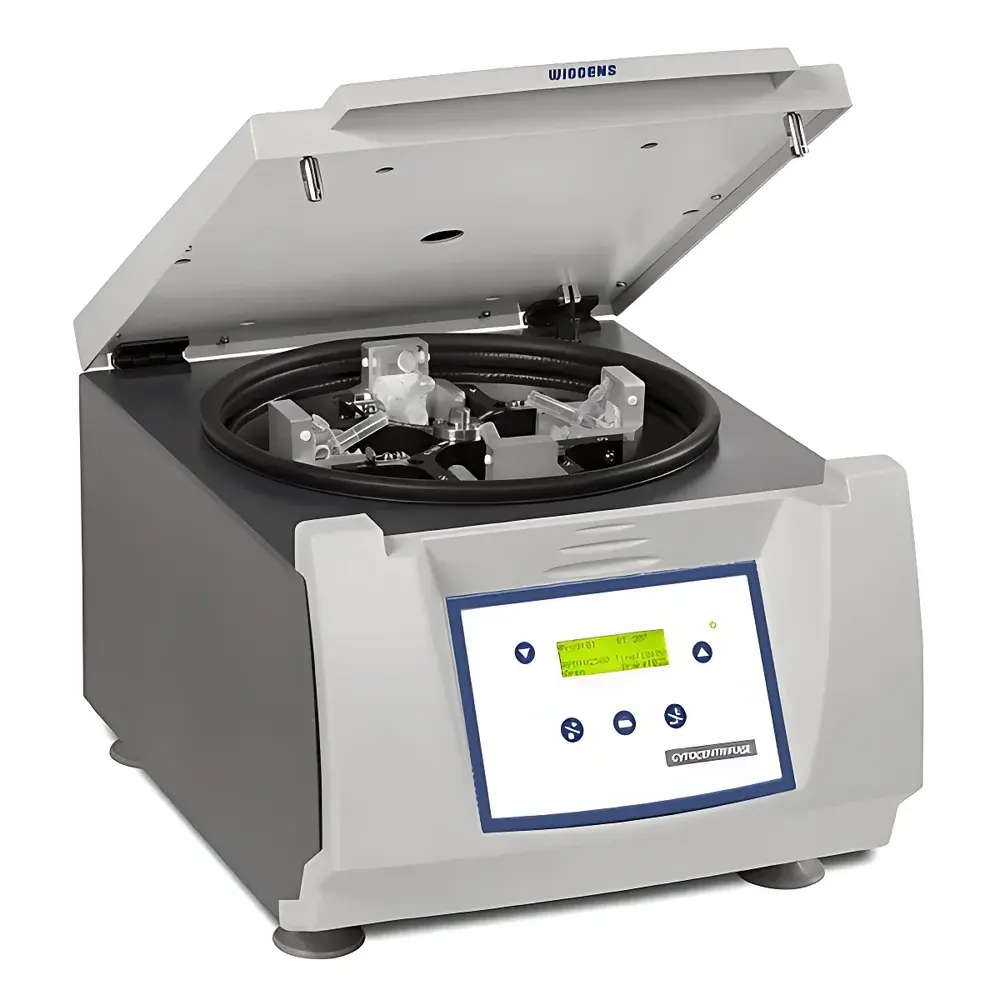
WIGGENS CE110 Cytocentrifuge
| Brand | WIGGENS |
|---|---|
| Origin | Germany |
| Model | CE110 |
| Type | Benchtop Cytocentrifuge |
| Max Speed | 2500 rpm |
| Max RCF | 839 × g |
| Capacity | 4 × 2.2 mL |
| Dimensions (W × D × H) | 410 × 530 × 320 mm |
| Weight | 36 kg |
| Power Supply | 220–230 V, 50–60 Hz |
| Power Consumption | 440 W |
| Safety Compliance | EN 61010-1, EN 61010-2-020, EN 61326-1, EN 61326-2-6 |
Overview
The WIGGENS CE110 Cytocentrifuge is a precision-engineered benchtop centrifuge designed specifically for cytological specimen preparation. Unlike conventional centrifuges, it operates on the principle of controlled, low-speed sedimentation—applying uniform radial force to deposit cells onto microscope slides or chambered surfaces while preserving cellular morphology and spatial integrity. This process, known as cytocentrifugation, enables high-fidelity monolayer formation of sparse or low-density biological suspensions—including cerebrospinal fluid (CSF), bronchoalveolar lavage (BAL) samples, fine-needle aspirates, and peripheral blood smears—without cell distortion or clumping. Its optimized rotor geometry and programmable acceleration/deceleration profiles ensure reproducible deposition across diverse sample viscosities and cell concentrations, making it an essential tool in diagnostic pathology laboratories adhering to CLIA, CAP, and ISO 15189 requirements.
Key Features
- Programmable low-speed operation (0–2500 rpm in 50 rpm increments; 0–839 × g in 50 × g steps) with real-time RPM/RCF display on backlit LCD interface
- Progressive Braking and Acceleration Control System (PCBS) offering 175 selectable ramp profiles to prevent resuspension or shearing of fragile cell monolayers
- 16-user-programmable memory slots supporting multi-step protocols with independent timing (1–99 min, 5-sec resolution), pause/resume functionality, and post-setpoint countdown/timer modes
- Horizontal swing-out rotor (RT207) accommodating four 2.2 mL sample positions; compatible with standard cytology chambers, capillary tubes (ID 6.2 mm or 8.7 mm), microcentrifuge tubes, and 96-well plate adapters
- Integrated acoustic and visual alerts every 20 seconds during operation to prevent slide desiccation—a critical safeguard for nucleic acid integrity and immunocytochemical antigen preservation
- Brushless DC motor with zero-maintenance design, operating at ≤60 dB(A) sound pressure level for quiet laboratory environments
- Auto-rotor recognition with overspeed protection and imbalance detection triggering immediate shutdown
Sample Compatibility & Compliance
The CE110 supports a broad range of clinical and research specimens: hematologic fluids (e.g., ascites, pleural effusions), microbiologic cultures (bacterial/fungal pellets), viral lysates, and dissociated tissue suspensions. All rotor components—including the RT207 aluminum alloy rotor and stainless-steel adapters—are autoclavable (121°C, 20 min, 1 bar) to meet stringent biosafety and GLP/GMP cleaning validation requirements. The centrifuge chamber is constructed from electropolished AISI 304 stainless steel, resistant to corrosion from alcohols, formalin, and xylene-based fixatives. Regulatory compliance includes full conformity with IVD Regulation (EU) 2017/746 (via legacy 98/79/EC), electromagnetic compatibility (EN 61326-1/-2-6), electrical safety (EN 61010-1/-2-020), and environmental directives (RoHS 2011/65/EU, WEEE 2012/19/EU).
Software & Data Management
While the CE110 operates via embedded microcontroller without external PC dependency, its firmware architecture supports audit-trail-ready operation per FDA 21 CFR Part 11 guidelines when integrated into networked LIS/HIS environments via optional RS-232 or USB-to-serial interfaces. All parameter changes, run logs, rotor ID registrations, and fault events are timestamped and stored in non-volatile memory for ≥10,000 cycles. Password-protected administrator mode allows configuration lockout for SOP-controlled workflows. Exportable log files (CSV format) include RCF, duration, rotor serial number, and thermal history—facilitating CAP accreditation documentation and internal QA reviews.
Applications
- Routine cytology preparation for Pap smears, urine sediment analysis, and CSF cell counts
- Pre-analytical processing prior to flow cytometry, FISH, or next-generation sequencing library prep
- Concentration of low-abundance pathogens (e.g., Mycobacterium tuberculosis, Cryptococcus neoformans) from large-volume respiratory specimens
- Preparation of monolayers for immunocytochemistry (ICC), in situ hybridization (ISH), and electron microscopy grid mounting
- Standardized cell pellet generation in clinical trials requiring batch-consistent morphologic assessment per WHO classification systems
FAQ
What distinguishes cytocentrifugation from standard centrifugation?
Cytocentrifugation uses precisely regulated low g-forces and specialized rotor geometry to gently deposit intact, undistorted cells onto solid substrates—whereas standard centrifugation pellets cells at high speed, often causing lysis or aggregation.
Can the CE110 process viscous or mucoid samples?
Yes—the PCBS system allows customized acceleration ramps to accommodate high-viscosity specimens such as sputum or gastric aspirates without compromising monolayer uniformity.
Is rotor calibration required before each use?
No—the RT207 rotor features factory-calibrated radius encoding; auto-recognition eliminates manual input errors and ensures RCF accuracy traceable to NIST standards.
Does the device support regulatory-compliant record retention?
Yes—onboard event logging meets minimum ALCOA+ principles (Attributable, Legible, Contemporaneous, Original, Accurate) and supports electronic signature integration when connected to validated LIMS platforms.
What maintenance is required beyond routine cleaning?
None—the brushless motor requires no lubrication or brush replacement; annual verification of RCF accuracy and door interlock function is recommended per ISO/IEC 17025 internal calibration schedules.



