
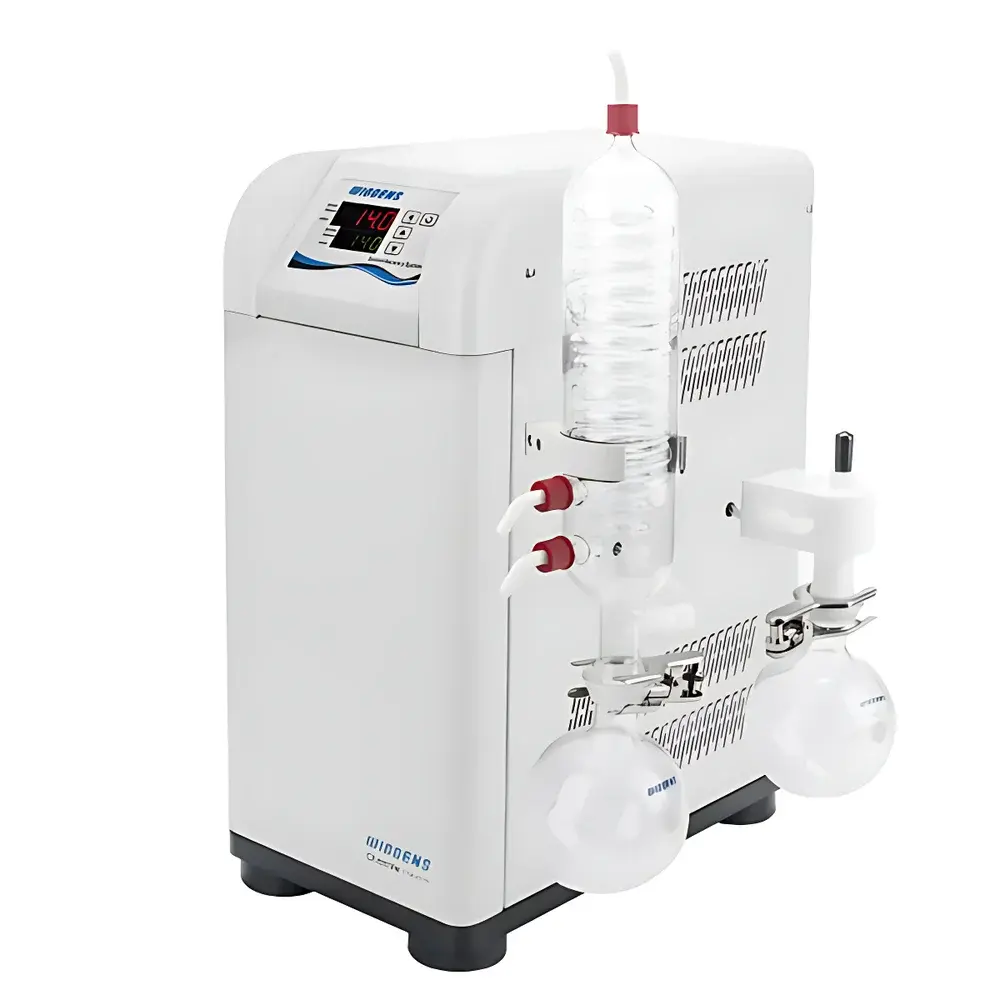
WIGGENS CSC960T Corrosion-Resistant Solvent Recovery Diaphragm Vacuum Pump
| Brand | WIGGENS |
|---|---|
| Origin | Germany |
| Model | CSC960T |
| Pump Type | Oil-Free Diaphragm Vacuum Pump |
| Ultimate Vacuum | ≤2 mbar |
| Pumping Speed | 60 L/min |
| Dimensions (W×D×H) | 220 × 400 × 495 mm |
| Weight | 25 kg |
| Motor Power | 400 W |
| Vacuum Resolution | 0.1 mbar |
| Vacuum Range | 0.1–1000 mbar |
| Noise Level | 50 dB(A) |
| Inlet Port Diameter | 10 mm |
| Ordering Code | 900534 |
Overview
The WIGGENS CSC960T is an oil-free, corrosion-resistant diaphragm vacuum pump engineered for solvent recovery applications in demanding laboratory and pilot-scale chemical processing environments. It operates on positive displacement principle via PTFE-coated diaphragms and stainless-steel valves, eliminating lubricating oil contamination and enabling safe handling of aggressive vapors—including organic solvents, acidic fumes, alkaline condensates, and halogenated compounds. Unlike rotary vane or water-ring pumps, the CSC960T maintains stable performance across variable load conditions without degradation from condensable vapors or particulate ingress. Its integrated variable-frequency drive (VFD) enables precise, closed-loop pressure control using AI-enhanced PID auto-tuning—dynamically adjusting motor speed to maintain setpoint vacuum within ±0.1 mbar resolution over the full 0.1–1000 mbar operating range. This capability supports reproducible vacuum distillation, fractional crystallization, reduced-pressure drying, and inert-atmosphere solvent recycling—particularly critical in pharmaceutical process development, fine chemical synthesis, and analytical sample preparation where residual solvent content, thermal sensitivity, and regulatory traceability are tightly controlled.
Key Features
- PTFE-wetted path construction throughout gas-contact surfaces—including diaphragms, valves, inlet/outlet manifolds, and internal tubing—ensuring long-term resistance to HCl, HF, HNO₃, NaOH, acetone, THF, DCM, and other aggressive media.
- Intelligent VFD control with self-tuning PID algorithm adapts to changing system conductance, vapor load, and ambient temperature—reducing energy consumption by up to 40% during low-demand phases while extending diaphragm service life beyond 10,000 hours.
- Integrated digital vacuum controller with real-time display, multi-segment programmable ramping, unit switching (mbar, Torr, kPa), analog I/O (0–10 V / 4–20 mA), and RS485 Modbus RTU interface for SCADA integration.
- Modular system architecture: pre-assembled baseplate accommodates optional cold trap, inlet buffer flask (with liquid-level sensor), condenser, and vacuum gauge—all aligned for minimal dead volume and optimal vapor capture efficiency.
- Passive acoustic damping housing and balanced dual-head diaphragm design achieve <50 dB(A) noise emission at 1 m distance—suitable for shared lab spaces and GLP-compliant environments requiring low ambient disturbance.
- No routine oil changes, filter replacements, or valve servicing required; validated for continuous unattended operation under ISO 8573-1 Class 0 (oil-free air) certification standards.
Sample Compatibility & Compliance
The CSC960T is validated for use with corrosive, condensable, and pyrophoric vapors commonly encountered in API purification, battery electrolyte recovery, semiconductor wafer cleaning effluent treatment, and EPA Method 502.2/8021B volatile organic analysis. All wetted materials comply with USP Class VI and FDA 21 CFR 177.1550 for PTFE components. The system meets CE Machinery Directive 2006/42/EC, EMC Directive 2014/30/EU, and RoHS 2011/65/EU requirements. When configured with optional data-logging firmware and audit trail module, it supports ALCOA+ principles and satisfies FDA 21 CFR Part 11 electronic record/electronic signature (ERES) readiness for regulated QC/QA workflows.
Software & Data Management
The embedded vacuum controller supports local parameter configuration via capacitive touchscreen and remote monitoring via Ethernet/Wi-Fi (optional). Logged vacuum profiles—including setpoint deviation, motor RPM, temperature, and runtime—are exportable as CSV or PDF reports with time-stamped metadata. Firmware updates are performed via secure HTTPS-based OTA protocol. For enterprise deployment, WIGGENS LabLink™ software (v3.2+) provides centralized fleet management, alarm escalation (email/SMS), SOP-linked vacuum recipes, and automated compliance reporting aligned with ISO/IEC 17025 clause 7.7 and ASTM E2500-13 validation documentation frameworks.
Applications
- Vacuum-assisted solvent recovery from rotary evaporators, falling-film concentrators, and short-path distillation units.
- Acid digestion fume extraction in ICP-MS and AAS sample preparation labs.
- Deaeration of photoresist solutions and precursor slurries in microelectronics fabrication.
- GMP-compliant lyophilization cycle support with pressure-controlled primary drying stages.
- Inert-gas purging and vacuum backfilling of gloveboxes handling air-sensitive organometallics.
- Continuous degassing of polymer melt streams prior to extrusion or casting.
FAQ
Is the CSC960T suitable for explosive vapor environments?
Yes—when equipped with ATEX-certified explosion-proof motor option (order code suffix “-EX”), it complies with Directive 2014/34/EU for Zone 2/22 classified areas.
Can the pump be integrated into a PLC-controlled process line?
Yes—standard 0–10 V analog input/output and Modbus RTU over RS485 enable bidirectional communication with Allen-Bradley, Siemens S7, and Beckhoff controllers.
What maintenance intervals are recommended?
None beyond annual visual inspection of inlet filter and buffer flask seals; diaphragms are rated for ≥10,000 hours at 60% duty cycle per ISO 5211 test protocol.
Does the system support multi-stage vacuum sequencing?
Yes—the controller supports up to 8-step vacuum ramps with dwell timers, pressure-triggered transitions, and conditional logic based on external sensor inputs.
How is calibration traceability ensured?
Factory calibration is NIST-traceable per ISO/IEC 17025; users may perform field verification using certified reference transducers connected via the analog input port.



