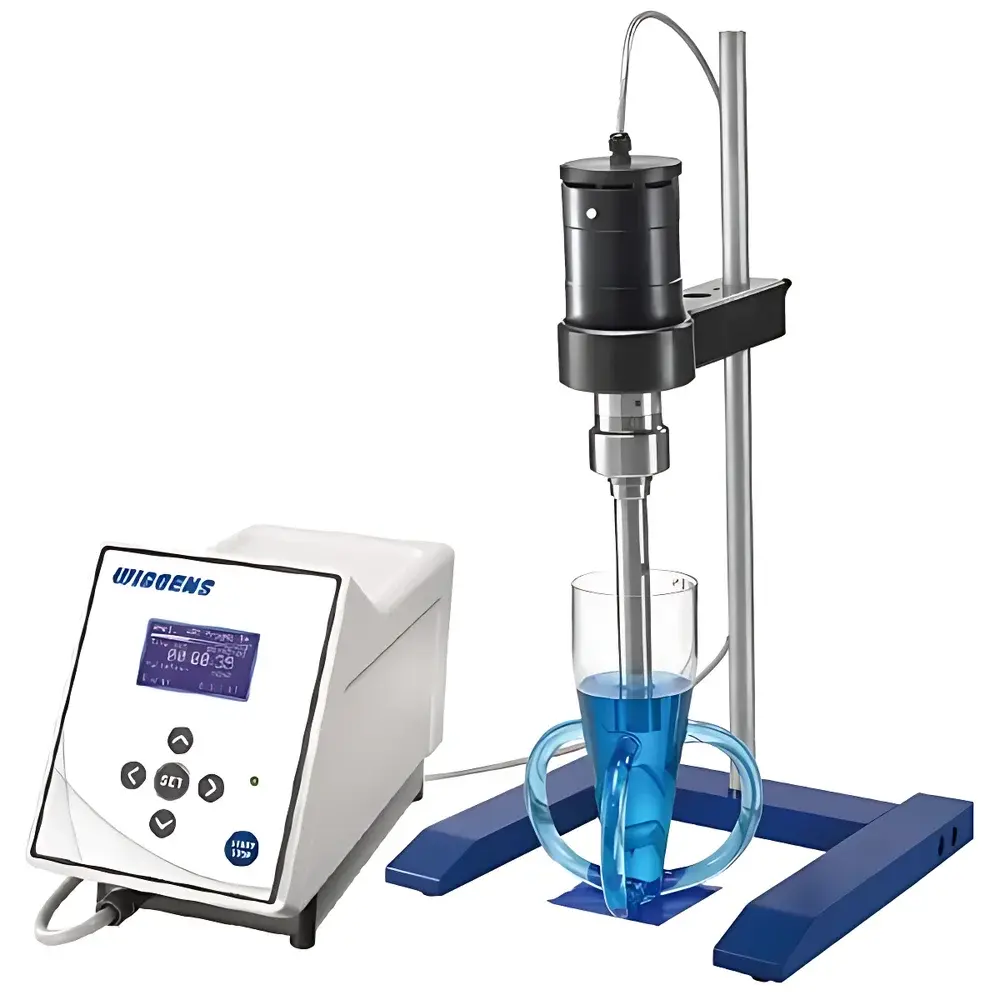
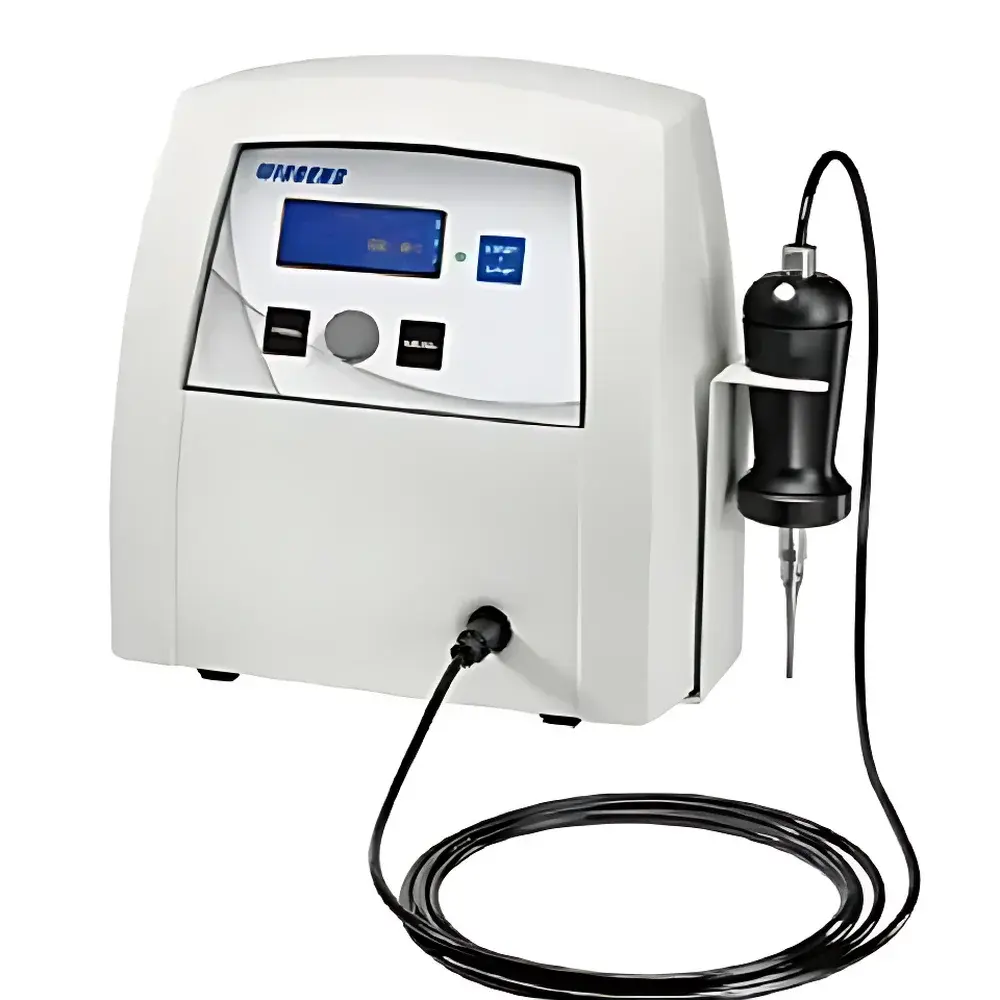
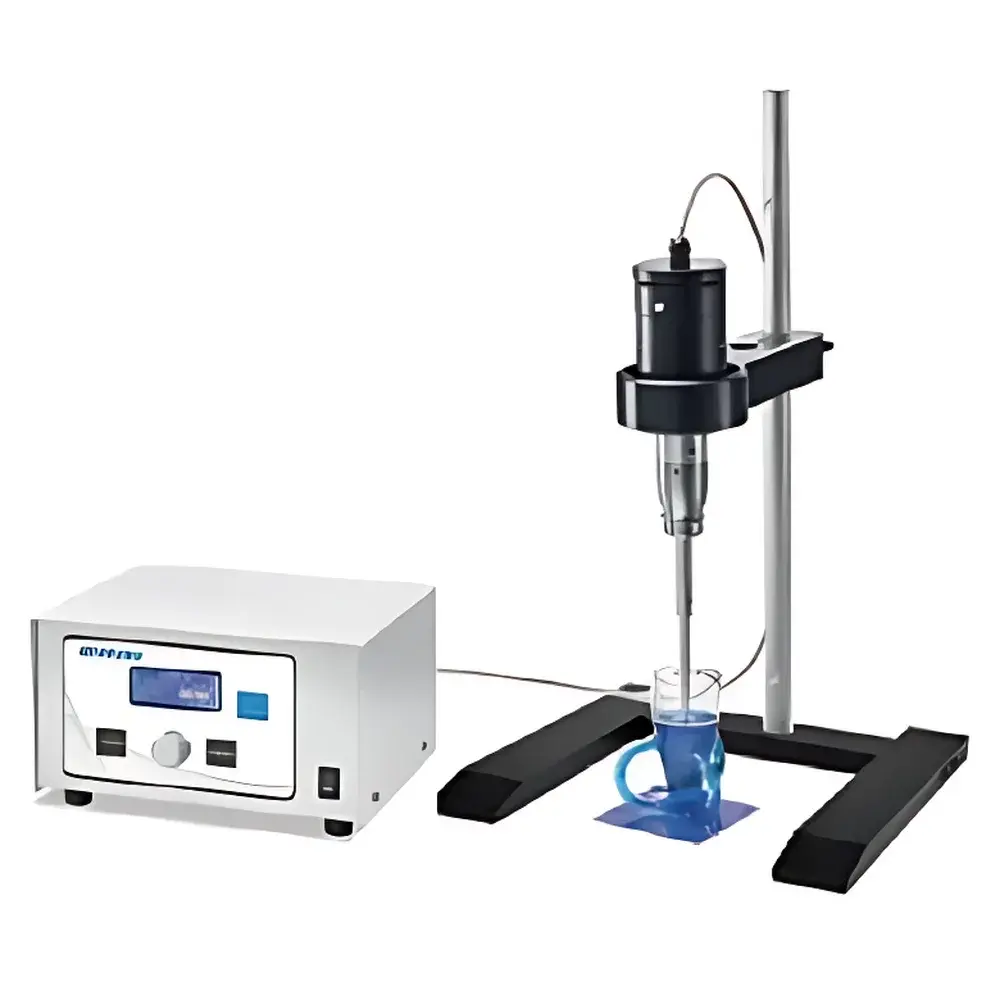
WIGGENS HD4200 High-Performance Ultrasonic Cell Disruptor
| Brand | WIGGENS |
|---|---|
| Origin | Germany |
| Model | HD4200 |
| Instrument Type | Ultrasonic Cell Disruptor |
| Operating Frequency | 20 kHz |
| Ultrasonic Power Output | 50 / 100 / 200 / 400 W (selectable) |
| Sample Volume Range | 0.5–3000 mL |
| Number of Samples per Run | 1 |
| Compliance | CE-marked, designed for GLP-compliant laboratories |
Overview
The WIGGENS HD4200 High-Performance Ultrasonic Cell Disruptor is an engineered solution for controlled, reproducible lysis of microbial, mammalian, and plant cells in research and quality control laboratories. Based on piezoelectric transduction and resonant ultrasonic energy delivery at a fixed frequency of 20 kHz, the system converts electrical input into high-intensity mechanical oscillations transmitted via titanium alloy probes into liquid media. This generates localized cavitation—rapid formation and collapse of microbubbles—producing intense shear forces, microstreaming, and transient high temperatures that disrupt cellular membranes and subcellular structures without significant thermal accumulation when operated under pulsed conditions. The HD4200 is not a benchtop homogenizer or vortex-based lyser; it is a calibrated, amplitude-stabilized ultrasonic processor designed for applications requiring precise energy dosing, scalability across volume ranges (0.5–3000 mL), and compatibility with temperature-sensitive biomolecules.
Key Features
- Stable amplitude control system maintaining consistent 20 kHz resonance across all power levels (50–400 W), ensuring inter-run reproducibility critical for comparative studies and method validation.
- Digitally adjustable ultrasonic intensity (10–100% of nominal output), enabling fine-tuned optimization for fragile samples such as protein complexes or extracellular vesicles.
- Programmable pulse mode with independent ON/OFF cycle definition (0.2–600 s each), facilitating active cooling intervals to mitigate sample heating during extended processing.
- Integrated digital timer with dual-mode operation: countdown timing (up to 9 h 59 min 59 s) and cumulative runtime logging—prevents unattended dry-running and supports audit-ready documentation.
- CE-certified architecture compliant with IEC 61000-6-3 (EMC) and IEC 61000-6-2 (immunity); constructed with industrial-grade aluminum housing and IP20-rated electronics for laboratory durability.
- Modular probe interface supporting standardized titanium horns (TT-series) with diameters from 13 mm up to 38 mm, including SH 200 G booster horn for enhanced amplitude transmission in viscous or high-density suspensions.
Sample Compatibility & Compliance
The HD4200 accommodates single-sample processing across a broad volume spectrum—from low-volume micro-preparations (0.5 mL in microtubes) to large-scale lysates (up to 3 L in jacketed reactors). Compatible sample matrices include bacterial cultures (E. coli, Bacillus spp.), yeast (S. cerevisiae), mammalian cell lines (HEK293, CHO), plant tissue homogenates, and viral particle suspensions. All titanium probe components meet ISO 10993-5 biocompatibility requirements for non-cytotoxicity. While the instrument itself does not incorporate real-time temperature sensing, its pulse-mode operation aligns with USP guidance on analytical instrument qualification for controlled disruption steps. When used with external recirculating chillers or ice-water baths, the system supports protocols adhering to ASTM E2917-22 (Standard Practice for Validation of Analytical Methods for Biotechnology Products).
Software & Data Management
The HD4200 operates via front-panel LCD interface with dedicated function keys for amplitude, time, and pulse parameter entry. It stores up to nine user-defined programs—including amplitude setpoint, duty cycle, total duration, and auto-shutdown logic—for rapid recall and cross-operator consistency. RS-232 serial interface enables integration with LIMS or custom scripting environments for automated run initiation, parameter logging, and electronic record retention. Although native FDA 21 CFR Part 11 compliance requires third-party validation packages, the device’s deterministic behavior, immutable parameter history, and absence of cloud connectivity make it suitable for environments implementing ALCOA+ data integrity principles under internal SOPs. Audit trails may be generated externally using timestamped serial logs synchronized with laboratory environmental monitoring systems.
Applications
- Nucleic acid extraction: Efficient release of genomic DNA and total RNA from Gram-positive bacteria and fibrous plant tissues where enzymatic lysis proves insufficient.
- Protein solubilization: Disruption of inclusion bodies in E. coli expression systems while preserving native conformation for downstream refolding assays.
- Subcellular fractionation: Selective membrane rupture for mitochondrial or nuclear isolation without chromatin shearing.
- Vaccine development: Lysis of whole-cell bacterial vaccines (e.g., pertussis) to generate antigenic lysates meeting EP 2.6.17 specifications.
- Nanoparticle dispersion: Deagglomeration of liposomes, polymeric micelles, and exosome preparations prior to DLS or NTA characterization.
- Quality control testing: Routine verification of cell wall integrity in fermentation broths per ISO 11133:2014 microbiological media performance standards.
FAQ
What is the maximum recommended continuous operating time per cycle?
The HD4200 supports uninterrupted operation for up to 9 hours 59 minutes 59 seconds per programmed sequence. However, for heat-sensitive samples, pulsed operation (e.g., 5 s ON / 10 s OFF) is strongly advised to maintain bulk temperature below 15 °C.
Can the HD4200 be validated for GMP manufacturing environments?
Yes—the instrument’s deterministic firmware, traceable calibration paths (via external power meters and calibrated hydrophones), and programmable parameter locking support IQ/OQ/PQ execution per ASTM E2500-21. Full validation requires documented probe wear assessment and amplitude verification at defined frequencies.
Is remote footswitch control supported?
Yes, the HD4200 includes a standard 3.5 mm mono jack for optional footswitch activation, enabling hands-free start/stop functionality during biosafety cabinet workflows.
Which probe sizes are compatible with the HD4200’s UW 400 transducer?
The UW 400 transducer interfaces with TT-series titanium probes having diameters of 13, 16, 19, 25, 32, and 38 mm. Larger-diameter probes require SH 3425 booster horns for optimal amplitude transfer and mechanical coupling efficiency.
Does the system provide energy dosage reporting in joules or kilojoules?
Yes—the LCD display reports cumulative energy delivered in kJ, calculated in real time from measured RMS voltage, current draw, and transducer efficiency curves supplied in the technical dossier.