
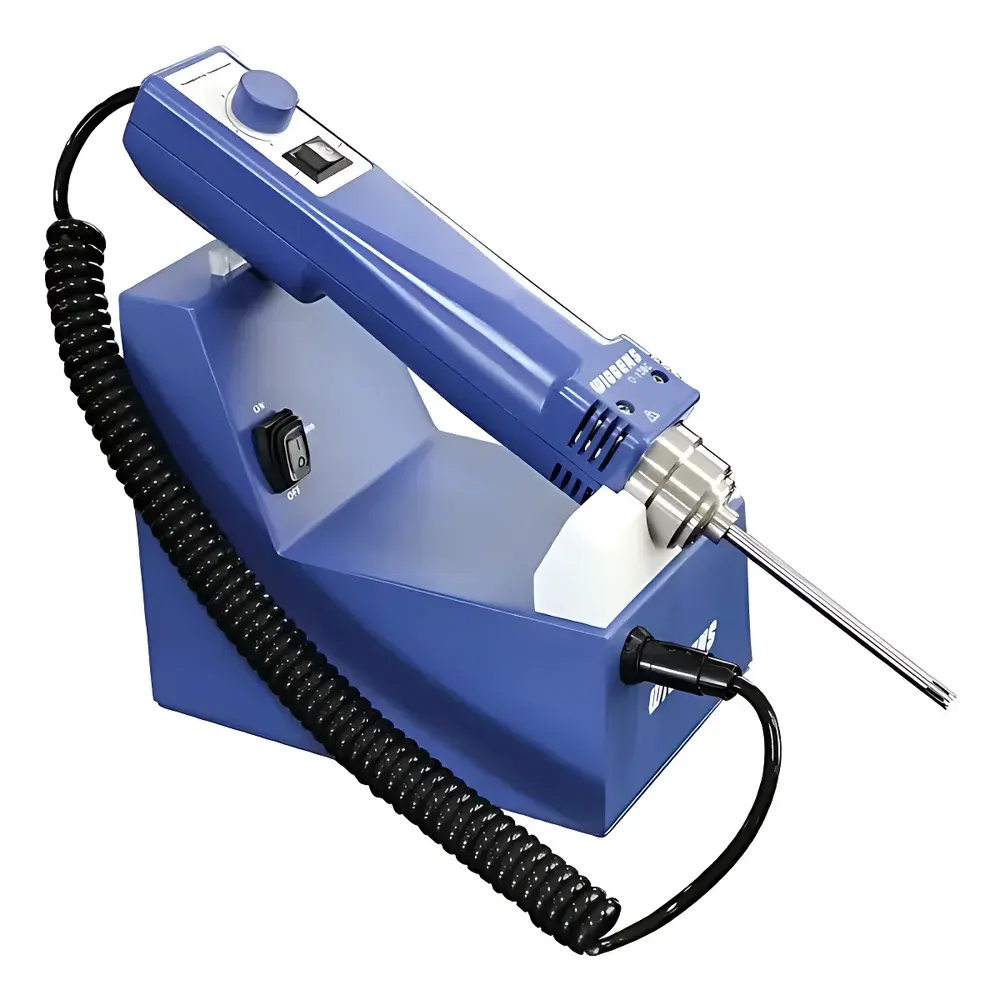
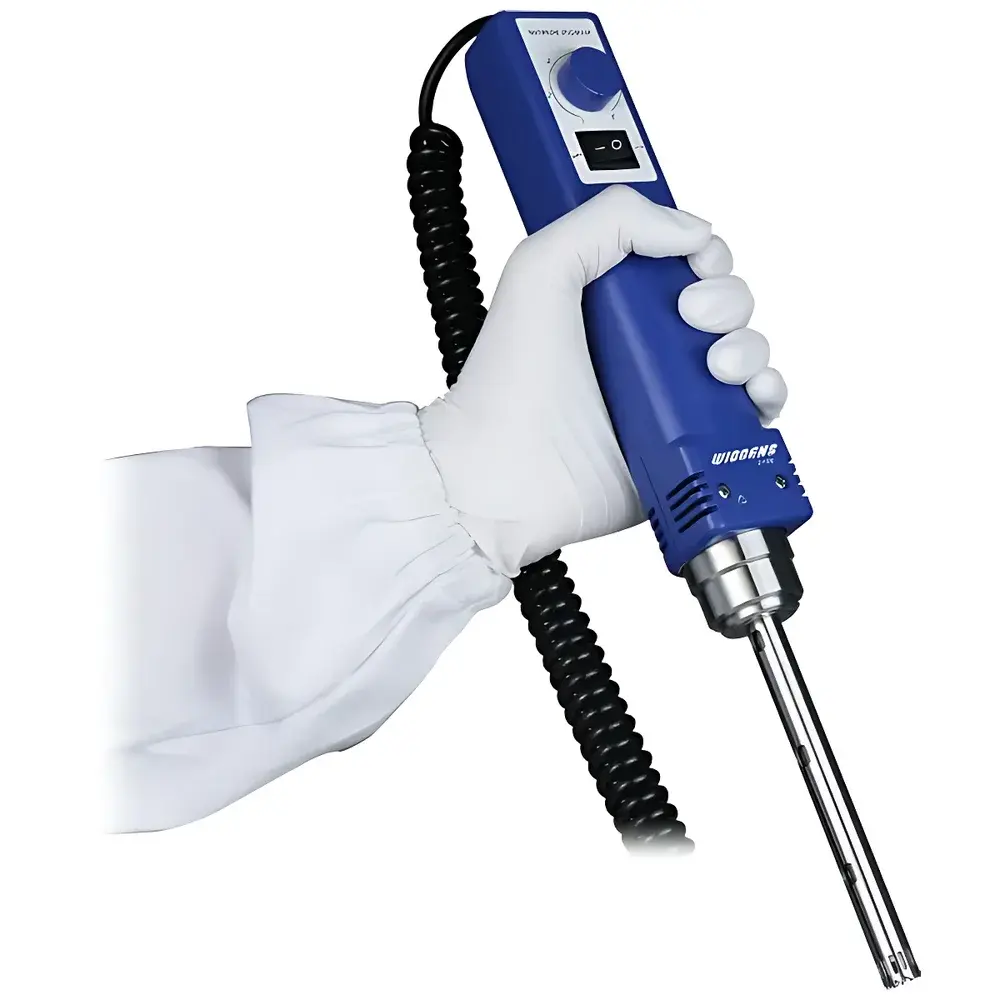
WIGGENS D-130C Handheld High-Shear Homogenizer
| Brand | WIGGENS |
|---|---|
| Origin | Germany |
| Model | D-130C |
| Instrument Type | Handheld Homogenizer |
| Instrument Category | Adjustable High-Speed Disperser |
| Sample Volume Range | 0.2–50 mL (with Shaft 5E) / 3–250 mL (with Shaft 12E), aqueous medium |
| Output Power | 100 W |
| No-Load Speed Range | 0–25,000 rpm |
| Motor Type | Brushless DC Motor |
| Contact Material | 316L Stainless Steel |
| IP Rating | IP30 |
| Shaft Coupling | Quick-Release Mechanism |
| Safety Control | Dual-Button Activation |
| Cable Length | 2 m Spiral Extension Cord |
| Dimensions (Base) | 160 × 185 × 162 mm |
| Dimensions (Handheld Unit) | 44 × 58 × 226 mm |
| Order Code | W3050130 |
Overview
The WIGGENS D-130C Handheld High-Shear Homogenizer is an engineered solution for rapid, reproducible sample homogenization, dispersion, emulsification, and cell lysis in research and quality control laboratories. Based on the principle of high-shear rotor-stator interaction, the device generates intense mechanical forces through controlled fluid acceleration within a narrow gap between a rotating rotor and a fixed stator. This hydrodynamic shear mechanism enables efficient particle size reduction, phase mixing, and disruption of biological matrices—without introducing significant thermal load or requiring cryogenic handling. Designed for benchtop flexibility and ergonomic operation, the D-130C delivers precise speed control across a broad range (0–25,000 rpm), supporting applications from low-volume nucleic acid extraction to high-throughput pharmaceutical dissolution testing.
Key Features
- Brushless DC motor ensures long service life, consistent torque delivery, and minimal electromagnetic interference—critical for stable operation in sensitive analytical environments.
- Ergonomic handheld design with balanced weight distribution allows single-handed operation and precise positioning over open vessels or tubes, minimizing cross-contamination risk.
- Quick-release coupling system enables tool-free interchange of sterilizable 316L stainless steel dispersing shafts (Shaft 5E and Shaft 12E), supporting scalable processing from microliter to 250 mL volumes.
- Dual-button activation prevents accidental start-up, complying with IEC 61000-6-2/6-4 electromagnetic compatibility standards and supporting laboratory safety protocols.
- IP30-rated housing provides protection against solid objects ≥2.5 mm; suitable for standard dry laboratory conditions but not for wet or pressurized environments.
- Integrated 2 m spiral extension cord decouples motor unit from base station, enhancing mobility while maintaining electrical isolation and mechanical stability during extended use.
Sample Compatibility & Compliance
The D-130C accommodates diverse sample types including soft tissues (e.g., tumor biopsies), plant material, microbial cultures, suspension formulations, and solid dosage forms (e.g., coated tablets). Its 316L stainless steel contact surfaces are compatible with autoclaving, chemical sterilization (e.g., ethanol, hydrogen peroxide vapor), and validated cleaning-in-place (CIP) procedures—aligning with GLP/GMP requirements for regulated QC labs. While the instrument itself does not carry CE marking for medical device classification, its construction and operational parameters conform to ISO 13485-aligned manufacturing practices. It supports method validation under USP , ASTM D2703 (emulsion stability), and ISO 13320 (laser diffraction particle sizing) when integrated into standardized workflows.
Software & Data Management
The D-130C operates via analog rotary speed control with tactile feedback and no digital interface; therefore, it does not generate electronic audit trails or export raw data streams. However, its mechanical repeatability—validated at ±2% speed deviation across the full 0–25,000 rpm range—enables robust manual SOP execution. Users may document operating parameters (shaft type, speed setting, duration, sample volume) in paper-based or LIMS-integrated electronic lab notebooks (ELN) to satisfy FDA 21 CFR Part 11 requirements for traceability. For laboratories requiring automated logging, external tachometer integration or video-based process recording is recommended for critical homogenization steps.
Applications
- Routine homogenization of mammalian and avian tissue samples prior to RNA/DNA isolation, ensuring high nucleic acid yield and integrity (RIN >8.5).
- Preparation of uniform suspensions for dissolution testing of immediate- and extended-release oral solid dosage forms per USP .
- Disruption of bacterial and yeast cells for intracellular protein recovery without denaturation.
- Emulsification of oil-in-water and water-in-oil systems for cosmetic and food-grade formulation development.
- Dispersion of nanomaterials (e.g., graphene oxide, metal oxides) in aqueous or organic solvents for colloidal stability assessment.
- Homogenization of small-volume clinical specimens (e.g., biopsy fragments, cerebrospinal fluid sediments) for downstream proteomic or metabolomic profiling.
FAQ
What is the maximum recommended continuous operating time per cycle?
For optimal thermal management and motor longevity, continuous operation should not exceed 60 seconds per cycle, followed by a minimum 30-second cooldown interval—especially at speeds above 15,000 rpm.
Can the D-130C be used for sterile processing in a laminar flow hood?
Yes; all wetted parts are autoclavable at 121°C for 20 minutes. Ensure complete drying before reassembly to prevent condensation-induced corrosion.
Is calibration required before first use or after shaft replacement?
No factory calibration is needed—the speed dial is pre-calibrated at manufacture. However, users should verify no-load speed against a certified tachometer annually or after impact events.
Which shaft is appropriate for homogenizing fibrous plant tissue?
Shaft 12E is recommended due to its higher linear velocity (14.1 m/s) and deeper immersion depth (≥40 mm), enabling effective fiber shearing in viscous slurries.
Does the device comply with RoHS or REACH directives?
Yes; WIGGENS certifies full compliance with EU Directive 2011/65/EU (RoHS2) and Regulation (EC) No 1907/2006 (REACH), including SVHC screening of all polymer and metallic components.



