
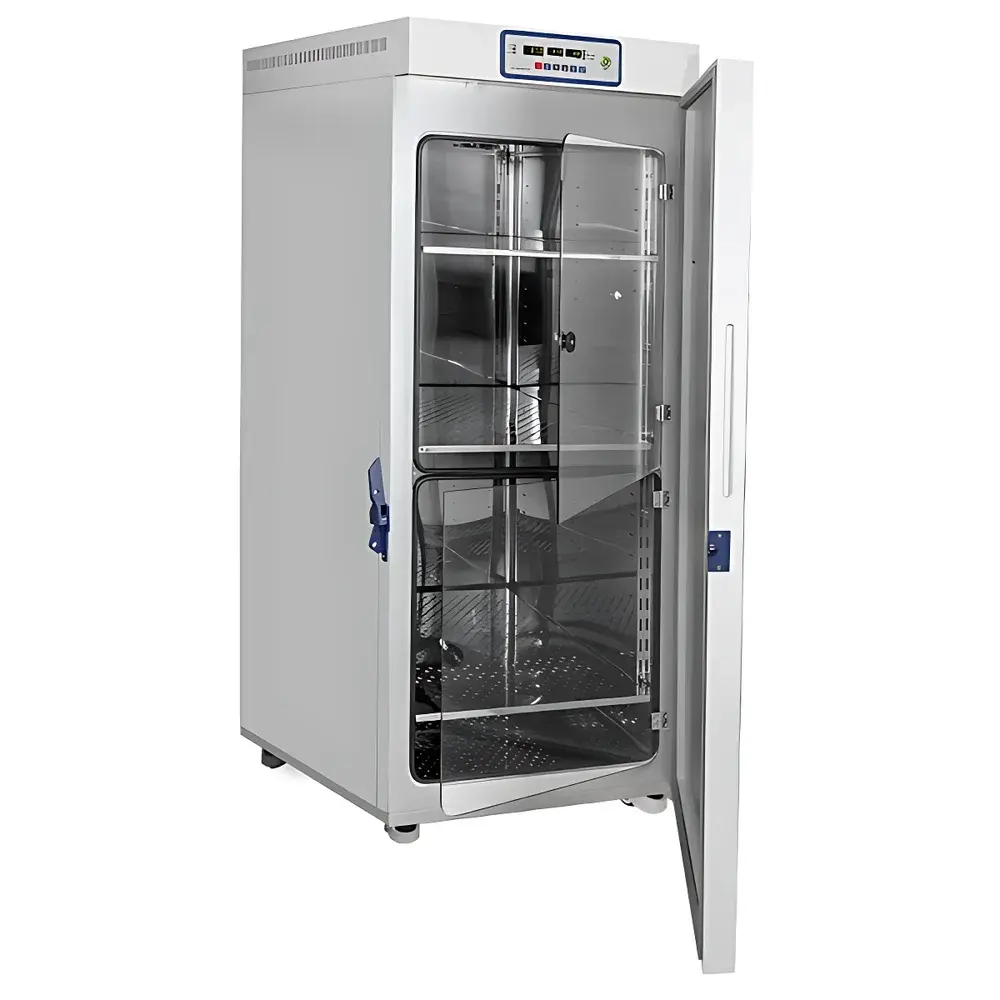
WIGGENS WCI-850T Tri-Gas Incubator
| Brand | WIGGENS |
|---|---|
| Origin | Germany |
| Model | WCI-850T |
| Instrument Type | Automated Tri-Gas Incubator |
| Temperature Range | Ambient +5°C to 60°C |
| Temperature Uniformity & Stability | ±0.1°C at 37°C |
| O₂ Concentration Range | 0.6%–85% |
| CO₂ Range | 0%–20% |
| CO₂ Accuracy | ±0.1% at 5% / 37°C |
| O₂ Sensor | Zirconia Electrochemical Sensor |
| CO₂ Sensor | Dual-Beam Infrared Sensor |
| Humidification | Heated Water Pan with Forced-Air Distribution |
| Chamber Material | AISI 304 Stainless Steel |
| Heating System | Six-Side Air-Jacketed Gradient Heating with Independent Calibration per Zone |
| Sterilization Options | Optional UV (4 W), O₃, or Dry-Heat (≤100°C) |
| Communication Interface | RS232 / RS485 |
| Compliance | Designed for ISO 13485-aligned lab environments |
Overview
The WIGGENS WCI-850T Tri-Gas Incubator is an engineered platform for precise, reproducible control of oxygen, carbon dioxide, and temperature in advanced life science applications. Unlike conventional CO₂ incubators, the WCI-850T integrates independent regulation of O₂ concentration (0.6–85%) alongside standard CO₂ (0–20%) and thermal control (ambient +5°C to 60°C), enabling reliable simulation of physiological hypoxia, hyperoxia, and normoxic microenvironments. Its operation is grounded in closed-loop gas mixing using mass flow controllers for N₂, O₂, and CO₂—ensuring stoichiometric accuracy and minimizing cross-gas interference. The chamber employs a six-sided air-jacketed heating architecture with individually calibrated platinum resistance thermometers (Pt100) per zone, delivering ±0.1°C uniformity at 37°C—a specification validated per ISO 13485 Annex C and aligned with ASTM E1912-22 for incubator performance verification.
Key Features
- Six-face gradient air-jacket heating system: Eliminates thermal stratification by distributing heat uniformly across all chamber walls, enabling rapid temperature recovery (<15 min after door opening) and minimizing thermal lag.
- Dual-sensor gas monitoring: A dual-beam infrared CO₂ sensor provides drift-free, humidity- and temperature-compensated measurement (±0.1% accuracy at 5% CO₂, 37°C); paired with a zirconia-based electrochemical O₂ sensor offering long-term stability and minimal calibration drift.
- Active humidity management: A bottom-mounted heated water pan generates saturated vapor, distributed via a top-mounted axial fan—achieving >95% RH without condensation, even during frequent access cycles.
- Condensation-free viewing window & frame: Integrated low-voltage heating elements on the inner glass surface and structural framework prevent dew formation under high-humidity, low-ambient conditions.
- Modular sterilization capability: Optional 4 W UV-C lamp (positioned adjacent to circulation fan, shielded from direct sample exposure) and ozone (O₃) generation module enable periodic decontamination without chamber disassembly.
- Structural integrity & contamination control: Entire interior constructed from electropolished AISI 304 stainless steel with radius-corner welds; removable, perforated stainless steel shelves optimize laminar airflow and resist corrosion from repeated disinfectant exposure.
Sample Compatibility & Compliance
The WCI-850T accommodates diverse biological systems including primary mammalian cell lines, stem cell monolayers, organoids, microbial anaerobes (e.g., Clostridium, Bifidobacterium), and reproductive tissue explants. Its multi-gas flexibility supports protocols requiring controlled hypoxia (e.g., 1–5% O₂ for embryonic stem cell maintenance), hyperoxia (e.g., 40–85% O₂ for oxidative stress modeling), or sequential gas transitions (e.g., ischemia-reperfusion simulations). All firmware operations—including parameter setting, alarm logging, and sterilization cycle execution—are timestamped and stored locally with tamper-resistant memory. The controller complies with ALCOA+ principles for data integrity and supports optional 21 CFR Part 11-compliant user authentication and electronic signature modules when integrated into regulated QC/QA workflows.
Software & Data Management
The embedded microprocessor uses digital PID algorithms for independent regulation of temperature, CO₂, and O₂ setpoints, with real-time deviation alerts and automatic fail-safe shutdown (e.g., thermal cutoff at user-defined upper limit). Data output is accessible via RS232/RS485 serial interface for integration into LIMS or SCADA systems. Optional remote monitoring software enables live parameter visualization, historical trend analysis (7-day internal buffer), and configurable email/SMS notifications for critical alarms (e.g., O₂ deviation >±0.5%, CO₂ loss >1%). Audit trails record operator ID, timestamp, parameter changes, and sterilization events—retained for ≥12 months and exportable as CSV or PDF for regulatory review.
Applications
- Mammalian cell culture under physiologically relevant O₂ tensions (e.g., tumor spheroid expansion at 2% O₂)
- Microaerophilic and obligate anaerobic bacterial cultivation (e.g., Helicobacter pylori, Fusobacterium nucleatum)
- Assisted reproductive technology (ART): Embryo culture in low-O₂ (5%) environments to reduce ROS generation
- Stem cell differentiation studies requiring dynamic O₂ modulation across developmental stages
- Pharmaceutical microbiology: Anaerobic susceptibility testing per CLSI M11-A9 guidelines
- Tissue engineering: Hypoxia-preconditioning of scaffolds prior to implantation
FAQ
What gas supply requirements does the WCI-850T have?
The unit requires three independent gas sources: medical-grade CO₂ (≥99.5%), compressed air or O₂ (for O₂ blending), and N₂ (≥99.998%) for O₂ dilution. Inlet pressure must be maintained within 0.9–1.0 bar for optimal mass flow controller performance.
Can the incubator operate without CO₂ while maintaining O₂ control?
Yes. The gas control system operates independently; CO₂ can be set to 0% while O₂ is actively regulated between 0.6% and 85%.
Is dry-heat sterilization supported, and what are its limitations?
Dry-heat mode is available as a factory-configured option (max 100°C, validated per ISO 14644-1 Class 5 cleanroom standards); it preserves IR CO₂ sensor integrity without requiring removal—unlike conventional autoclave cycles.
How is humidity stability verified during validation?
Humidity uniformity is assessed using calibrated hygrometers placed at 9 standardized locations (per ISO 14644-3 Annex B), with acceptance criteria of ±3% RH across the working volume at steady state.
Does the system support IQ/OQ documentation packages?
Yes. WIGGENS provides GxP-ready Installation Qualification (IQ) and Operational Qualification (OQ) templates, including test protocols for temperature mapping, CO₂/O₂ linearity, and alarm response verification.




