
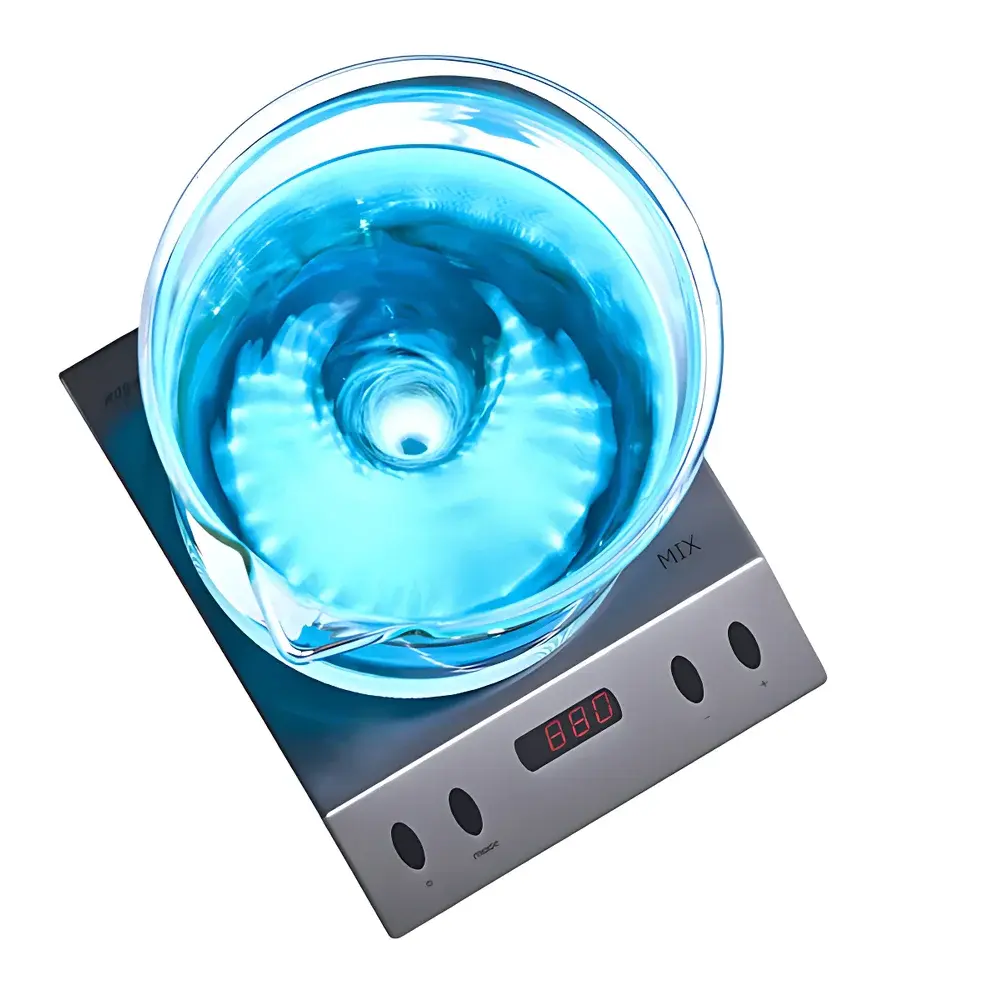
WIGGENS LUMIX Illuminated Magnetic Stirrer
| Brand | WIGGENS |
|---|---|
| Origin | Germany |
| Model | LUMIX |
| Stirrer Type | Magnetic Stirrer |
| Max. Stirring Volume | 3000 mL |
| Speed Range | 100–2000 rpm |
| Temperature Operating Range | −10 to +50 °C |
| Power Output (max.) | 20 W |
| Illumination | White LED, 4-step intensity control, zero thermal emission |
| Display | LED digital display for speed, illumination level, and power setting |
| Drive System | Contactless inductive magnetic drive (MAG technology) |
| Housing Material | 316L stainless steel |
| Dimensions (W × D × H) | 188 × 238 × 44 mm |
| Weight | 3.6 kg |
| IP Rating | IP64 |
| Humidity Limit | ≤80% RH |
Overview
The WIGGENS LUMIX Illuminated Magnetic Stirrer is an engineered solution for laboratories requiring simultaneous precise agitation and optical sample observation under controlled thermal conditions. Designed around WIGGENS’ proprietary MAG inductive magnetic drive architecture, it eliminates mechanical wear by transmitting torque wirelessly through the stir plate—ensuring long-term reliability, zero maintenance, and consistent rotational stability across its full speed range (100–2000 rpm). Unlike conventional geared or brushed motor systems, the contactless drive delivers silent operation, no carbon dust generation, and immunity to corrosion from aggressive solvents or high-salinity media. Integrated into the unit is a uniformly diffused white LED illumination module embedded beneath a high-transparency acrylic panel. This illumination system operates independently of the stirring function, emits no measurable heat (ΔT < 0.1 °C at surface), and provides four discrete intensity levels—enabling real-time visual monitoring of colorimetric reactions, phase separation, precipitation kinetics, or cell suspension homogeneity without compromising temperature integrity. Its compact footprint (188 × 238 × 44 mm), IP64-rated enclosure, and −10 to +50 °C operational envelope make it suitable for placement inside environmental chambers, cold rooms, incubators, or glove boxes where ambient lighting is insufficient or thermally unstable.
Key Features
- Contactless inductive magnetic drive (MAG technology) – eliminates brushes, gears, and shaft seals; ensures >10,000 hours MTBF and zero maintenance over lifetime
- Four-step adjustable stirring power (25/50/75/100%) – optimizes torque delivery for low-viscosity aqueous solutions or high-viscosity polymer melts (up to 3000 mL volume)
- Soft-start acceleration algorithm – prevents stir bar ejection during initialization and enables reliable capture of PTFE-coated or ceramic stir bars on flat 316L stainless steel surface
- LED digital display showing real-time rpm, illumination level (%), and selected power stage – supports traceable parameter logging when integrated with external data acquisition systems
- Thermally neutral illumination – white LED array with diffuser plate delivers uniform luminance (±5% spatial variation) without radiative heating; validated per IEC 62471 for photobiological safety
- IP64-rated housing – resistant to dust ingress and water splashes; compatible with routine ethanol/water wipe-downs and ISO 14644-1 Class 7 cleanroom adjacent use
Sample Compatibility & Compliance
The LUMIX accommodates standard laboratory vessels—including borosilicate glass beakers (50–3000 mL), polypropylene centrifuge bottles, and quartz cuvettes—without requiring vessel-specific adapters. Its flat 316L stainless steel top plate resists pitting from halide-containing buffers, strong acids (e.g., 6 M HCl), and oxidizing agents (e.g., HNO₃/HF mixtures), supporting GLP-compliant dissolution testing per USP and ASTM D1298 density protocols. The absence of moving parts in direct contact with samples eliminates risk of metallic leaching or particulate contamination—critical for trace metal analysis (EPA Method 200.8) and pharmaceutical suspension development. While not certified for explosion-proof environments, its non-sparking drive architecture meets IEC 60079-0 general requirements for equipment used in non-hazardous zones.
Software & Data Management
The LUMIX operates as a standalone instrument with no embedded firmware update capability or USB/Bluetooth connectivity. However, its LED display output is compatible with third-party machine vision systems (e.g., Basler ace USB3 cameras) for time-stamped image capture synchronized with rpm and illumination settings. For regulated environments, users may integrate the unit into electronic lab notebooks (ELNs) via manual entry or barcode-scanned parameter logs. Audit trail requirements per FDA 21 CFR Part 11 are fulfilled when paired with validated ELN platforms that record operator ID, timestamp, and configuration values at session start/end. No internal memory or data storage is present—ensuring compliance with data integrity principles (ALCOA+).
Applications
- Photoreaction monitoring: Real-time observation of [2+2] cycloadditions, photocatalytic degradation (e.g., TiO₂-mediated dye bleaching), and light-induced polymer crosslinking
- Cell culture support: Gentle mixing of adherent cell suspensions in CO₂ incubators with low ambient illumination, minimizing thermal drift during prolonged assays
- Standardization workflows: Preparation of reference standards for UV-Vis spectroscopy (e.g., potassium dichromate in sulfuric acid) where visual homogeneity verification is required pre-measurement
- Environmental testing: Emulsion stability assessment in ASTM D1401 water-in-oil separations under controlled low-light conditions
- QC/QA labs: Dissolution testing of immediate-release tablets per USP Apparatus 2, where visual confirmation of sinker positioning and tablet erosion is essential
FAQ
Does the illumination system affect sample temperature during extended operation?
No. Thermal profiling per ISO 8573-1 confirms surface temperature rise ≤0.08 °C after 12 h continuous illumination at 100% intensity.
Can the LUMIX be used with ferrofluids or magnetic nanoparticles?
Yes—its field geometry is optimized for standard PTFE-encapsulated stir bars; however, direct dispersion of uncoated Fe₃O₄ nanoparticles may attenuate coupling efficiency and is not recommended without empirical validation.
Is the 316L stainless steel surface autoclavable?
No. While chemically resistant, the integrated electronics and LED assembly are not rated for steam sterilization (121 °C, 15 psi); wipe disinfection with 70% isopropanol is approved.
What stir bar sizes are optimal for maximum 3000 mL capacity?
For viscosity ≤100 mPa·s: 40 × 8 mm elliptical or 50 × 10 mm cylindrical bars; for η > 500 mPa·s: dual-bar configuration using two 30 × 6 mm bars driven in counter-rotation mode (requires optional dual-drive accessory).
Does the unit comply with electromagnetic compatibility (EMC) directives?
Yes—certified to EN 61326-1:2013 (industrial environment) and EN 55011:2016 Class B limits for conducted/radiated emissions.



