
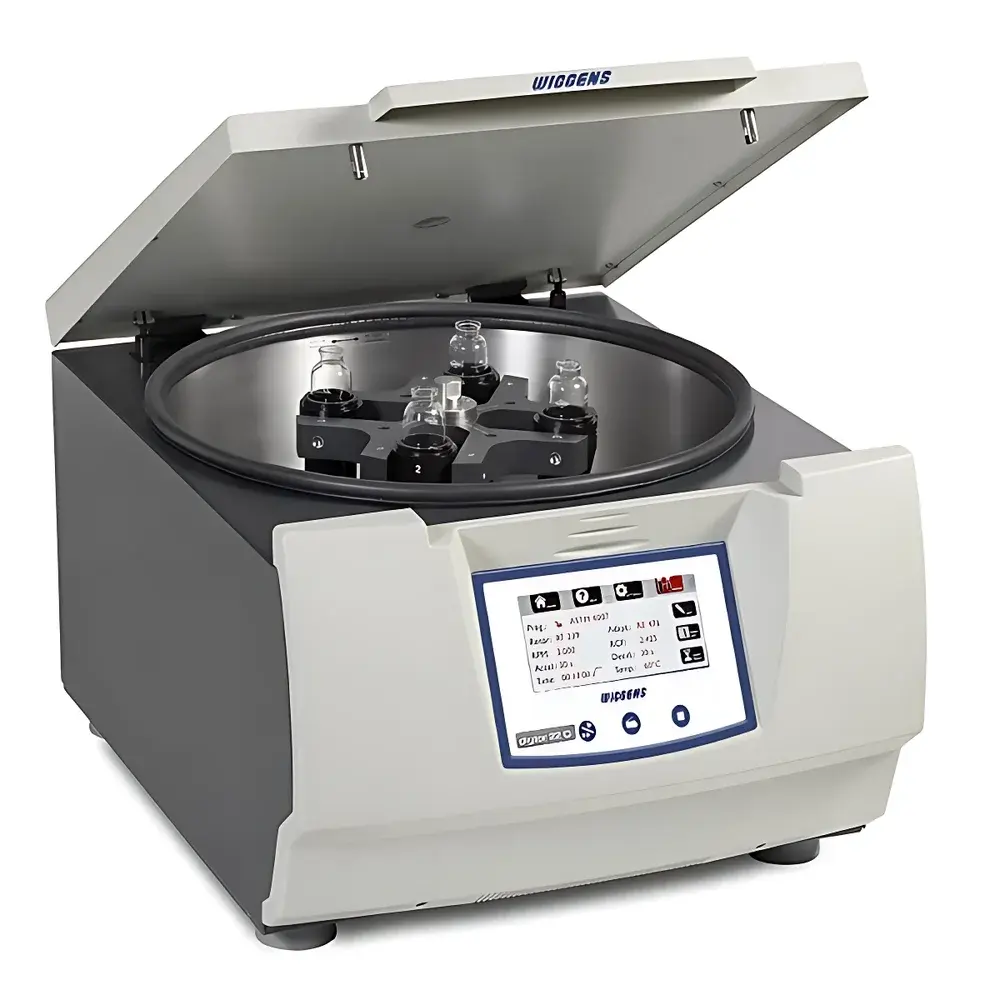
WIGGENS Digtor 22 C Benchtop Centrifuge
| Brand | WIGGENS |
|---|---|
| Origin | Germany |
| Model | Digtor 22 C |
| Instrument Type | Benchtop Centrifuge |
| Speed Range | up to 3000 rpm |
| Max RCF | 2425 ×g |
| Max Capacity | 4 × 100 mL (6" or 8" tubes) |
| Dimensions (W×D×H) | 540 × 650 × 400 mm |
| Temperature Range | RT+5°C to 80°C (±1°C resolution) |
| Noise Level | <60 dB(A) |
| Compliance | EN 61010-1, EN 61010-2-020, EN 61326-1, EN 61326-2-6, EN 61010-2-010 |
| Certifications | 2011/65/EU (RoHS), 2012/19/EU (WEEE), 2014/30/EU (EMC), 2014/35/EU (LVD), 98/79/EC (IVDR) |
Overview
The WIGGENS Digtor 22 C is a high-performance benchtop centrifuge engineered for reproducible, temperature-controlled sedimentation and phase separation in petroleum, lubricant, and industrial fluid analysis. Designed around a robust horizontal rotor architecture, it operates on the principle of gravitational sedimentation under controlled rotational force—enabling precise quantification of suspended solids, water content, sludge formation, and insoluble deposits in hydrocarbon-based samples. Its mechanical design adheres to ISO 3734 and ASTM D 91/D 96 protocols for oil and fuel testing, with integrated thermal regulation supporting standardized pre-heating and isothermal centrifugation per ASTM D 1796 and IP 75. Unlike general-purpose centrifuges, the Digtor 22 C is purpose-built for compliance-driven laboratories performing routine quality control in refineries, lubricant formulation facilities, and third-party testing labs accredited to ISO/IEC 17025.
Key Features
- TFT color display with >3 m viewing distance, showing real-time RPM, RCF, elapsed time, acceleration/deceleration profiles, and unbalance position (ULS)
- Digital speed control in 10 rpm / 10 ×g increments; automatic RCF recalculation based on selected rotor geometry and tube dimensions
- Programmable timer from 1 second to 99 hours with stepwise program execution, pause/resume capability, and endpoint-triggered timing (e.g., start timer only after reaching target RCF)
- PCBS (Progressive Control Braking System) with 175 selectable acceleration/deceleration slopes to minimize post-centrifugation resuspension and preserve sediment integrity
- 40 user-programmable methods with password protection, automatic recall of last-used parameters, and rotor identification via mechanical encoding
- Integrated heating system with cavity-mounted Pt100 sensor, overtemperature cutoff, and thermal insulation to maintain ±1°C stability across RT+5°C–80°C range
- Brushless DC motor with maintenance-free operation, low acoustic emission (<60 dB[A]), and instantaneous spin function for quick pellet inspection
Sample Compatibility & Compliance
The Digtor 22 C accommodates standard ASTM and API sample formats—including 6″ and 8″ conical tubes (ASTM D 91), pear-shaped tubes (ASTM D 893), and 12.5 mL API finger tubes (ASTM D 2709)—via interchangeable horizontal rotors RT293 and RT289 (both rated ≤3000 rpm, 2425 ×g, 4 × 100 mL). All rotors and adapters are autoclavable (121°C, 20 min) and constructed from corrosion-resistant stainless steel. The instrument complies with critical international standards for petroleum testing: ASTM D 91 (sediment in fuel oils), D 96 (water in petroleum products), D 1796 (insolubles in diesel fuel), D 2711 (sludge in lubricating oils), ISO 9030 (determination of sediment in crude oil), and API RP 2542/2548 (centrifugal separation of water and sediment). Its safety architecture meets EN 61010-2-020 for centrifuge-specific hazards and includes dual mechanical lid locks, emergency manual release, anti-drop lid dampening, and automatic imbalance shutdown.
Software & Data Management
While the Digtor 22 C operates as a standalone instrument without external PC connectivity, its embedded firmware supports full audit-trail functionality required for GLP and GMP environments. All parameter changes, run logs (start/stop time, actual RCF, temperature profile, rotor ID), and error events (e.g., ULS activation, overtemp alert) are timestamped and stored in non-volatile memory. Password-protected method editing ensures operator-level access control. Though not FDA 21 CFR Part 11 compliant out-of-the-box due to absence of electronic signature capability, the device satisfies core data integrity requirements for regulated testing when paired with laboratory documentation systems. Firmware updates are performed via USB port using WIGGENS-certified binaries.
Applications
- Quantitative determination of water and sediment (W&S) in crude oil, diesel, jet fuel, and lubricants per ASTM D 96 and IP 75
- Sediment analysis in transformer oils and insulating fluids (IEC 60163, ASTM D 2711)
- Insoluble deposit evaluation in engine oils and hydraulic fluids (ASTM D 893, D 4007)
- Sludge formation testing in crankcase lubricants (ASTM D 1796)
- Phase separation studies in biodiesel blends and emulsified fuels (ASTM D 5546)
- Routine QC in refinery laboratories conducting API MPMS Chapter 10.8 and ISO 3734-compliant assays
FAQ
Does the Digtor 22 C support refrigeration?
No—it is a heated-only centrifuge designed for elevated-temperature sedimentation assays. Refrigerated models are not available in the Digtor 22 series.
Can I use non-WIGGENS rotors or adapters?
No. Only certified WIGGENS rotors (RT293, RT289) and matched adapters (RE475, RE476, RE477, RE454–RE456) are validated for safety and performance. Unauthorized components void certification and invalidate test compliance.
Is the heating system calibrated traceable to national standards?
Yes. Each unit ships with a factory calibration certificate referencing DIN EN ISO/IEC 17025-accredited temperature verification at three points (25°C, 50°C, 75°C), with uncertainty ≤±0.8°C.
What maintenance is required beyond routine cleaning?
Annual verification of rotor balance, lid lock engagement force, and temperature sensor accuracy is recommended. No lubrication or motor servicing is needed—the brushless motor is sealed and maintenance-free.
How does the ULS (Unbalance Location System) identify rotor imbalance?
ULS uses integrated vibration spectrum analysis during ramp-up to localize mechanical asymmetry to a specific bucket position (1–4), displayed numerically on the TFT screen—enabling rapid correction without trial-and-error rebalancing.
Related Products



