
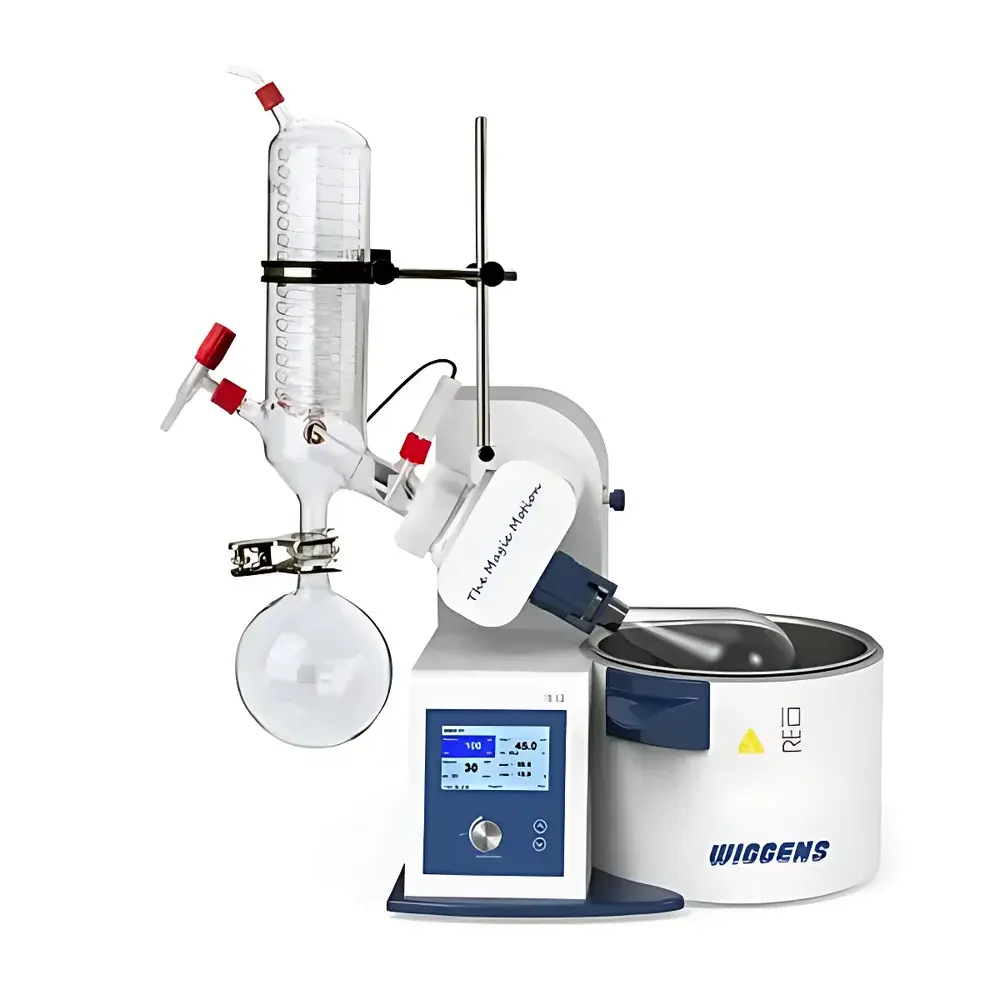
WIGGENS RE10 Rotary Evaporator
| Brand | WIGGENS |
|---|---|
| Origin | Germany |
| Model | RE10 |
| Capacity | 5 L |
| Rotation Speed | 5–300 rpm |
| Temperature Range | RT +5 to 180°C (oil bath), RT +5 to 85°C (water bath) |
| Temperature Control Accuracy | ±0.2°C |
| Condenser Surface Area | 1500 cm² |
Overview
The WIGGENS RE10 Rotary Evaporator is an engineered solution for precise, reproducible solvent removal, concentration, and purification under reduced pressure. Based on the fundamental principle of rotary evaporation—where a rotating flask increases surface area while controlled heating and vacuum lower the boiling point of solvents—the RE10 delivers consistent performance across academic, pharmaceutical, and industrial R&D laboratories. Its modular architecture integrates a high-torque DC motor, programmable temperature-controlled bath, and intelligent lift mechanism to ensure operational stability across extended distillation cycles. Designed and assembled in Germany, the system complies with IEC 61010-1 safety standards for laboratory electrical equipment and supports GLP-compliant workflows through audit-trail-capable method storage and parameter logging.
Key Features
- Motor-driven vertical or inclined lift mechanism with 115 mm total travel distance; adjustable stop positions enable precise immersion depth control for evaporating flasks ranging from 50 mL to 3000 mL.
- 4.3-inch multi-color touchscreen interface with multilingual support (English, German, French, Spanish, Chinese), lockable screen, and intuitive navigation via rotary encoder and touch input.
- Programmable distillation protocols: up to 9-step sequential methods with manual confirmation between steps; timer-based termination; auto-restart after power interruption with safe flask retraction.
- PTFE- and carbon fiber-reinforced sealing system ensures chemical resistance against aggressive solvents (e.g., chlorinated hydrocarbons, strong acids/bases) and eliminates glass-to-glass cold welding during prolonged use.
- Dual-bath compatibility: stainless steel circular bath (5 L capacity, 1400 W heating power) supports both water (max 85°C) and silicone oil (max 180°C) operation, with automatic thermal mode recognition and independent setpoint calibration.
- Real-time monitoring of vapor temperature (threaded sensor with protective glass sleeve), coolant inlet/outlet temperature, and vacuum level (when paired with optional WIGGENS vacuum controller).
- Ergonomic quick-lock flask clamping system prevents component loss; designed to maintain mechanical integrity under high vacuum (<5 mbar) while enabling rapid disassembly for cleaning or glassware replacement.
Sample Compatibility & Compliance
The RE10 accommodates standard ground-glass joints (ISO 29/32 and ISO 45/50) and accepts a full range of borosilicate 3.3 glassware—including 1000 mL evaporation and collection flasks (standard), plus optional sizes from 250 mL to 3000 mL. Safety-coated glass variants meet DIN EN 17427 requirements for shatter-resistant labware. All wetted materials comply with USP Class VI biocompatibility standards. The system supports regulatory traceability per FDA 21 CFR Part 11 when used with validated software configurations and external electronic lab notebook (ELN) integration. Electrical safety conforms to CE marking directives (2014/30/EU EMC, 2014/35/EU LVD), and thermal protection includes dry-run detection, overtemperature cutoff (>185°C oil bath), and automatic elevation upon power failure.
Software & Data Management
Method parameters—including bath temperature, rotation speed, lift position, condensate temperature thresholds, and vacuum setpoints—are stored as user-defined profiles with timestamped version history. Each profile retains last-used values across power cycles. Data export is supported via USB port (CSV format) for post-processing in Excel or LIMS platforms. Optional WIGGENS Vacuum Controller VC-10 enables closed-loop vacuum regulation with PID tuning and real-time pressure display directly on the RE10’s main screen. Firmware updates are performed via USB stick with SHA-256 signature verification to ensure integrity.
Applications
- Solvent recovery and concentration of heat-sensitive natural extracts (e.g., terpenes, flavonoids) in phytochemistry labs.
- Removal of low-boiling solvents (e.g., dichloromethane, ethyl acetate) following column chromatography or solid-phase extraction in QC/QA environments.
- Preparative-scale purification of synthetic intermediates under inert atmosphere (via optional N₂ purge adapter).
- Concentration of aqueous polymer solutions prior to GPC analysis, minimizing thermal degradation.
- Parallel evaporation support using multi-port adapters and explosion-proof spherical traps for hazardous solvent handling (e.g., diethyl ether, THF).
FAQ
What vacuum level is recommended for optimal performance with the RE10?
For most organic solvents, a stable vacuum between 5–50 mbar is ideal; the system achieves efficient evaporation at ≤10 mbar when paired with a two-stage diaphragm pump (e.g., WIGGENS VP-200).
Can the RE10 operate unattended overnight?
Yes—provided appropriate safety interlocks are enabled (dry-run protection, auto-lift on power loss, vapor temperature limit), and compatible vacuum/cooling units are selected.
Is the condenser interchangeable between inclined and vertical configurations?
No—each RE10 variant (M1/M3/M4/M6) ships with a fixed condenser orientation; however, both designs provide identical 1500 cm² cooling surface area and meet ISO 8573-1 purity class 4 for compressed air–assisted cooling systems.
Does the RE10 support external communication protocols (e.g., RS-232, Ethernet)?
Not natively; remote control and data logging require integration via analog voltage outputs (0–10 V) for bath temperature and rotation speed, or third-party SCADA middleware using Modbus RTU over USB-serial bridge.
How often should the PTFE/carbon fiber seal be replaced?
Under normal usage (≤8 hrs/day, non-corrosive solvents), replacement is recommended every 12–18 months; more frequent inspection is advised when processing halogenated or strongly oxidizing media.



