
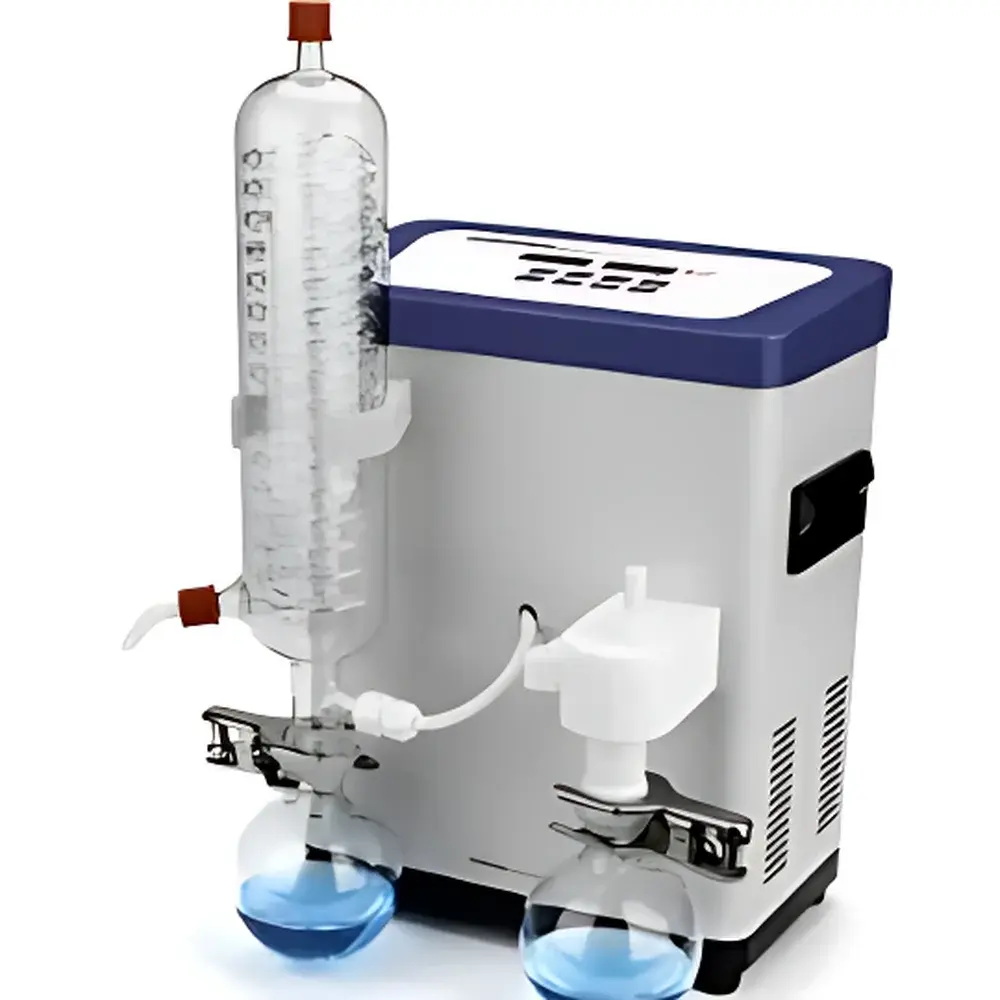
WIGGENS CSC 410 Corrosion-Resistant Solvent Recovery Vacuum System
| Brand | WIGGENS |
|---|---|
| Origin | Germany |
| Model | CSC 410 |
| Pump Type | Oil-Free Diaphragm Vacuum Pump |
| Max Vacuum Level | 13 mbar |
| Flow Rate Range | 10–95 L/min |
| Adjustable Vacuum Range | 2–30 mbar |
| Motor Power | 95 W |
| Weight | 16 kg |
| Inlet/Outlet Port OD | 10 mm |
| Compliance | CE, RoHS |
| Standard Configuration | ChemVak-CSC modular system with DVR380 digital vacuum controller, separator flask, condenser assembly, base plate with support rods, and corrosion-resistant tubing & fittings |
Overview
The WIGGENS CSC 410 Corrosion-Resistant Solvent Recovery Vacuum System is an integrated, oil-free diaphragm-based vacuum solution engineered for safe, precise, and chemically inert operation in demanding laboratory applications involving aggressive solvents, acidic vapors, alkaline fumes, or moisture-laden streams. Unlike traditional rotary vane or water-ring pumps, the CSC 410 employs a PTFE-coated diaphragm mechanism with EPDM and FKM elastomer seals—ensuring long-term resistance to halogenated hydrocarbons (e.g., chloroform, DCM), esters, ketones, alcohols, and strong inorganic acids (e.g., HCl, HNO₃) and bases (e.g., NaOH). Its core function is to generate and maintain stable vacuum levels between 2 and 30 mbar while enabling continuous solvent vapor condensation and recovery via an integrated, jacketed condenser and separator flask. This architecture supports gentle, controllable evaporation and distillation under reduced pressure—critical for thermally labile compounds, high-purity pharmaceutical intermediates, and moisture-sensitive organometallics.
Key Features
- Oil-free, maintenance-free diaphragm pump with chemically resistant wetted materials (PTFE diaphragm, FKM/EPDM valves and seals)
- Digital vacuum control via DVR380 controller: real-time display, setpoint regulation, multi-step programmable vacuum profiles, and unit switching (mbar, Torr, kPa, psi)
- Modular system design: pump, controller, separator flask, condenser, and mounting base are pre-aligned and factory-tested for leak-tight integration
- Integrated inlet buffer flask prevents liquid carryover and particulate ingress—protecting diaphragm integrity and extending service life
- Condenser assembly optimized for low-boiling-point solvents (bp < 100°C), including acetone, ethyl acetate, diethyl ether, and THF, with optional coolant circulation compatibility
- Quiet operation (<52 dB(A)) suitable for shared lab environments and laminar flow hoods
- CE-marked and RoHS-compliant; designed to meet IEC 61010-1 safety requirements for laboratory electrical equipment
Sample Compatibility & Compliance
The CSC 410 is validated for use with corrosive, volatile, and hazardous process streams encountered in synthetic chemistry, QC/QA laboratories, and pilot-scale purification workflows. It complies with ISO 8573-1:2010 Class 0 air purity standards for oil-free operation—eliminating risk of sample contamination from lubricant carryover. The system supports GLP/GMP-aligned documentation through DVR380’s audit-trail-capable logging (when connected to external data acquisition systems), and its vacuum stability (±0.5 mbar repeatability over 8-hour operation) meets ASTM E2912-22 requirements for controlled evaporation in method validation. Applications involving regulated substances (e.g., USP analytical instrument qualification) benefit from traceable vacuum setpoints and programmable ramp-hold sequences.
Software & Data Management
While the DVR380 controller operates as a standalone unit with intuitive membrane keypad and OLED display, it features analog output (0–10 V DC) and RS-232 interface for integration into centralized lab automation platforms (e.g., LabVantage, Thermo Fisher SampleManager). Vacuum setpoints, actual readings, elapsed time, and alarm status (e.g., overtemperature, condensate overflow) are exportable as CSV files. No proprietary software installation is required; configuration is performed directly on-device. For 21 CFR Part 11 compliance, third-party electronic lab notebook (ELN) systems may capture controller logs via timestamped serial polling—enabling full audit trail generation without modifying the embedded firmware.
Applications
- Routine and preparative rotary evaporation with solvent recovery (e.g., DCM, hexane, methanol)
- Vacuum-assisted crystallization and recrystallization of APIs under inert atmosphere
- Short-path and fractional distillation of heat-sensitive natural products
- Lyophilization pre-freeze and primary drying stage support (as auxiliary vacuum source)
- Filtration under reduced pressure for acid-digested environmental samples (EPA Method 3050B)
- Extraction and concentration of electroplating bath additives in semiconductor R&D
- Removal of residual solvents from polymer films and thin-film coatings prior to characterization
FAQ
What vacuum level accuracy does the DVR380 controller provide?
The DVR380 maintains setpoint accuracy within ±0.5 mbar across the 2–30 mbar range, verified per ISO 2533:2020 calibration protocols using traceable reference gauges.
Can the CSC 410 handle hydrogen chloride (HCl) gas streams?
Yes—its fully fluorinated wetted path (PTFE diaphragm, FKM valves, borosilicate glass separator) is rated for continuous exposure to saturated HCl vapor at ambient temperature and ≤20 mbar operating pressure.
Is the condenser compatible with dry ice/acetone cooling?
The standard jacketed condenser accepts circulating coolant only; for sub-ambient operation, a separate cryogenic condenser (e.g., WIGGENS CC-200) must be installed in-line upstream of the separator flask.
Does the system require periodic calibration?
The DVR380 vacuum sensor is factory-calibrated and retains NIST-traceable certification for 12 months; annual recalibration is recommended for GLP-regulated environments.
What maintenance intervals apply to the diaphragm pump?
No scheduled maintenance is required; the pump is rated for 15,000 hours MTBF under continuous operation at ≤70% of max flow capacity. Visual inspection of diaphragm integrity is advised every 6 months in high-duty-cycle applications.



