
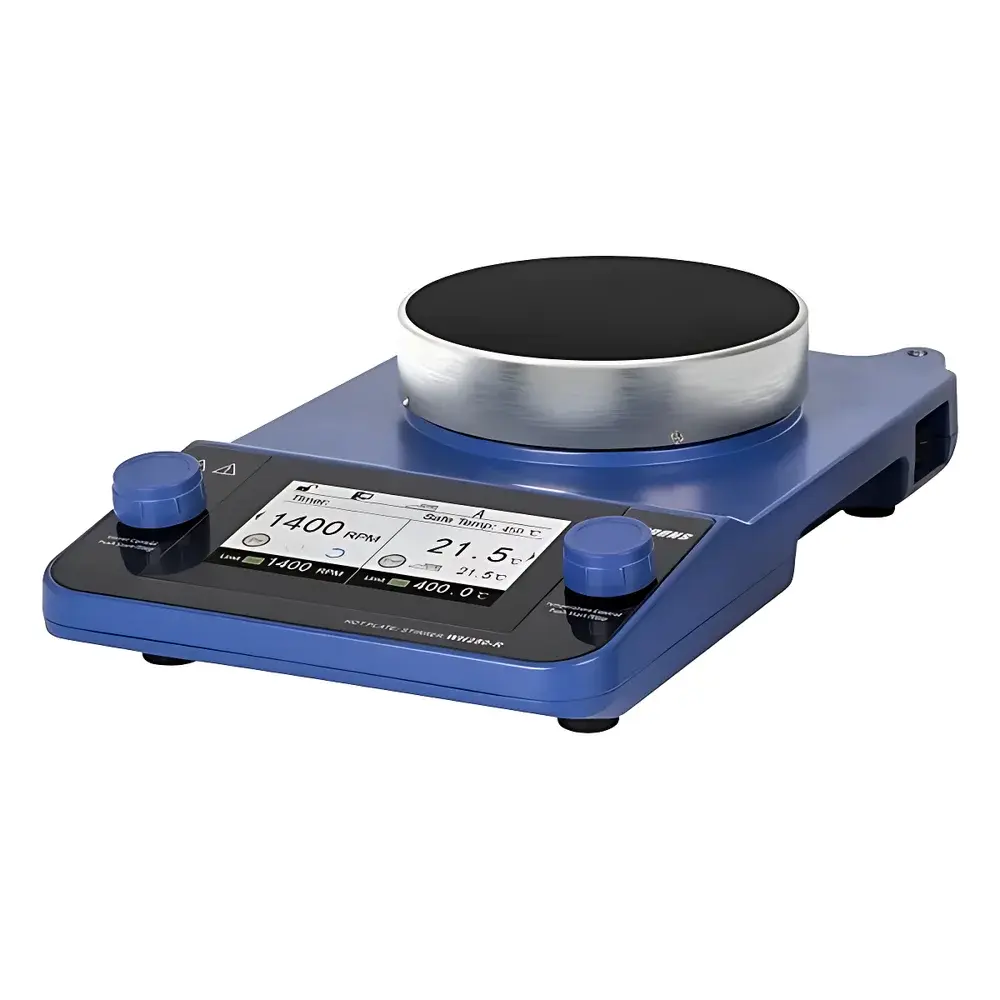
WIGGENS WH280-R High-Temperature Magnetic Stirrer with Integrated Heating and PID Temperature Control
| Brand | WIGGENS |
|---|---|
| Origin | Germany |
| Model | WH280-R |
| Maximum Stirring Volume | 20 L |
| Speed Range | 100–1500 rpm |
| Heating Temperature Range | 0–450 °C |
| Plate Material | Enamel-Coated Glass |
| Plate Diameter | Ø135 mm |
| Heating Power | 800 W |
| Temperature Stability (with Pt100) | ±1 °C |
| Over-Temperature Protection Range | 50–500 °C (adjustable) |
| Solution Over-Temp Offset | 10–50 °C (adjustable) |
| External Temperature Sensors | Pt100 probe + optional thermocouple |
| Interface | RS-232 & RS-485 |
| Timer Range | 00:01:00 to 99:59:00 or continuous |
| Dimensions (W×D×H) | 187 × 315 × 79 mm |
| Weight | 2.4 kg |
| Power Supply | 220 V / 50 Hz |
Overview
The WIGGENS WH280-R is a high-precision, high-temperature magnetic stirrer engineered for demanding laboratory applications requiring simultaneous precise heating and robust mechanical mixing. Unlike basic hotplates or standalone stirrers, the WH280-R integrates infrared-enhanced heating elements with a digitally controlled magnetic drive system—enabling stable thermal management and reproducible agitation across a wide operational envelope. Its core measurement and control architecture relies on closed-loop PID temperature regulation, supported by dual external sensing capability: a calibrated Pt100 resistance thermometer for accurate sample temperature feedback and an independent thermocouple for auxiliary safety monitoring. This dual-sensor architecture ensures compliance with GLP-aligned experimental traceability requirements, particularly in regulated environments where temperature deviation logging and over-temperature event recording are mandatory per internal SOPs or ISO/IEC 17025 guidelines.
Key Features
- Enamel-coated glass heating plate (Ø135 mm) offering chemical resistance, uniform heat distribution, and easy cleaning—ideal for acidic, alkaline, or organic solvent exposure.
- Intelligent ICC (Intelligent Current Control) stirring motor delivering consistent torque from 100 to 1500 rpm, with selectable clockwise or counterclockwise rotation for optimized suspension homogeneity or viscous media deaeration.
- High-resolution color touchscreen interface with rotary encoder knob—supporting intuitive parameter entry for temperature setpoint, speed, timer duration, and safety thresholds without menu nesting.
- Auto-recall function stores the last active configuration (temperature, speed, timer, protection offsets), reducing setup time for routine protocols and minimizing operator-induced variability.
- Integrated anti-spill liquid channel above the control panel—designed to contain accidental drips or condensate, preventing ingress into electronics and extending service life under humid or multi-step wet-lab conditions.
- Dual-stage thermal protection: primary cutoff via internal bimetallic switch at user-defined excess (50–500 °C), plus programmable solution over-temperature offset (10–50 °C above setpoint) to prevent thermal degradation of sensitive samples.
- RS-232 and RS-485 serial interfaces enable bidirectional communication with LIMS or SCADA systems—supporting remote parameter upload/download, real-time data streaming, and audit-trail generation compliant with FDA 21 CFR Part 11 when paired with validated software.
Sample Compatibility & Compliance
The WH280-R accommodates aqueous and non-aqueous media up to 20 L (water-equivalent volume), with verified thermal stability of ±1 °C when operated with a calibrated Pt100 sensor immersed directly in the sample vessel. Its enamel-glass surface resists corrosion from common reagents including HCl (≤6 M), NaOH (≤2 M), ethanol, acetone, and DMF—making it suitable for synthesis, dissolution testing (per USP ), and buffer preparation workflows. The unit meets IEC 61010-1:2010 safety standards for laboratory electrical equipment and carries CE marking for EMC and low-voltage directive compliance. Optional calibration certificates (traceable to DKD/DAkkS standards) are available for users operating under ISO/IEC 17025-accredited quality systems.
Software & Data Management
While the WH280-R operates autonomously via its embedded firmware, its RS-232/RS-485 ports support integration with third-party laboratory automation platforms—including LabVIEW, MATLAB, or custom Python-based control scripts using Modbus RTU protocol. Logged parameters (actual temperature, setpoint, RPM, elapsed time, fault codes) can be timestamped and exported as CSV files for post-run analysis. When deployed in GxP-regulated settings, the device supports electronic signature-enabled configuration locking and change history tracking when interfaced with validated middleware that enforces 21 CFR Part 11 audit trails, including user authentication, action timestamps, and immutable record retention.
Applications
- Controlled-temperature synthesis reactions (e.g., esterification, condensation, nanoparticle precipitation) requiring sustained heating above 300 °C with homogeneous mixing.
- Dissolution testing of pharmaceutical dosage forms per USP apparatus II, where precise bath temperature maintenance (±0.2 °C) and paddle stability are critical.
- Preparation of high-viscosity polymer solutions, catalyst slurries, or colloidal dispersions where variable-speed agitation prevents sedimentation without shear-induced degradation.
- Calibration of reference thermometers and validation of thermal profiles in jacketed reactors or incubators.
- Long-duration stability studies involving accelerated aging protocols at elevated temperatures (e.g., 40–450 °C) with uninterrupted agitation cycles exceeding 24 hours.
FAQ
Does the WH280-R support external temperature feedback for closed-loop control?
Yes—it accepts input from a standard Pt100 sensor (supplied) for direct sample temperature regulation, enabling true process-relevant thermal control rather than plate-surface approximation.
Can the unit operate continuously for extended periods?
Yes—the WH280-R is rated for continuous duty cycling; its sealed enclosure, thermally isolated electronics, and redundant thermal cutoffs ensure safe unattended operation up to 99 hours 59 minutes or indefinitely in continuous mode.
Is the enamel-glass plate resistant to thermal shock?
The plate is designed for rapid heating and cooling within its specified range (0–450 °C); however, direct contact with sub-zero cryogenic vessels or sudden immersion in cold liquids is not recommended and may compromise coating integrity.
What safety certifications does the WH280-R carry?
It complies with IEC 61010-1:2010 (Safety Requirements for Electrical Equipment for Measurement, Control, and Laboratory Use) and bears CE marking for conformity with EU electromagnetic compatibility (2014/30/EU) and low-voltage (2014/35/EU) directives.
How is calibration verification performed?
Users may perform in-house verification using NIST-traceable reference thermometers and tachometers; WIGGENS also offers factory calibration services with DKD/DAkkS-certified documentation upon request.



