
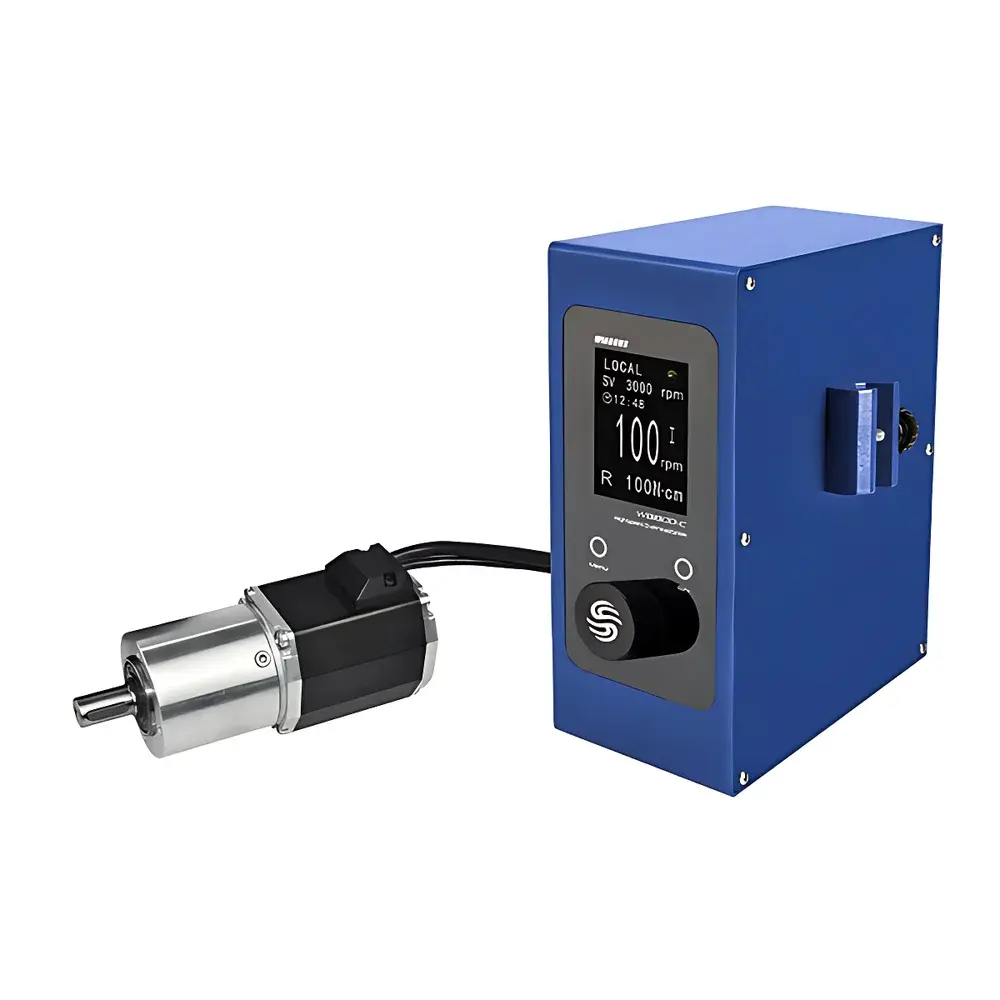
WIGGENS WB3000-C & WB1800-C Separated High-Torque High-Speed Laboratory Stirrers
| Brand | WIGGENS |
|---|---|
| Origin | Germany |
| Model | WB3000-C / WB1800-C |
| Maximum Stirring Volume | 100 L |
| Speed Range | 20–3000 rpm |
| Torque | ≤1320 N·cm (WB1800-C), ≤330 N·cm (WB3000-C) |
| Continuous Rated Torque | 188 N·cm (WB1800-C), 47 N·cm (WB3000-C) |
| Viscosity Range | ≤150,000 cP (WB1800-C), ≤100,000 cP (WB3000-C) |
| Control Accuracy | ±1 rpm |
| Motor Type | Brushless DC |
| Input/Output Power | 150 W |
| Motor Dimensions (W×D×H) | 65×65×216 mm (WB1800-C), 65×65×157 mm (WB3000-C) |
| Motor Weight | 2.3 kg (WB1800-C), 1.8 kg (WB3000-C) |
| Interface | USB 2.0, 0–10 V analog input/output, 0–20 mA analog input, footswitch port |
Overview
The WIGGENS WB3000-C and WB1800-C are industrial-grade, separated high-performance laboratory stirrers engineered for demanding mixing, dispersion, and homogenization tasks in R&D, QC, and pilot-scale production environments. Unlike conventional magnetic or overhead stirrers, these units employ a modular architecture—decoupling the motor head from the electronic controller—to enable safe, flexible integration into fume hoods, biosafety cabinets, gloveboxes, and custom reactor systems. The core actuation relies on brushless DC motors paired with sealed planetary gear reducers, delivering exceptional torque density, thermal stability, and long-term operational reliability without lubrication or routine maintenance. Each model is purpose-optimized: the WB1800-C emphasizes high-torque low-to-mid-speed operation (20–800 rpm, up to 1320 N·cm peak torque), ideal for viscous polymer solutions, pastes, and suspension polymerization; the WB3000-C prioritizes high-speed precision (70–3000 rpm, up to 330 N·cm), suited for rapid emulsification, nanoparticle dispersion, and low-viscosity turbulent mixing. Both models feature closed-loop speed regulation via real-time current feedback, ensuring consistent rotational velocity regardless of load fluctuations—a critical requirement for reproducible shear history in rheologically complex systems.
Key Features
- Modular separated design: Motor unit and controller operate independently, enabling remote placement of the motor inside containment enclosures while retaining full digital control from outside.
- Brushless DC motor with integrated sealed planetary gearbox: Delivers quiet (20,000 hours of continuous service life.
- Real-time torque monitoring and display: Digital readout of instantaneous motor torque (in N·cm) allows direct assessment of process resistance, aiding in endpoint detection and batch consistency verification.
- Precision speed control: ±1 rpm accuracy across full range, supported by microprocessor-based PID regulation and dynamic current compensation to maintain setpoint under variable viscosity loads.
- Multi-interface connectivity: Standard USB 2.0 port for PC communication with programmable control software; optional analog I/O (0–10 V input/output, 0–20 mA input) for PLC integration or external process synchronization.
- Extended cable options: Factory-configurable motor-controller cables (1.5 m, 3 m standard, 6 m or 10 m optional) facilitate ergonomic and safety-compliant system layout.
- TFT touchscreen controller: Intuitive graphical interface with password-protected parameter locking, multi-step program storage, and runtime logging.
Sample Compatibility & Compliance
These stirrers accommodate vessels from 50 mL beakers to 100 L jacketed reactors using standardized clamping adapters (e.g., ISO-KF, DIN 1588, or custom flange mounts). Compatible with PTFE, glass, stainless steel, and Hastelloy stirring shafts and impellers—including anchor, helical ribbon, turbine, and disperser types—enabling optimization for Newtonian and non-Newtonian fluids. The aluminum motor housing provides passive thermal management, maintaining stable internal temperatures during prolonged high-load operation. Units comply with IEC 61000-6-3 (EMC emission) and IEC 61000-6-2 (immunity), and meet CE marking requirements for laboratory equipment. While not intrinsically rated for hazardous areas, their separated architecture supports integration into ATEX-certified systems when installed per manufacturer-specified mounting and grounding protocols. Designed for GLP/GMP-aligned workflows, audit trails (via USB log export) and parameter lockout support data integrity requirements under FDA 21 CFR Part 11 when used with validated software configurations.
Software & Data Management
The included Windows-compatible control software enables full remote operation, including real-time speed/torque plotting, multi-segment ramp-hold programs, and event-triggered data capture. All parameter changes and operational events (start/stop, overload alerts, direction reversal) are timestamped and exportable as CSV or XML for traceability. Software supports automated calibration file loading and user-defined alarm thresholds (e.g., torque >95% max for 5 s triggers audible alert and pause). USB interface conforms to CDC ACM class, requiring no proprietary drivers. For enterprise deployment, the analog I/O ports allow seamless integration into SCADA or LabVantage environments, enabling centralized monitoring and SOP-driven execution without manual intervention.
Applications
- Chemical synthesis: Controlled addition and mixing in exothermic Grignard or lithiation reactions within cooled reactors.
- Pharmaceutical formulation: Homogenization of ointments, gels, and suspensions under ISO 14644-1 Class 5 containment.
- Materials science: Dispersion of carbon nanotubes or graphene in polymer matrices at controlled shear rates.
- Food & cosmetics: Emulsification of mayonnaise, creams, and liposomal delivery systems requiring precise energy input.
- Biotechnology: Agitation of high-density microbial cultures in single-use bioreactors with minimal foaming.
- Quality control: Reproducible viscosity benchmarking per ASTM D2196 or ISO 2555 using standardized spindle geometries.
FAQ
What distinguishes the WB1800-C from the WB3000-C in practical use?
The WB1800-C is optimized for high-torque, low-to-medium speed applications (20–800 rpm) with peak torque up to 1320 N·cm—ideal for highly viscous materials such as silicone elastomers or battery electrode slurries. The WB3000-C targets high-speed, lower-viscosity processes (70–3000 rpm) with enhanced rotational stability at elevated speeds, making it suitable for nano-emulsions and fine particle deagglomeration.
Can these stirrers be integrated into automated reactor platforms?
Yes—both models support analog I/O (0–10 V, 0–20 mA) and USB communication, allowing bidirectional control and data exchange with common lab automation frameworks (e.g., DeltaV, LabVIEW, or custom Python-based orchestration).
Is torque measurement traceable to national standards?
Torque values are derived from calibrated motor current and known gear reduction ratios. While not NIST-traceable out-of-box, users may perform in-house verification using certified torque transducers per ISO 376 procedures.
What safety certifications apply to operation inside biosafety cabinets?
The separated design inherently reduces electrical risk. When installed with properly grounded, shielded cabling and mounted per EN 61326-1, the motor unit meets requirements for Class II B2 cabinet integration without compromising airflow integrity or operator protection.



