
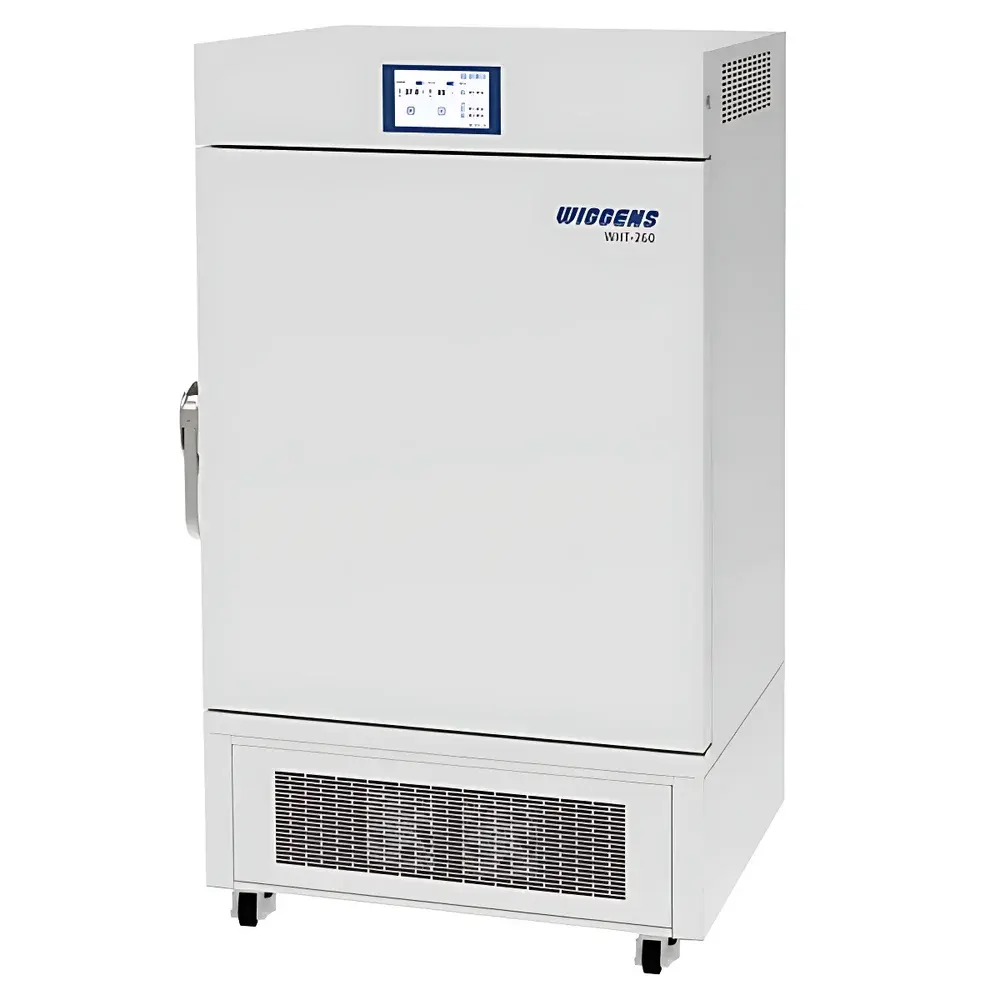
WIGGENS WHT-260 Temperature and Humidity Controlled Chamber
| Brand | WIGGENS |
|---|---|
| Origin | Germany |
| Model | WHT-260 |
| Instrument Type | Upright Chamber |
| Temperature Range | +4 to +60 °C |
| Humidity Range | 10–85 %RH (at 25–55 °C) |
| Temperature Uniformity | < ±0.5 °C |
| Temperature Fluctuation | ±0.1 °C |
| Humidity Uniformity | < ±3 %RH |
| Humidity Fluctuation | ±1 %RH |
| Internal Dimensions (W×D×H) | 640 × 500 × 800 mm |
| Internal Volume | 260 L |
| Construction | 304 Stainless Steel Interior |
| Insulation | Eco-friendly rigid polyurethane foam |
| Heating Power | 1350 W |
| Compressor Cooling Power | 550 W |
| Interface | RS232/RS485 |
| Weight | 175 kg |
Overview
The WIGGENS WHT-260 Temperature and Humidity Controlled Chamber is a precision-engineered environmental test system designed for stable, repeatable simulation of climatic conditions in laboratory and quality assurance settings. Based on a dual-loop PID control architecture, it integrates independent refrigeration and humidification subsystems with forced-air convection to maintain tightly specified thermal and hygroscopic profiles across its 260 L stainless steel working chamber. Unlike basic incubators or dry ovens, the WHT-260 employs an outer jacketed cooling/heating system—surrounding the entire inner cavity—to minimize thermal lag and improve response time during setpoint transitions. Its operational envelope spans +4 to +60 °C at humidity levels from 10 to 85 %RH (conditioned within the 25–55 °C temperature band), enabling compliance with standardized environmental stress testing protocols used in materials science, pharmaceutical stability studies (ICH Q1A–Q1E), electronics reliability validation (JEDEC JESD22-A110), and accelerated aging assessments per ISO 11783-12 and ASTM D4332.
Key Features
- Robust construction with 304 stainless steel interior and high-density eco-friendly polyurethane insulation (non-outgassing, zero VOC emission)
- Independent compressor-based refrigeration and ultrasonic humidification systems for decoupled, high-fidelity control of temperature and relative humidity
- Forced-air circulation with adjustable fan speed ensures uniform temperature distribution (< ±0.5 °C) and humidity homogeneity (< ±3 %RH) throughout the chamber volume
- Dual-channel digital PID controller with 0.1 °C and 1 %RH resolution, supporting ramp-hold programming and multi-step profile execution
- Integrated safety architecture including overtemperature cutoff, overcurrent protection, door-open interlock (fan & heater disable + visual alarm), and auto-restart (Autostart) with user-selectable resume/stop behavior after power interruption
- Mobility and ergonomics: Leveling feet plus four lockable casters for flexible lab integration; external dimensions (820 × 752 × 1485 mm) accommodate standard laboratory corridors and service aisles
- Standard communication interface: RS232/RS485 port compliant with Modbus RTU protocol for remote monitoring, data logging, and integration into LIMS or MES environments
Sample Compatibility & Compliance
The WHT-260 accommodates diverse sample geometries via up to nine configurable stainless steel shelves (standard: two load-rated at 30 kg each). Its inert 304 SS interior and low-particulate insulation make it suitable for cleanroom-adjacent applications, including packaging permeability testing (ASTM F1249), polymer moisture absorption kinetics (ISO 62), textile conditioning (ISO 139), and electronic component preconditioning (IPC-J-STD-033). The chamber meets CE marking requirements under the EU Machinery Directive 2006/42/EC and Electromagnetic Compatibility Directive 2014/30/EU. While not certified as Class II medical device equipment, its control stability and audit-ready operation support GLP-compliant workflows when paired with validated calibration procedures and electronic logbook software.
Software & Data Management
Equipped with factory-default firmware supporting real-time parameter display, event logging (door openings, alarms, setpoint changes), and timestamped CSV export via RS232/485. When interfaced with third-party SCADA or LabVIEW-based acquisition platforms, the WHT-260 enables full traceability—including operator ID, environmental deviations, and maintenance alerts—in alignment with FDA 21 CFR Part 11 requirements for electronic records. Optional PC software (sold separately) provides graphical trend analysis, deviation reporting, and automated PDF report generation compatible with ISO/IEC 17025 documentation frameworks.
Applications
- Stability testing of pharmaceuticals, biologics, and medical devices per ICH guidelines
- Conditioning of plastics, composites, and elastomers prior to tensile, impact, or creep testing (ASTM D618, ISO 291)
- Accelerated corrosion testing of coated metals (ASTM D2247)
- Electronic component burn-in and humidity exposure screening (MIL-STD-810H Method 507.6)
- Food product shelf-life modeling under controlled hygrothermal stress
- Calibration and verification of portable hygrometers and thermometers in metrology labs
FAQ
What is the maximum allowable ambient temperature for continuous operation?
The WHT-260 is rated for use in rooms maintained between 10 and 35 °C. Operation outside this range may compromise cooling efficiency and long-term compressor reliability.
Is the humidity system self-contained, or does it require external water supply?
It features an integrated 3.5 L reservoir with automatic level detection and refill alert; no continuous tap connection is required.
Can the chamber be validated for GxP environments?
Yes—its stable control performance, digital audit trail capability, and mechanical design allow IQ/OQ/PQ qualification when executed using documented protocols and NIST-traceable reference sensors.
Are additional shelves available as accessories?
Up to seven extra shelves (part number W6045260-SH) can be ordered; all are 304 SS, load-rated to 30 kg, and fully compatible with the existing mounting rail system.
Does the unit include a built-in printer or USB port?
No—data output is exclusively via RS232/RS485. Local printing requires external hardware or host PC-based logging solutions.



