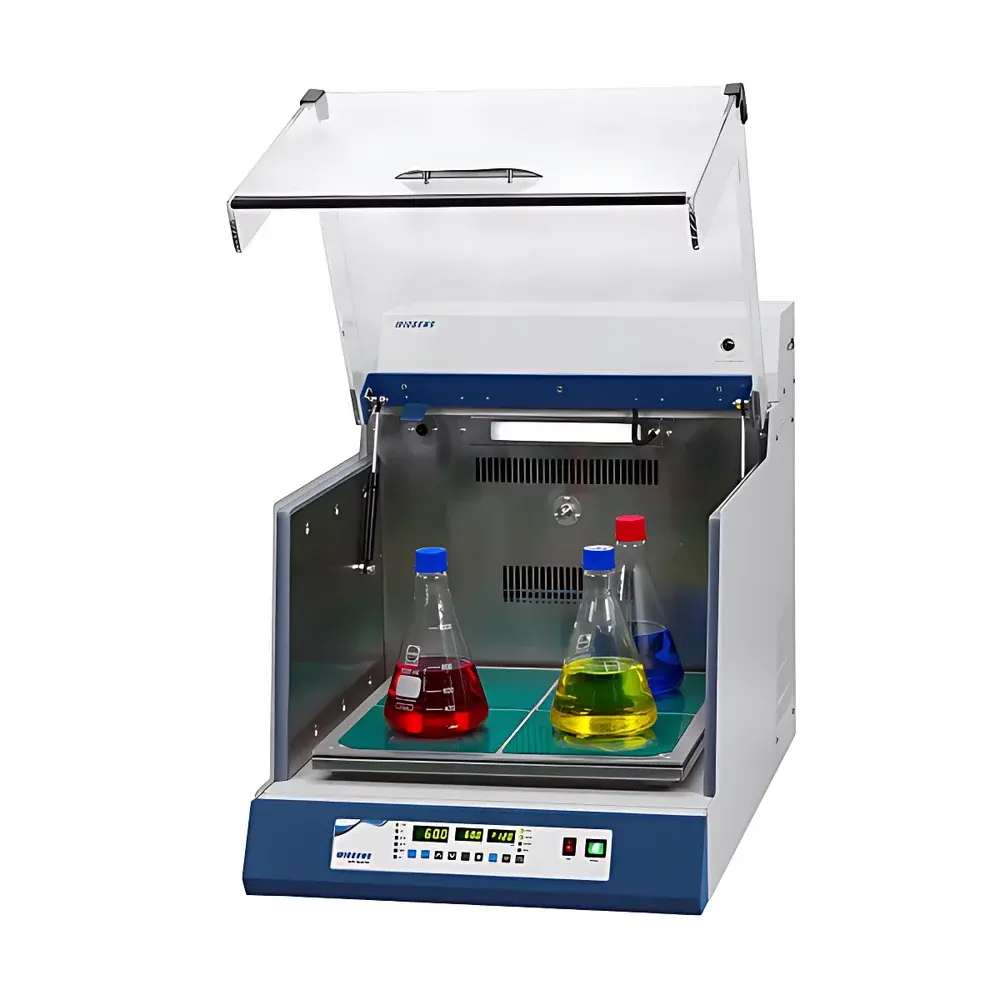
WIGGENS WS-300R Temperature-Controlled Orbital Shaker Incubator
| Brand | WIGGENS |
|---|---|
| Origin | Germany |
| Model | WS-300R |
| Timing Range | 10 sec – 999 hr 59 min 59 sec |
| Oscillation Frequency | 30–300 rpm |
| Orbit Amplitude | 20 / 30 (standard) / 40 mm |
| Temperature Range | 15–60 °C |
| Platform Quantity | 1 |
| Temperature Accuracy | ±0.1 °C (at 38 °C) |
| Temperature Uniformity | ±1.0 °C (at 38 °C) |
| Platform Size | 350 × 350 mm |
| Internal Chamber Dimensions | 410 × 410 × 320 mm |
| Net Weight | 74 kg |
| Max Load Capacity | 10 kg |
| Heating Power | 600 W |
| Speed Accuracy | ±1 rpm (at 150 rpm) |
| Control System | PID-regulated touchscreen interface with programmable multi-step protocols |
Overview
The WIGGENS WS-300R is a precision-engineered temperature-controlled orbital shaker incubator designed for reproducible, long-term cultivation of microbial, mammalian, and insect cell cultures under tightly regulated thermal and mechanical conditions. Operating on the principle of controlled orbital motion—where the platform rotates in a circular path at a defined radius—the instrument ensures uniform oxygen transfer and suspension homogeneity across culture vessels without shear-induced damage typical of reciprocating or vortex agitation. Its integrated Peltier-free resistive heating system, combined with high-resolution PID feedback control, maintains chamber temperatures within ±0.1 °C at setpoint (measured at 38 °C), while spatial uniformity remains within ±1.0 °C across the full working volume. The unit is certified to meet IEC 61010-1 safety standards for laboratory equipment and complies with electromagnetic compatibility (EMC) requirements per EN 61326-1, ensuring stable operation in shared instrumentation environments.
Key Features
- Orbital motion with selectable amplitude options (20 mm, 30 mm standard, 40 mm) to optimize mixing efficiency for diverse vessel types—from Erlenmeyer flasks to deep-well microplates.
- Brushless DC motor drive delivering consistent rotational speed across load ranges (30–300 rpm, ±1 rpm accuracy at 150 rpm), eliminating carbon wear and enabling >20,000 hours of maintenance-free operation.
- Multi-mode programmability: users may define sequences comprising clockwise rotation, counterclockwise rotation, pause intervals, and timed termination—each step assignable with independent duration (10 sec to 999 hr 59 min 59 sec).
- Intelligent load compensation algorithm dynamically adjusts motor torque to sustain constant orbital velocity regardless of vessel mass distribution (up to 10 kg).
- Safety interlocks include automatic shutoff of shaking and fan upon door opening, overtemperature alarm with audible alert and heater disablement, and configurable power-resume behavior (auto-restart or auto-hold) following unexpected mains interruption.
- Front-panel capacitive touch interface with intuitive icon-based navigation and real-time display of actual vs. setpoint values for both temperature and rpm.
Sample Compatibility & Compliance
The WS-300R accommodates standard labware via interchangeable platforms—including universal spring-clamp plates, rubber-matted trays, separatory funnel holders, microtube racks, microplate clamps, and adhesive mounting pads—ensuring secure retention of vessels ranging from 15 mL conical tubes to 5 L baffled flasks. Its internal chamber (410 × 410 × 320 mm) supports ISO Class 5-compatible workflows when used in conjunction with laminar flow hoods. The device meets essential regulatory prerequisites for GLP-compliant bioprocess development: audit-trail-capable event logging (optional firmware upgrade), temperature deviation alerts, and traceable calibration records aligned with ISO/IEC 17025 metrological practices. While not FDA 21 CFR Part 11–certified out-of-the-box, its data export functionality (via USB) supports integration into validated LIMS or ELN systems requiring raw time-series datasets.
Software & Data Management
The WS-300R operates autonomously via embedded firmware with non-volatile memory retaining up to 20 user-defined protocols. Time-stamped operational logs—including start/stop timestamps, temperature excursions, speed deviations, and fault codes—are stored internally and exportable as CSV files for post-experiment analysis. Optional PC connectivity (RS-232 or USB-to-serial adapter) enables remote monitoring and parameter adjustment using WIGGENS’ proprietary LabControl Suite v3.x, which supports batch protocol deployment, real-time graphing, and automated report generation compliant with ISO 9001 documentation requirements. All firmware updates are delivered as digitally signed binaries to ensure integrity and version traceability.
Applications
This incubator shaker serves critical functions across academic, pharmaceutical, and industrial life science laboratories. It is routinely deployed in aerobic bacterial fermentation (e.g., E. coli protein expression), yeast propagation for biomanufacturing, suspension-adapted CHO cell expansion, enzymatic reaction kinetics under controlled thermal agitation, solubility profiling of APIs, and microbiological assay preparation per USP sterility testing guidelines. Its precise amplitude and temperature coupling make it especially suitable for studies requiring correlation between metabolic rate and dissolved oxygen saturation—such as respiratory quotient (RQ) determination in metabolic phenotyping assays.
FAQ
What is the maximum flask size compatible with the WS-300R’s standard platform?
The 350 × 350 mm platform supports up to two 2.8 L baffled flasks or four 1 L flasks when using appropriate spring clamps.
Does the unit support external temperature probe input for chamber validation?
No—temperature sensing is performed exclusively via internal PT100 sensor; however, third-party calibrated probes may be placed inside the chamber for independent verification during IQ/OQ qualification.
Can multiple WS-300R units be synchronized for parallel runs?
Not natively; each unit operates independently, though identical protocols can be duplicated across devices using exported configuration files.
Is the heating system suitable for sub-ambient operation?
No—the WS-300R provides only heating functionality (15–60 °C range); refrigerated variants (e.g., WS-300RC) require separate ordering.
How often does the system require recalibration?
Annual calibration is recommended per ISO/IEC 17025; temperature and speed sensors should be verified using NIST-traceable references before critical validation campaigns.