
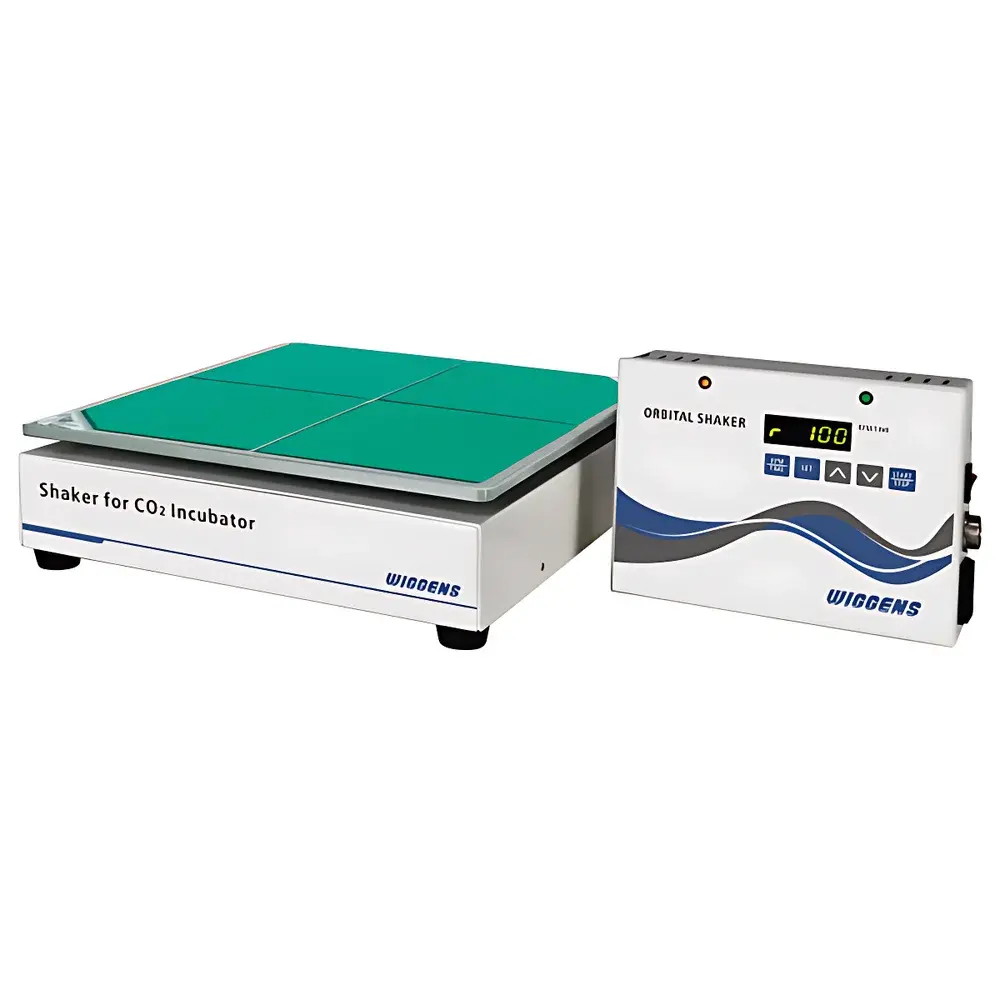
WIGGENS SRC CO₂ Incubator-Compatible Orbital Shaker
| Brand | WIGGENS |
|---|---|
| Origin | Germany |
| Model | SRC |
| Drive Type | Electromagnetic Induction |
| Oscillation Mode | Orbital (Reciprocating Optional) |
| Speed Range | 30–300 rpm |
| Increment | ±1 rpm |
| Amplitude | 25 mm (standard), 50 mm (optional) |
| Timer Range | Continuous or 0–99 h 59 min |
| Timer Increment | 1 min |
| Platform Dimensions | 300 × 330 mm |
| Max Load Capacity | 100 mL × 16 / 250 mL × 9 / 500 mL × 5 / 1000 mL × 4 / 2000 mL × 1 |
| Power Supply | 100–240 V, 50/60 Hz |
| IP Rating | IPX4-equivalent (moisture-resistant design) |
| Compliance | Designed for ISO 13485-aligned lab environments |
Overview
The WIGGENS SRC CO₂ Incubator-Compatible Orbital Shaker is an engineered solution for precise, thermally neutral agitation of cell cultures within controlled-environment incubators. Unlike conventional motor-driven shakers, the SRC employs electromagnetic induction drive technology—eliminating mechanical brushes, gearboxes, and direct heat-generating components from the incubator chamber. This architecture ensures zero conductive or convective thermal load on the internal incubator environment, preserving setpoint accuracy of temperature (±0.1 °C) and CO₂ concentration (±0.1% v/v) during extended cultivation periods. Its low-profile, sealed platform integrates directly beneath standard incubator shelves or inside custom-fit enclosures, enabling continuous orbital motion (25 mm standard amplitude) at speeds from 30 to 300 rpm—optimized for suspension cultures, microbial growth, and adherent cell passaging under physiological gas conditions.
Key Features
- Thermally Isolated Electromagnetic Drive: Coil assembly and actuation electronics are fully potted in epoxy resin, preventing condensation-induced failure and eliminating heat transfer into the incubator chamber.
- External Remote Control Unit: A compact, magnet-mountable controller (155 × 95 × 25 mm, 0.5 kg) displays real-time speed, timer status, and operational mode—accessible without opening the incubator door, minimizing CO₂ loss and thermal perturbation.
- Incubator-Grade Sealing Interface: Thin-diameter, flexible cable passes through standard glass-sealed incubator ports (e.g., 6–12 mm diameter) without compromising chamber integrity or requiring internal power outlets.
- Dual-Amplitude Configuration: Standard 25 mm orbital displacement supports most mammalian suspension cultures; optional 50 mm amplitude accommodates high-viscosity media or dense microbial inocula.
- Microprocessor-Controlled Stability: Closed-loop feedback maintains speed accuracy within ±1 rpm across load variations up to 8.5 kg (2000 mL max capacity), independent of ambient humidity or voltage fluctuation (100–240 V, 50/60 Hz).
Sample Compatibility & Compliance
The SRC accommodates common sterile culture formats—including flasks (T25 to T225), deep-well plates (96-/384-well), roller bottles, and custom bioreactor vessels—via its 300 × 330 mm stainless-steel platform with non-slip silicone mat interface. All wetted surfaces comply with USP Class VI biocompatibility standards. The device is designed for use in ISO 13485-certified manufacturing environments and aligns with Good Laboratory Practice (GLP) requirements for traceable parameter logging. While the SRC itself does not generate electronic records, its remote controller output signals can be integrated into validated data acquisition systems compliant with FDA 21 CFR Part 11 when paired with appropriate middleware.
Software & Data Management
The SRC operates via embedded firmware with no onboard software stack; all configuration and monitoring occur through the physical remote controller’s LED interface. For laboratories requiring digital integration, analog voltage outputs (0–10 V) corresponding to speed and timer status are accessible via terminal block on the controller unit—enabling connection to PLCs, SCADA systems, or LIMS platforms for centralized logging. Audit trails (e.g., start/stop timestamps, speed changes) must be manually recorded or captured externally; no internal memory or timestamped event log is provided per design intent—prioritizing electromagnetic compatibility and thermal neutrality over digital functionality.
Applications
- Mammalian cell line expansion in CO₂-controlled suspension bioreactors
- Hybridoma culture and monoclonal antibody production under physiological O₂/CO₂
- Stem cell differentiation assays requiring sustained, low-shear orbital motion
- Microbial fermentation kinetics studies where temperature stability dictates metabolic reproducibility
- High-throughput drug screening using 96-well plates under normoxic/hypoxic incubation
- Transfection efficiency optimization via controlled agitation during plasmid uptake phase
FAQ
Can the SRC be installed inside a hypoxia workstation?
Yes—the absence of internal power conversion and brushless electromagnetic drive makes it suitable for nitrogen- or argon-purged environments, provided the external controller remains outside the anaerobic chamber.
Is calibration documentation available?
WIGGENS provides factory calibration certificates (traceable to DIN EN ISO/IEC 17025) upon request; field recalibration requires torque-speed verification using a certified tachometer and inertial load test.
Does the device support RS-232 or USB communication?
No—communication is intentionally limited to LED display and analog voltage outputs to maintain EMI immunity and simplify validation in regulated labs.
What maintenance is required?
No scheduled maintenance is specified; periodic visual inspection of the epoxy-coated coil housing and cleaning of the platform surface with 70% ethanol is recommended.
Can multiple SRC units be synchronized?
Synchronization is not natively supported; each unit operates independently. Phase-matched operation requires external TTL triggering via the analog control interface, subject to user-developed timing logic.



