WIGGENS WCI-850CH / WCI-650CH CO₂ Incubated Orbital Shaker
| Key | Brand: WIGGENS |
|---|---|
| Origin | Germany |
| Model | WCI-850CH / WCI-650CH |
| Timer Range | 1 min – 99 h 59 min |
| Oscillation Speed | 30–300 rpm |
| Amplitude | 25 mm |
| Temperature Range | Ambient +5°C to 60°C |
| Number of Shaking Platforms | 3 |
| CO₂ Range | 0–20% (±0.3% accuracy at 5% @ 37°C) |
| Humidity | ≥70% RH (@ 37°C) |
| Chamber Volume | 650 L / 850 L |
| Heating System | Air-jacketed, 6-point PID-controlled |
| Sensor Type | Dual-beam infrared CO₂ sensor |
| Filtration | HEPA-grade sterile air filter |
| UV Sterilization | 4 W UV-C lamp |
| Construction | 304 stainless steel interior and track system |
| Compliance | Designed for GLP/GMP-aligned cell culture workflows |
Overview
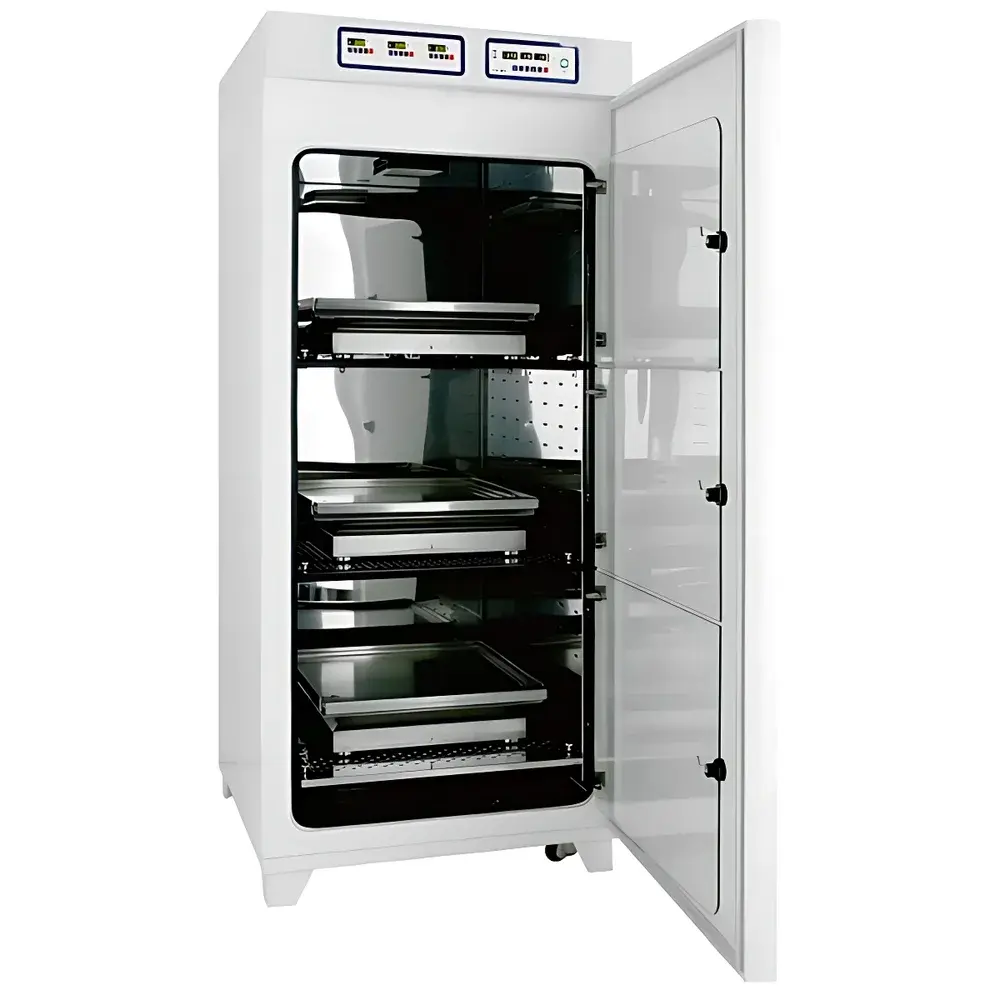
The WIGGENS WCI-850CH and WCI-650CH CO₂ Incubated Orbital Shakers are precision-engineered life science instruments designed for scalable, contamination-controlled suspension culture of mammalian and insect cells under physiologically relevant conditions. Unlike conventional incubators or standalone shakers, these systems integrate three independently controlled orbital shaking platforms within a single, unified CO₂-regulated chamber—enabling parallel experiments with distinct agitation parameters while maintaining tight environmental control across all zones. The system operates on the principle of orbital motion (25 mm diameter), generating uniform shear profiles essential for high-density suspension cultures of sensitive eukaryotic lines such as CHO, HEK293, and HeLa. Dual-beam infrared CO₂ sensing ensures rapid, drift-free gas concentration monitoring and feedback-driven regulation, while six-point air-jacketed heating with PID algorithms delivers ±1°C temperature uniformity at 37°C—critical for reproducible metabolic activity and protein expression.
Key Features
- Triple-zone architecture: Three physically isolated compartments, each equipped with an independent orbital drive unit, glass observation door, and dedicated control interface—minimizing cross-contamination risk and enabling heterogeneous experimental setups (e.g., different cell lines, media formulations, or agitation speeds).
- Magnetic drive technology: Fully enclosed induction coil motor eliminates mechanical wear, heat generation, and external vibration transmission—ensuring long-term operational stability and reducing thermal load on cultured samples.
- GMP-compliant construction: Interior chamber, platform tracks, and shelving fabricated from electropolished 304 stainless steel; resistant to corrosion under high-humidity CO₂ environments and compatible with standard autoclaving and hydrogen peroxide vapor (HPV) decontamination protocols.
- Integrated sterilization: 4 W UV-C lamp positioned adjacent to the recirculation fan provides continuous or on-demand air-phase disinfection; HEPA-grade particulate filter ensures >99.97% removal efficiency for particles ≥0.3 µm in the internal airflow loop.
- Intelligent environmental recovery: Automatic oscillation pause upon door opening in any zone; full resumption of setpoint conditions—including CO₂, temperature, and humidity—within ≤3 min after door closure.
- Modular platform design: Each 520 × 520 mm stainless steel tray is fully extractable via low-friction rails; upper two tiers can be reconfigured to accommodate large-volume vessels (e.g., 5 L or 10 L Fernbach flasks) by removing one shelf.
Sample Compatibility & Compliance
The WCI series supports a wide range of culture vessels including Erlenmeyer flasks (100–2000 mL), deep-well microplates, roller bottles, and custom bioreactor bags mounted on rigid carriers. Maximum loading capacity per zone is configurable: up to 156 × 100 mL, 90 × 250 mL, 60 × 500 mL, 48 × 1000 mL, or 9 × 2000 mL flasks—at 150 rpm. All materials contacting the sample environment meet USP Class VI biocompatibility standards. The system’s architecture aligns with ISO 13408-1 (aseptic processing), ASTM E2500 (user requirement specification for pharmaceutical equipment), and FDA 21 CFR Part 11-ready data logging when paired with optional compliant software modules. Built-in audit trail functionality records operator actions, parameter changes, alarm events, and door openings—supporting GLP and GMP documentation requirements.
Software & Data Management
The front-panel LED interface provides real-time display of temperature (0.1°C resolution), CO₂ concentration (% v/v), relative humidity (% RH), oscillation speed (rpm), amplitude (fixed at 25 mm), and elapsed timer. Optional Ethernet or RS-485 connectivity enables integration into centralized laboratory information management systems (LIMS) or SCADA networks. Data export (CSV format) includes timestamped environmental logs with metadata tagging per zone. Firmware supports password-protected user roles (Operator, Supervisor, Administrator) and configurable alarm thresholds with relay outputs for external notification systems. All configuration changes are logged with user ID, timestamp, and pre-/post-values—meeting ALCOA+ data integrity principles.
Applications
- Monoclonal antibody production using CHO suspension cultures under controlled pH and dissolved oxygen proxies (via CO₂ setpoint modulation).
- Transient transfection optimization for recombinant protein expression in HEK293 cells across variable shear regimes.
- 3D spheroid formation assays requiring precise agitation to prevent aggregation while maintaining nutrient homogeneity.
- Microbial consortia studies where differential growth kinetics necessitate independent agitation control per compartment.
- Bioprocess development workflows transitioning from shake flask to benchtop bioreactor—leveraging identical orbital dynamics and environmental baselines.
- Stem cell expansion protocols demanding strict avoidance of metal ion leaching and endotoxin accumulation—enabled by 304 SS wetted parts and UV/HEPA air sanitation.
FAQ
What is the difference between the WCI-650CH and WCI-850CH models?
The primary distinction lies in internal chamber volume (650 L vs. 850 L) and external dimensions—both share identical control architecture, sensor specifications, oscillation performance, and material construction.
Can the system operate without CO₂ supply?
Yes—the CO₂ control loop can be disabled, allowing use as a high-capacity, temperature- and humidity-controlled orbital incubator for non-CO₂-dependent applications such as bacterial or yeast culture.
Is remote monitoring supported out of the box?
Basic local display and manual operation are standard; Ethernet or RS-485 communication modules are available as factory-installed options for integration with building management or process control systems.
How often must the HEPA filter be replaced?
Under typical cleanroom-class lab conditions, replacement is recommended every 6–12 months; the system does not include a filter life sensor, so maintenance scheduling should follow institutional biosafety protocols.
Does the UV lamp operate during active shaking?
Yes—UV irradiation is decoupled from oscillation status and may be activated manually at any time, including during ongoing culture runs, to suppress airborne microbial load without interrupting agitation.