
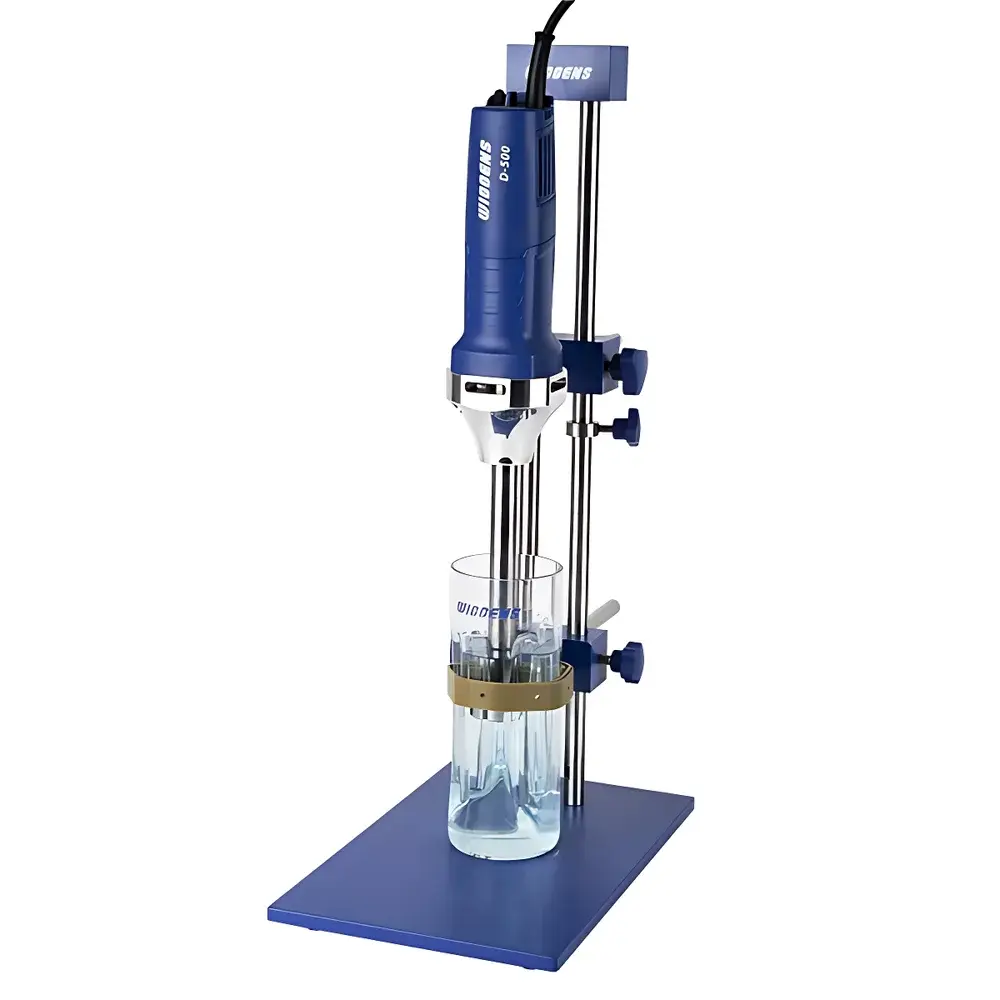
WIGGENS D-500 High-Shear Homogenizer
| Brand | WIGGENS |
|---|---|
| Origin | Germany |
| Model | D-500 |
| Instrument Type | Probe-type Rotor-Stator Homogenizer |
| Dimensions (W×D×H) | 70×70×255 mm (host unit only) |
| Weight | 1.3 kg (host unit only) |
| Processing Volume | 10–40,000 mL |
| Speed Range | 10,000–30,000 rpm |
| No-Load Speed | 10,000–30,000 rpm |
| Rotor Diameter | 4–23 mm |
| Maximum Viscosity | 10,000 cP |
| Tip Speed | 34.9 m/s |
| Power | 500 W |
| Voltage | 220 V / 50 Hz |
| Noise Level | 66 dB (at 2,500 rpm), 72 dB (at 30,000 rpm) |
| Operating Temperature | 0–40 °C |
| Relative Humidity | ≤80 % RH |
| IP Rating | IP20 |
| Material of Rotor/Stator | ASTM F138-certified 316L stainless steel |
Overview
The WIGGENS D-500 High-Shear Homogenizer is a compact, probe-type rotor-stator homogenization system engineered for precision dispersion, emulsification, and cell disruption in research and quality control laboratories. Based on the Couette flow principle, it generates intense hydrodynamic shear forces through high-speed rotation of a precisely engineered rotor within a fixed stator—creating controlled cavitation, turbulent mixing, and particle size reduction at the microscale. Designed for versatility across sample volumes from 10 mL to 40 L, the D-500 delivers reproducible results in applications ranging from pharmaceutical formulation development to food science and life sciences sample preparation. Its German-engineered architecture ensures mechanical stability, thermal management under continuous operation, and long-term calibration integrity—critical for GLP-compliant workflows and routine QC testing.
Key Features
- Probe-based rotor-stator configuration with interchangeable dispersing heads (4–23 mm rotor diameters) enabling optimization for viscosity, volume, and particle size targets
- Continuous speed control via precision rotary dial (10,000–30,000 rpm), calibrated for ±150 rpm accuracy across full range
- 316L stainless steel rotor and stator assemblies conforming to ASTM F138 for biocompatibility and corrosion resistance in aqueous, acidic, and mildly organic media
- Three-tier safety architecture: electronic overload protection, soft-start motor control, and integrated safety switch that deactivates drive upon probe removal or housing disengagement
- Compact footprint (70 × 70 × 255 mm) and lightweight host unit (1.3 kg) facilitate benchtop mobility and integration into biosafety cabinets or fume hoods
- Tip speed up to 34.9 m/s supports efficient nano-emulsion formation and sub-micron particle dispersion without auxiliary cooling
- IP20-rated enclosure suitable for standard laboratory environments; compliant with IEC 61010-1 for electrical safety in measurement and laboratory equipment
Sample Compatibility & Compliance
The D-500 accommodates a broad spectrum of sample types—including low-to-high-viscosity liquids (up to 10,000 cP), suspensions, crude tissue homogenates, polymer solutions, and thermolabile formulations. Its rotor-stator geometry minimizes heat generation during short-duration cycles (<60 s), preserving enzyme activity and antigen integrity in biological samples. For regulated environments, the instrument supports audit-ready documentation when paired with validated SOPs. While the D-500 itself does not include electronic audit trails, its mechanical consistency and repeatability align with USP , ISO 13485, and ASTM D3925 protocols for sample homogenization prior to analytical testing. All wetted parts are autoclavable (121 °C, 20 min), supporting sterile processing in microbiological and cell culture applications.
Software & Data Management
The D-500 operates as a stand-alone analog-controlled device with no embedded firmware or digital interface. Speed settings are manually selected and visually confirmed via engraved scale markings on the control dial—ensuring operational simplicity, electromagnetic immunity, and zero software validation burden. This design prioritizes robustness and regulatory transparency: all process parameters (speed, duration, probe geometry, sample volume) are recorded externally in lab notebooks or LIMS-compatible worksheets. For laboratories requiring traceability, users may integrate the D-500 into electronic batch records using time-stamped video capture or external tachometer logging—fully compatible with FDA 21 CFR Part 11 requirements when governed by procedural controls.
Applications
- Pre-analytical sample homogenization for HPLC, GC-MS, and ICP-MS analysis in environmental, clinical, and forensic labs
- Emulsion stabilization studies in cosmetic R&D (e.g., oil-in-water creams, liposomal delivery systems)
- Cell lysis and organelle isolation in molecular biology, including plant protoplast preparation and bacterial inclusion body dispersion
- Particle size reduction of pigments, resins, and nanomaterials for coating and ink formulation
- Dissolution enhancement of poorly soluble APIs during early-phase pharmaceutical development
- Standardized tissue homogenization per AOAC 986.18 and ISO 6887-1 for food microbiology and nutritional analysis
- Quality control of suspension uniformity in veterinary vaccines and agrochemical concentrates
FAQ
What is the maximum recommended operating time per cycle to avoid thermal degradation?
For heat-sensitive samples (e.g., proteins, enzymes), limit continuous operation to ≤45 seconds with ≥2-minute cooling intervals between cycles. Use ice-jacketed vessels for extended protocols.
Can the D-500 be used for sterilizing homogenates?
No—the D-500 is not a sterilization device. However, all dispersing heads and probes are autoclavable (121 °C, 20 min) and compatible with ethylene oxide and vaporized hydrogen peroxide decontamination.
Is the D-500 compliant with ISO/IEC 17025 for accredited testing labs?
Yes—when operated under documented, validated methods with calibrated tachometers and traceable probe geometry records, the D-500 meets method equivalence requirements for homogenization steps in ISO/IEC 17025-accredited test procedures.
Does WIGGENS provide IQ/OQ documentation for the D-500?
WIGGENS supplies factory calibration certificates and mechanical verification reports. Site-specific IQ/OQ protocols must be developed by the end user per GAMP5 guidelines, leveraging the instrument’s deterministic analog control architecture.
What maintenance is required to sustain performance over time?
Routine inspection of rotor/stator alignment and surface finish every 200 hours of operation; replacement of O-rings annually or after 500 autoclave cycles; lubrication-free design eliminates grease-related contamination risks.



