
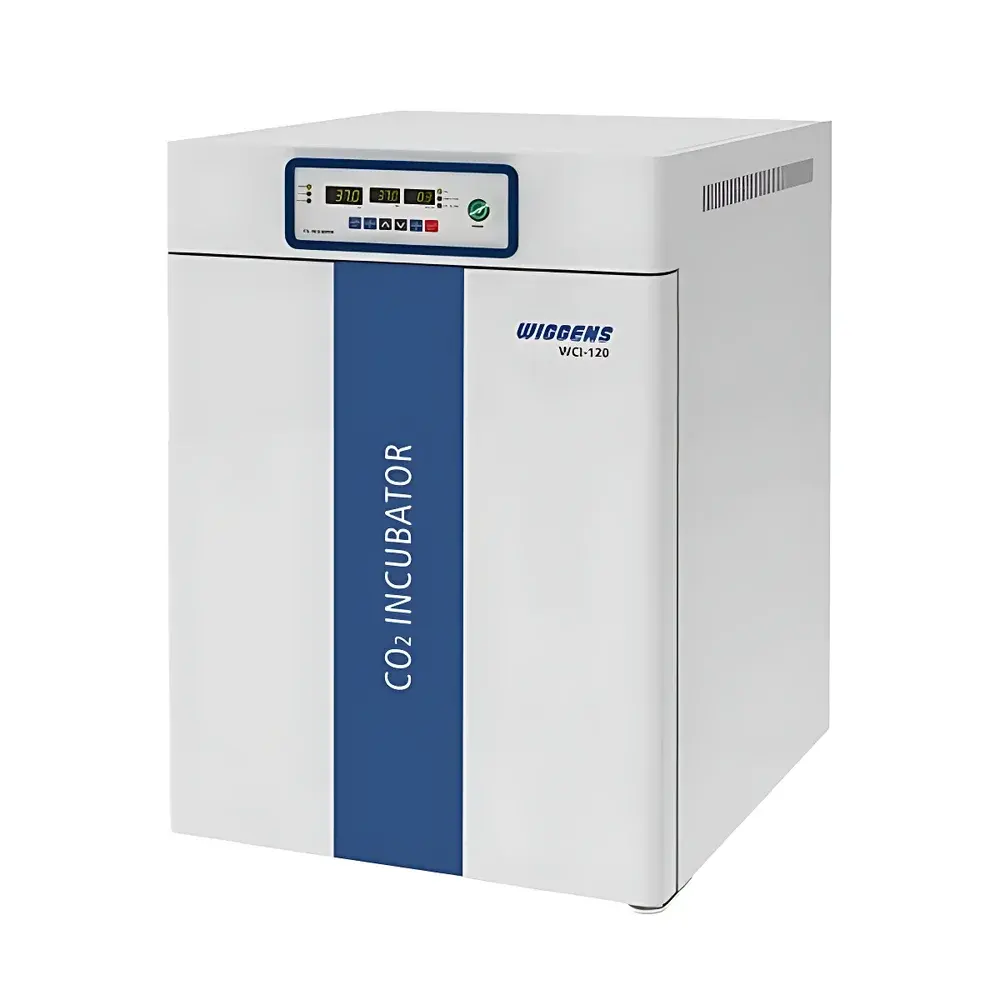
WIGGENS WCI-120 Carbon Dioxide Incubator
| Brand | WIGGENS |
|---|---|
| Origin | Germany |
| Model | WCI-120 |
| Temperature Range | RT +5 to 60 °C |
| Temperature Uniformity | ±0.3 °C (at 37 °C and 20 °C) |
| Chamber Volume | 120 L |
| External Dimensions | 580 × 560 × 765 mm |
| Heating Power | 320 W |
| CO₂ Range | 0–20% |
| CO₂ Accuracy | ±0.1% (at 5% CO₂, 37 °C) |
| CO₂ Sensor | Dual-beam infrared |
| Temperature Display Resolution | 0.1 °C |
| CO₂ Resolution | 0.1% |
| Chamber Material | SUS304 stainless steel |
| Control System | Microprocessor-based PID with independent dual-channel keypad |
| Air Jacket Type | Gas-jacketed with six-sided gradient heating |
| HEPA Filtration | Standard (optional high-temp HEPA) |
| Safety Features | Overtemperature cutoff, door-heating anti-condensation, audible alarm for CO₂/temperature deviation |
Overview
The WIGGENS WCI-120 Carbon Dioxide Incubator is a precision-engineered, gas-jacketed incubation system designed for reliable, long-term cell culture under controlled physiological conditions. It operates on the principle of maintaining a stable CO₂–bicarbonate buffered environment—critical for pH regulation in mammalian cell cultures—while delivering exceptional thermal stability and humidity uniformity. Engineered for life science laboratories requiring GxP-aligned workflows, the WCI-120 integrates a dual-beam infrared CO₂ sensor, six-sided air-jacket heating architecture, and microprocessor-driven PID control to ensure reproducible environmental parameters across the entire 120 L working chamber. Its design complies with fundamental requirements for ISO 13485-supported cleanroom-adjacent operations and supports routine validation protocols per ASTM E2874 (Standard Guide for Validation of Environmental Chambers).
Key Features
- Six-Sided Gradient Air-Jacket Heating: Independent heating elements embedded within the cavity walls—positioned between the stainless steel chamber and outer insulation layer—enable rapid temperature recovery (<15 min from ambient to 37 °C) and minimize thermal drift during door openings.
- Dual-Beam Infrared CO₂ Sensor: Non-dispersive infrared (NDIR) technology with optical path compensation ensures stable, drift-free CO₂ measurement across 0–20% range, unaffected by fluctuations in temperature or relative humidity.
- Active Humidification System: Bottom-mounted water pan heater generates saturated vapor, distributed uniformly via a top-mounted circulation fan; achieves >95% RH at 37 °C without condensation on viewing window or chamber surfaces.
- Anti-Condensation Design: Heated observation door and frame-integrated thermal barrier eliminate dew formation—preserving optical clarity and preventing microbial niche development.
- SUS304 Stainless Steel Chamber: Seamless, radius-cornered interior facilitates cleaning and decontamination; compatible with 70% ethanol, hydrogen peroxide vapor (HPV), and validated liquid sporicidal agents.
- Microprocessor PID Control: Dual independent control loops manage temperature and CO₂ concentration simultaneously; LED display shows real-time setpoints and measured values with 0.1 °C/0.1% resolution.
- Integrated Safety Protocols: Hardware-enforced overtemperature cutoff (>45 °C configurable limit), audible alarm for CO₂ deviation (>±0.3%), and automatic power disconnect on critical fault detection.
Sample Compatibility & Compliance
The WCI-120 accommodates standard T-25, T-75, and multi-well plates, as well as roller bottles and Petri dishes—supported by up to eight optional stainless steel perforated shelves (standard configuration: three). Its chamber geometry (480 × 470 × 520 mm internal) allows unrestricted airflow around stacked vessels. The unit meets IEC 61010-1 safety standards for laboratory equipment and incorporates HEPA filtration (0.3 µm, 99.99% efficiency) on all incoming air streams—available with high-temperature sterilizable variants (up to 180 °C). While not certified for ISO Class 5 environments, its filtered, laminar airflow profile supports adherence to CLSI MM12-A and USP recommendations for low-risk compounding and primary cell isolation.
Software & Data Management
The WCI-120 operates autonomously via its embedded microcontroller; no external PC interface is included in the base configuration. However, analog output ports (0–5 V DC) are provided for optional external data loggers. All operational events—including door openings, CO₂ deviations, temperature excursions, and alarm triggers—are timestamped and stored in non-volatile memory for up to 30 days. Audit trail functionality satisfies GLP documentation requirements for QC labs performing routine cell line maintenance. Optional RS-232 or Ethernet modules (sold separately) enable integration into centralized facility monitoring systems compliant with FDA 21 CFR Part 11 when paired with validated third-party software platforms.
Applications
- Mammalian cell culture (e.g., CHO, HEK293, MCF-7) under 5% CO₂ / 37 °C / >95% RH conditions
- Embryonic stem cell and induced pluripotent stem cell (iPSC) expansion requiring minimal environmental perturbation
- Microbial cultivation of fastidious organisms (e.g., Neisseria gonorrhoeae, Helicobacter pylori) requiring capnophilic atmospheres
- Tissue engineering scaffold seeding and bioreactor pre-conditioning
- Plant tissue culture initiation and callus propagation under elevated CO₂ (e.g., 10–15%)
- Long-term stability studies of biologics in formulation buffers
FAQ
What is the recommended calibration frequency for the CO₂ sensor?
Annual verification against NIST-traceable gas standards is advised; field calibration using zero-air and 5% CO₂ reference gases may be performed quarterly per internal SOP.
Can the WCI-120 support dry-heat sterilization cycles?
Yes—the optional dry-heat sterilization model (Order No. W6012120) features reinforced insulation and a high-temp HEPA filter rated for 180 °C exposure up to 2 hours.
Is the chamber pressure positively regulated?
No—the system maintains atmospheric equilibrium; inlet gas pressure is regulated externally (0.3–0.5 bar required) and does not pressurize the chamber.
How many shelves can be installed without compromising airflow?
Up to eight perforated stainless steel shelves may be used; optimal uniformity is maintained with ≤6 shelves loaded at 70% capacity.
Does the unit comply with electromagnetic compatibility (EMC) directives?
Yes—it conforms to EN 61326-1:2013 for laboratory equipment and EN 55011:2016 Class B emission limits.




