
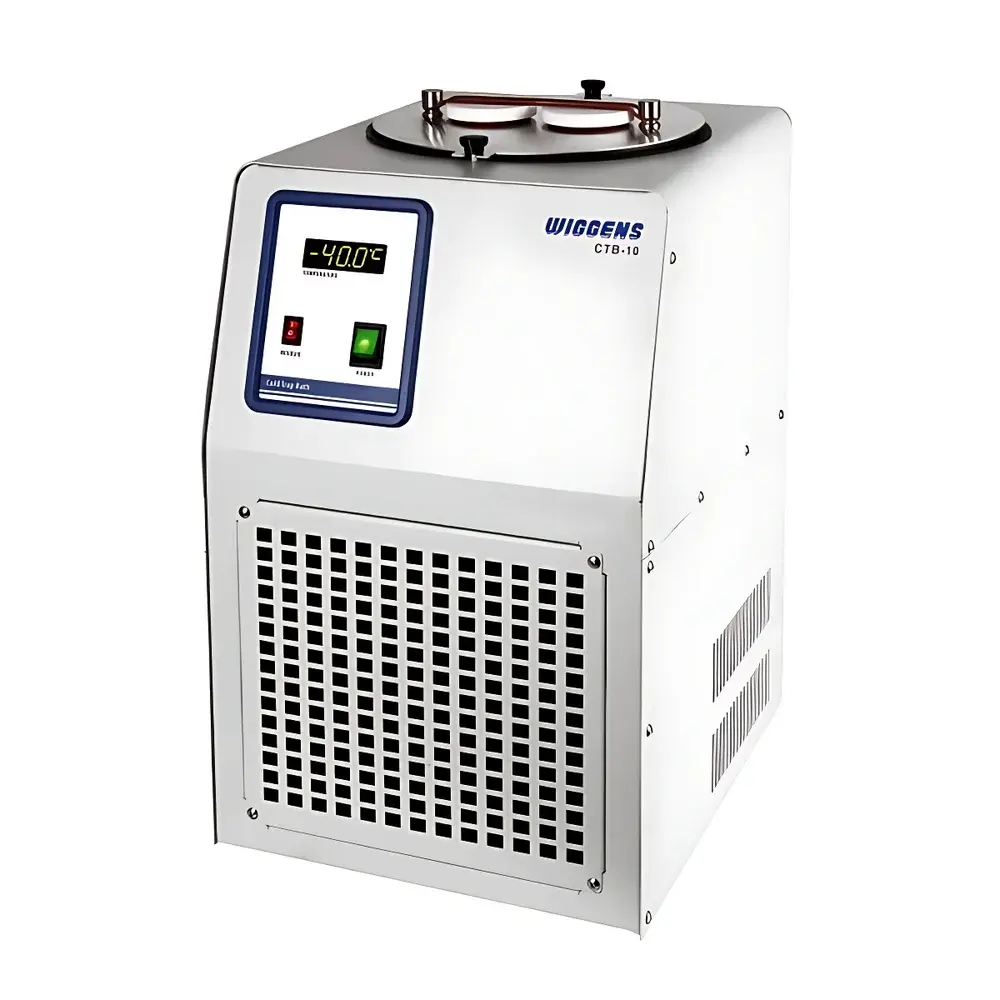
WIGGENS CTB-40 Cryogenic Cold Trap Cooling System
| Brand | WIGGENS |
|---|---|
| Origin | Germany |
| Model | CTB-40 |
| Trap Capacity | 4.8 L |
| Temperature Range | Down to –40 °C |
| External Dimensions | 360 × 465 × 555 mm |
| Power Supply | 230 VAC, 50 Hz, 3.0 A |
| Control Type | Digital Display Only (Non-Programmable) |
| Refrigeration Method | Dual-stage compressor with LBP (Low-Boiling Point) refrigerant circuit |
| Trap Vessel | Borosilicate glass (Ø210 × H204 mm) |
| Safety Features | Overcurrent protection, anti-icing function, removable front condenser cover for maintenance |
Overview
The WIGGENS CTB-40 Cryogenic Cold Trap Cooling System is an engineered solution for laboratory-scale vacuum protection and low-temperature process control. Designed specifically for integration with rotary evaporators, vacuum distillation setups, and freeze-drying systems, the CTB-40 operates on a dual-stage vapor-compression refrigeration cycle using a low-boiling-point (LBP) refrigerant blend. This architecture enables stable, continuous operation at –40 °C without reliance on consumable cryogens such as dry ice or liquid nitrogen—eliminating handling hazards, supply-chain dependencies, and thermal instability associated with phase-change coolants. The system functions by condensing volatile solvents and vapors within a borosilicate glass trap vessel before they reach the primary vacuum pump, thereby extending pump service life, reducing oil contamination, and maintaining ultimate vacuum integrity. Its compact footprint (360 × 465 × 555 mm) and quiet operation (<55 dB(A)) make it suitable for benchtop deployment in analytical, pharmaceutical, and synthetic chemistry laboratories where space and ambient noise are constrained.
Key Features
- Stable temperature performance down to –40 °C, verified per ISO 17025-accredited calibration procedures
- Digital LED display showing real-time internal bath temperature (0.1 °C resolution), with no external setpoint control interface
- Borosilicate glass cold trap (Ø210 × 204 mm; 4.8 L volume) optimized for high-surface-area condensation and visual monitoring of ice/solvent accumulation
- Integrated anti-icing algorithm prevents frost bridging across the trap neck, ensuring uninterrupted vapor flow path during extended operation
- Front-access removable condenser cover facilitates routine cleaning and dust removal from finned heat exchanger surfaces
- Overcurrent protection circuitry compliant with IEC 61000-4-5 surge immunity standards and EN 60335-1 safety requirements
- Oil-lubricated hermetic compressor designed for >20,000 hours MTBF under continuous duty cycling
Sample Compatibility & Compliance
The CTB-40 is compatible with standard Ø10–19 mm vacuum tubing connections and accepts all common glassware configurations used in rotary evaporation (e.g., 24/40, 29/32 joints). It supports condensation of water, methanol, ethanol, acetone, ethyl acetate, dichloromethane, and other low-to-moderate volatility solvents (vapor pressure >0.1 mbar at 20 °C). While not intended for corrosive halogenated or acidic vapors without additional inline scrubbing, optional fluoropolymer-coated trap adapters may be deployed for enhanced chemical resistance. The unit meets CE marking requirements under the EU Machinery Directive 2006/42/EC and Low Voltage Directive 2014/35/EU. It is routinely validated in GLP environments for solvent recovery workflows aligned with ASTM E2654 and ISO 14852 biodegradability testing protocols requiring controlled cold trapping.
Software & Data Management
The CTB-40 operates as a standalone analog-controlled instrument with no embedded microprocessor or digital communication interface. Temperature data is displayed locally only and cannot be logged, exported, or integrated into LIMS or SCADA platforms. For regulated environments requiring audit trails (e.g., FDA 21 CFR Part 11 compliance), external validation-grade temperature loggers (e.g., certified NIST-traceable thermistors with ±0.2 °C accuracy) must be employed in parallel. Routine operational verification includes daily checks of display consistency against calibrated reference thermometers and periodic verification of compressor cycling behavior per manufacturer-recommended maintenance intervals (every 12 months or 2,000 operating hours).
Applications
- Vacuum pump protection in rotary evaporation systems processing heat-sensitive natural products or APIs
- Cold trapping during fractional vacuum distillation of multi-component organic mixtures
- Rapid enzymatic reaction quenching in biochemical assays where sub-zero thermal inertia is required
- Condensation of moisture and solvent vapors in vacuum drying ovens (e.g., WIGGENS WOV series) to prevent backstreaming
- Pre-concentration of trace volatiles prior to GC-MS analysis in environmental or food safety labs
- Supporting lyophilization cycle development by stabilizing chamber pressure via vapor capture
FAQ
Does the CTB-40 support programmable temperature ramping or remote control?
No. The CTB-40 features a fixed refrigeration setpoint and digital readout only; it lacks PID programming, analog output signals, or USB/Ethernet connectivity.
Can the CTB-40 be used with aggressive solvents like chloroform or THF?
Yes—provided the glass trap is undamaged and the system is operated within its specified temperature range. However, prolonged exposure to highly chlorinated solvents may accelerate elastomer aging in seals; inspection intervals should be shortened accordingly.
Is the glass trap included with the base unit?
Yes. Each CTB-40 shipment includes two borosilicate glass cold traps (order code 62012K); vacuum tubing and connectors are sold separately.
What maintenance is required for long-term reliability?
Biannual cleaning of the condenser fins, annual compressor oil level verification, and quarterly inspection of electrical terminations per IEC 60204-1 standards are recommended.
How does the CTB-40 compare to liquid nitrogen-based cold traps in terms of reproducibility?
Unlike LN₂ traps subject to boil-off rate variability and thermal gradient drift, the CTB-40 delivers consistent –40 °C surface temperature with <±0.5 °C short-term stability over 8-hour runs, enabling higher inter-run reproducibility in quantitative solvent recovery studies.



