
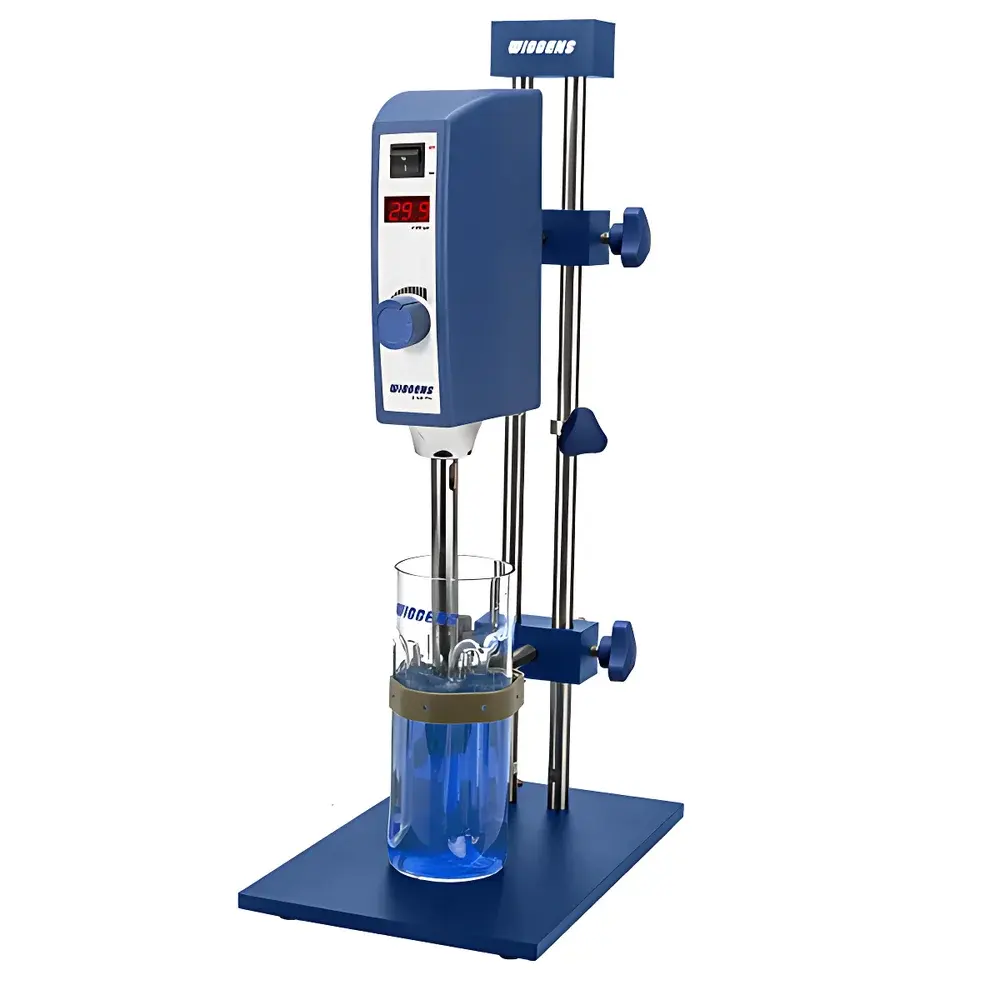
WIGGENS D-500Pro Digital Display High-Shear Homogenizer
| Brand | WIGGENS |
|---|---|
| Origin | Germany |
| Model | D-500Pro |
| Instrument Type | Probe-type Rotor-Stator Homogenizer |
| Dimensions (W×D×H) | 157 × 76 × 234 mm |
| Processing Volume | 0.1–250 mL |
| Speed Range | 500–30,000 rpm |
| Maximum Viscosity Handling | 10,000 cP |
| Tip Speed | ≤34.9 m/s |
| Motor | Brushless DC, 500 W |
| Noise Level | 66 dB (at 2,500 rpm), 72 dB (at 30,000 rpm) |
| Power Supply | 220 V / 50 Hz |
| Operating Temperature | 0–40 °C |
| Relative Humidity | ≤80 % RH |
| IP Rating | IP20 |
| Weight | 1.8 kg (host only) |
| Rotor Diameter Options | Ø4–Ø23 mm |
| Safety Features | Overload protection, soft-start, safety switch |
| Wetted Materials | ASTM F899-grade 316L stainless steel |
Overview
The WIGGENS D-500Pro Digital Display High-Shear Homogenizer is an engineered solution for precise, reproducible sample homogenization, emulsification, dispersion, and cell lysis in research and quality control laboratories. Based on rotor-stator shear principle—where high-speed rotation of a precision-machined probe generates intense hydrodynamic cavitation and turbulent flow within the sample—the D-500Pro delivers consistent mechanical energy input across small-volume samples (0.1–250 mL). Its brushless DC motor ensures stable speed maintenance under variable load conditions, critical for applications requiring defined shear history, such as nanoparticle dispersion, pharmaceutical suspension preparation, or tissue homogenization prior to nucleic acid extraction. Designed and assembled in Germany, the instrument complies with IEC 61010-1 for laboratory electrical safety and meets CE marking requirements for EMC and low-voltage directives.
Key Features
- Precision digital speed control via rotary encoder: real-time LED display with resolution of ±50 rpm across full 500–30,000 rpm range
- Interchangeable 316L stainless steel probes (Ø4–Ø23 mm) certified for autoclaving (ISO 17664-compliant cleaning validation support)
- Three-layer safety architecture: electronic overload cutoff, programmable soft-start ramp (0–3 s), and integrated safety switch interrupting power upon probe removal
- Optimized thermal management: aluminum housing with passive convection cooling maintains motor temperature rise <15 K at continuous 500 W operation
- Compact footprint (157 × 76 × 234 mm) and lightweight design (1.8 kg) enable benchtop mobility and integration into biosafety cabinets or cold rooms
- Tip speed calculation embedded in firmware (v = π × d × n / 60) allows direct correlation between rotational speed and hydrodynamic shear stress
Sample Compatibility & Compliance
The D-500Pro accommodates aqueous, organic, and semi-viscous media up to 10,000 cP—validated using standard silicone oil calibration fluids per ASTM D2196. Probe geometry supports compatibility with common labware including borosilicate glass vials (35 mL–2 L), stainless-steel vessels, and custom-fit GS-series dispersion cups that eliminate vortex formation and improve radial mixing efficiency by >40% compared to cylindrical containers (data per WIGGENS Application Note AN-HM-2023-07). All wetted surfaces conform to USP Class VI biocompatibility testing and are compatible with NaOH-based CIP protocols. The system supports GLP/GMP workflows through optional audit-trail-enabled firmware (compliant with FDA 21 CFR Part 11 Annex 11 when paired with validated LIMS integration).
Software & Data Management
While the D-500Pro operates as a standalone unit, its digital interface provides RS-232 output (optional USB-to-serial adapter) for external logging of speed setpoint, actual rpm, runtime, and fault codes. When connected to WIGGENS’ optional Homogenizer Control Suite (v3.2+), users gain access to method storage (up to 99 protocols), time-stamped event logs, and exportable CSV reports traceable to ISO/IEC 17025 clause 7.7. Calibration certificates for speed accuracy (±0.5% of reading, NIST-traceable tachometer verification) and torque linearity are provided with each unit shipment.
Applications
- Pre-analytical sample preparation: homogenization of tumor biopsies, liver/kidney tissues, and plant material for downstream RNA/DNA isolation (validated per QIAGEN RNeasy and Zymo Quick-DNA protocols)
- Pharmaceutical QC: rapid disintegration testing of coated tablets (USP ), suspension uniformity assessment (USP ), and particle size reduction in nanosuspension development
- Materials science: exfoliation of graphene oxide dispersions, carbon nanotube deagglomeration, and polymer nanocomposite formulation
- Microbiology: bacterial cell lysis for plasmid prep (E. coli DH5α, OD600 ≤2.0), yeast spheroplast disruption, and viral capsid shearing
- Food & cosmetics: emulsion stability testing (oil-in-water, water-in-oil), pigment dispersion in cosmetic bases, and viscosity profiling of hydrocolloid systems
FAQ
What is the minimum recommended processing volume for optimal shear transfer?
For consistent energy delivery and avoidance of probe cavitation air ingestion, the minimum volume is 0.1 mL with Ø4 mm probe; for larger rotors (≥Ø10 mm), ≥1 mL is advised.
Can the D-500Pro be used in cold room environments?
Yes—operational specification covers 0–40 °C ambient; however, condensation mitigation requires pre-equilibration of probe and sample to target temperature prior to activation.
Is validation documentation available for GMP-regulated environments?
Yes: IQ/OQ templates, preventive maintenance schedules, and metrological traceability records for speed and torque sensors are included in the WIGGENS Validation Support Package (Order Code: VS-D500P-2024).
How does the GS dispersion cup improve homogenization efficiency?
Its asymmetric internal geometry disrupts laminar vortex formation, inducing multi-directional flow patterns that increase sample recirculation frequency by 3.2× versus standard cylindrical vessels—reducing processing time by up to 38% at equivalent rpm (per WIGGENS Fluid Dynamics Lab Report FD-2023-04).
What sterilization methods are approved for the 316L probes?
Autoclaving (121 °C, 20 min, saturated steam), dry heat (180 °C, 2 h), and ethylene oxide gas exposure—all validated per ISO 17664 and manufacturer’s cleaning instructions.



