
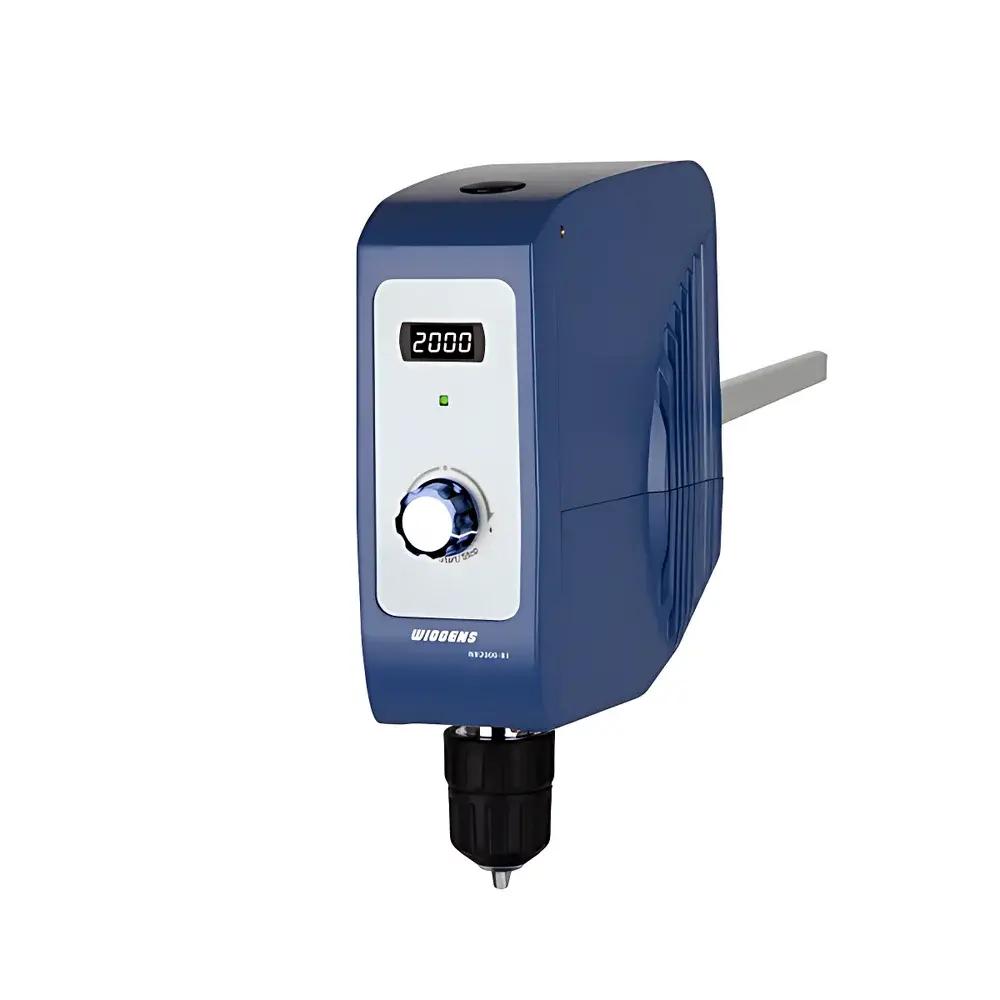
WIGGENS WB2000-B1 High-Torque Overhead Stirrer
| Brand | WIGGENS |
|---|---|
| Origin | Germany |
| Model | WB2000-B1 |
| Max. Mixing Volume | 70 L |
| Speed Range | 50–2000 rpm |
| Torque | ≤105 N·cm |
| Viscosity Range | ≤75,000 mPa·s |
| Motor Type | Brushless DC |
| Display Resolution | 1 rpm |
| Speed Accuracy | ≤±3% (n > 300 rpm) |
| Power Input/Output | 200 / 140 W |
| Dimensions (W×D×H, excl. support rod) | 100 × 241 × 295 mm |
| Weight (unit + power supply) | 6.3 kg |
| IP Rating | IP42 |
| Communication Interface | RS485 |
| Chuck Capacity | 0.5–10 mm |
| Hollow Shaft ID | 10.2 mm |
| Temperature Resolution | 0.1 °C |
| Operating Modes | LED display + rotary knob control |
| Safety Features | Auto overload protection, soft-start, status LEDs (standby/blue, run/green, alarm/red) |
Overview
The WIGGENS WB2000-B1 High-Torque Overhead Stirrer is an engineered solution for demanding laboratory mixing applications requiring consistent rotational performance across wide viscosity and volume ranges. Designed around a brushless DC motor architecture, it eliminates carbon brush wear and delivers stable torque output without degradation over extended operational cycles—critical for reproducible long-duration experiments in QC, R&D, and process development labs. Its overhead configuration enables direct drive coupling to stir rods via a precision-machined hollow shaft (ID 10.2 mm), supporting deep-vessel immersion without mechanical interference or height recalibration. The system operates on the principle of controlled rotational torque transmission, maintaining set speed within ±3% deviation above 300 rpm through closed-loop microprocessor-based feedback control. With a maximum torque rating of 105 N·cm and capacity for aqueous systems up to 70 L, it accommodates high-viscosity formulations—including polymer solutions, suspensions, and viscous emulsions—while preserving laminar-to-transitional flow regimes essential for scalable process correlation.
Key Features
- Brushless DC motor with integrated thermal and current monitoring for continuous-duty operation under load
- Hollow-shaft design (10.2 mm internal diameter) enabling full-length stir rod insertion and flexible positioning without re-leveling the unit
- High-contrast LED display with 1-rpm resolution and intuitive rotary speed adjustment knob—optimized for gloved-hand operation
- Self-locking, tool-free chuck mechanism (0.5–10 mm clamping range) ensuring concentricity and minimizing vibration-induced wobble
- Intelligent safety architecture: programmable soft-start, automatic overload cutoff, and tri-color status LED indicators (blue/standby, green/run, red/alarm)
- RS485 serial interface compliant with Modbus RTU protocol for integration into centralized lab automation networks or SCADA systems
- IP42-rated enclosure with corrosion-resistant surface finish suitable for routine exposure to solvents, acids, and humidity in ISO 17025-accredited laboratories
Sample Compatibility & Compliance
The WB2000-B1 supports a broad spectrum of sample types—from low-viscosity buffers and culture media to shear-thinning gels and abrasive particulate suspensions—when paired with appropriate impeller geometries (e.g., pitched-blade, anchor, or helical ribbons). Its torque delivery remains linear across the full 50–2000 rpm range, making it compatible with ASTM D2196 (viscosity of paints), ISO 3219 (rheology of polymer solutions), and USP (dissolution apparatus verification) protocols where mechanical consistency is mandated. The unit meets IEC 61010-1:2010 requirements for electrical safety in laboratory equipment and includes documentation traceability aligned with GLP and GMP audit expectations, including calibration certificate options and firmware version logging.
Software & Data Management
While operating as a standalone instrument, the WB2000-B1 integrates seamlessly into digital lab infrastructures via its RS485 port. When connected to a host PC or PLC controller, real-time parameters—including actual speed, elapsed runtime, fault codes, and temperature readings (via optional external probe)—can be logged at user-defined intervals. Data export formats include CSV and XML, facilitating import into LIMS platforms or statistical analysis tools such as JMP or Minitab. Firmware updates are performed via secure serial command sets, and all operational events—including start/stop commands, speed changes, and protective shutdowns—are timestamped with millisecond precision to satisfy FDA 21 CFR Part 11 requirements for electronic records and signatures when configured with audit-trail-enabled software.
Applications
- Homogenization of biopolymer solutions in pharmaceutical formulation development
- Mixing of catalyst slurries and heterogeneous reaction media in fine chemical synthesis
- Preparation of standardized reference suspensions for particle size analyzer calibration
- Long-term stability testing of emulsions and colloidal dispersions under controlled shear conditions
- Batch-scale dissolution studies in compliance with USP Apparatus 2 (paddles) and Apparatus 7 (reciprocating cylinder) auxiliary agitation protocols
- Viscometric pre-conditioning of samples prior to rheological characterization on rotational or capillary instruments
FAQ
What impeller types are recommended for high-viscosity applications?
Pitched-blade turbines and anchor impellers with close-clearance geometry are preferred for viscosities exceeding 20,000 mPa·s; ensure impeller diameter does not exceed 70% of vessel ID to avoid excessive power draw.
Can the WB2000-B1 be used in explosion-proof environments?
No—the unit is not ATEX or IECEx certified; for hazardous area use, consult WIGGENS’ intrinsically safe overhead stirrer variants with Class I, Division 1 compliance.
Is firmware update capability available remotely?
Firmware updates require local RS485 connection and authenticated command execution; remote updates are not supported to maintain data integrity and cybersecurity standards.
Does the device support analog signal output for PLC integration?
No analog outputs are provided; however, digital speed and status signals can be mapped via Modbus registers for seamless PLC handshake logic implementation.
What maintenance schedule is recommended for the brushless motor?
Zero scheduled maintenance is required; the motor’s sealed construction and thermal management system ensure >20,000 hours MTBF under nominal load conditions per IEC 60034-18-41.



