
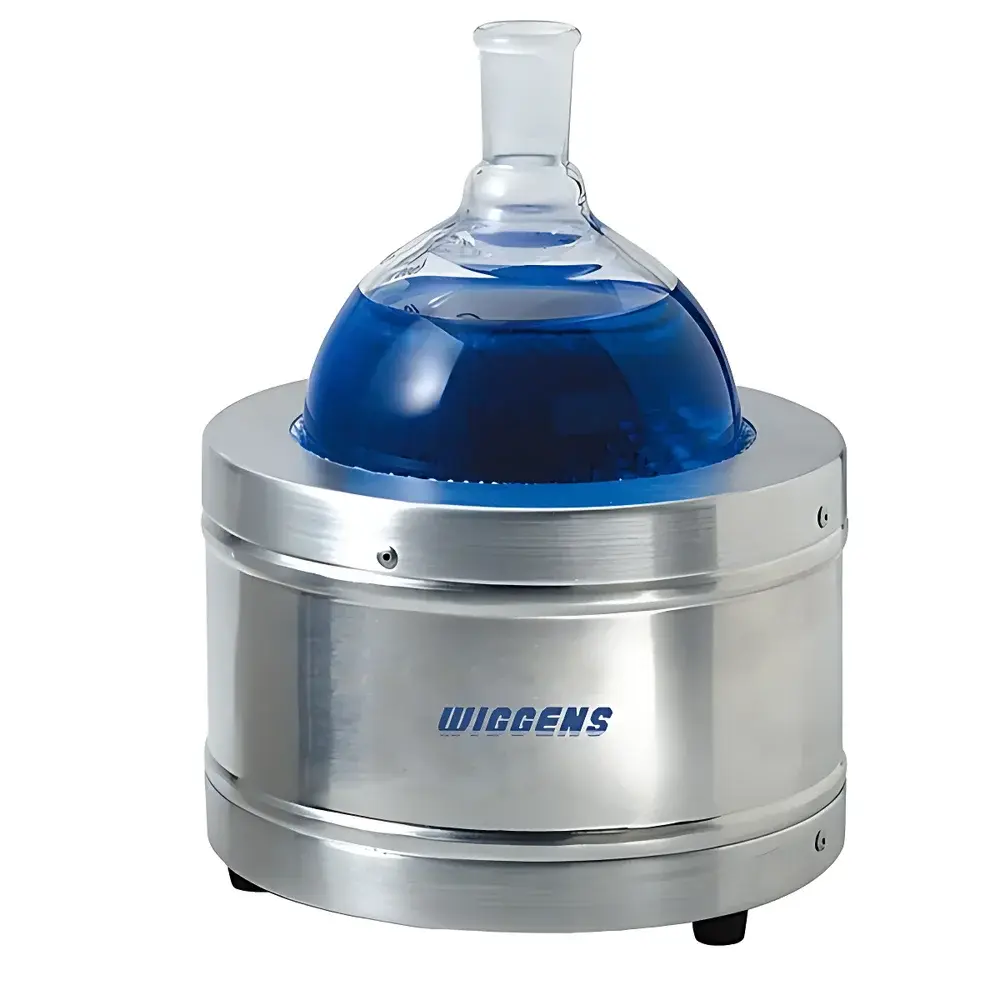
WIGGENS TM Series Aluminum Electric Heating Mantles
| Brand | WIGGENS |
|---|---|
| Origin | Germany |
| Model | TM95 |
| Max Operating Temperature | 450 °C |
| Power Range | 60–7200 W (model-dependent) |
| Construction | Anodized Aluminum Housing with Ceramic-Fiber Insulation |
| Internal Lining | Nest-structured High-Temp Fiberglass Fabric |
| Electrical | 3-wire Cord (1.2 m standard |
| Controller Compatibility | PL524 Pro Digital Temperature Controller (standard on TM122) |
| Compliance | CE-marked, RoHS-compliant, Designed per IEC 61000-6-3 (EMC) and IEC 61000-6-2 (Immunity) |
Overview
The WIGGENS TM Series Aluminum Electric Heating Mantles are precision-engineered thermal management systems designed for controlled, uniform, and safe heating of laboratory glassware and metal vessels under demanding reaction conditions. Based on resistive heating principles, each mantle integrates a tightly wound, insulated resistance wire embedded within a high-density ceramic-fiber matrix—ensuring efficient thermal transfer while minimizing thermal gradients across the vessel surface. The anodized aluminum outer shell provides structural rigidity, corrosion resistance, and long-term dimensional stability at continuous operating temperatures up to 450 °C. Unlike open-heating plates or oil baths, the TM Series mantles deliver contact-based conduction heating that conforms precisely to vessel geometry—eliminating hot spots, reducing thermal shock risk to borosilicate glass, and enabling accurate temperature regulation in exothermic, reflux, distillation, polymerization, and catalytic synthesis workflows.
Key Features
- Rigid, lightweight anodized aluminum housing engineered for mechanical stability during extended operation and compatible with standard lab stands and clamping systems.
- Nest-structured high-temperature fiberglass internal lining—soft yet dimensionally stable—that cradles glassware without pressure points, significantly lowering thermal shock-induced fracture probability in round-bottom flasks and other sensitive vessels.
- Modular design available in six specialized configurations: spherical (for round-bottom flasks), cylindrical (for jacketed reactors and straight-walled vessels), flat-bottom metal-vessel, beaker, funnel, and Buchner funnel variants—each optimized for thermal envelope conformity and application-specific mounting.
- Optional center-opening configuration (e.g., TM56x HOLE series) accommodates bottom-discharge valves, thermowells, or stirrer shafts without compromising thermal integrity.
- Gas-cooling compatibility (TM107–TM122 models): integrated gas inlet port enables direct introduction of inert or cooling gases (e.g., N₂, compressed air) into the mantle cavity for active thermal quenching or condensation control.
- Standardized electrical interface: all models ship with a 1.2 m (or 4-ft) 3-conductor cable terminated in a NEMA 5-15P locking plug—ensuring grounding continuity and reducing accidental disconnection in shared bench environments.
Sample Compatibility & Compliance
The TM Series supports a broad range of vessel types and materials—including ASTM E438 Type I Class A borosilicate glass (e.g., Pyrex®, Duran®), stainless steel reactors (316/304), Hastelloy-lined vessels, and coated metal containers used in coatings and polymer R&D. Vessel compatibility spans nominal volumes from 50 mL to 72 L, with diameters up to 522 mm and maximum heights exceeding 356 mm. Each model is validated for use under GLP and GMP-aligned laboratory practices: temperature stability ≤ ±2 °C (at setpoint, steady-state), repeatability < 1.5 °C over 24 h cycling, and thermal response time (25–200 °C) typically < 12 min for mid-range models. Units comply with CE marking requirements (2014/30/EU EMC Directive and 2014/35/EU LVD Directive), RoHS 2011/65/EU, and meet IEC 61010-1:2010 safety standards for laboratory electrical equipment. Optional integration with PL524 Pro controllers supports audit-ready data logging, user-access level management, and 21 CFR Part 11–compliant electronic signatures when paired with validated software platforms.
Software & Data Management
While the base TM mantles operate as standalone analog/digital-heated elements, full traceability and process control are achieved via the optional PL524 Pro digital temperature controller—standard on TM122 and available as an accessory for all other models. The PL524 Pro features PID algorithm tuning, ramp-soak programming (up to 16 segments), real-time graphing (via USB or RS-485), and CSV export capability. When deployed in networked lab environments, it interfaces seamlessly with LIMS and ELN systems using Modbus RTU protocol. All logged temperature profiles include timestamp, operator ID, setpoint history, and deviation alerts—supporting ISO/IEC 17025 clause 7.7 (result reporting) and FDA 21 CFR Part 11 Subpart B requirements for electronic records and signatures. Firmware updates are delivered via secure HTTPS portal with version-controlled release notes and validation documentation.
Applications
The TM Series is routinely deployed across synthetic organic chemistry (Grignard reactions, lithium–halogen exchange), pharmaceutical process development (API crystallization, solvent removal), polymer science (polycondensation, epoxy curing), petrochemical testing (ASTM D86, D1160 distillation), and materials research (sol-gel processing, nanoparticle synthesis). Spherical variants (e.g., WTM95–WTM122) enable unobstructed visual monitoring during reflux or heterogeneous catalysis. Cylindrical models (TM56x) prevent localized softening of resin-lined reactors. Funnel and Buchner variants maintain consistent wall temperature for high-melting-point filtrates (e.g., waxes, fatty acids, bitumen fractions), eliminating clogging in ASTM D97 pour point determinations. Metal-vessel mantles (TM63x) support direct heating of Hastelloy C-276 autoclaves in hydrogenation studies where magnetic stirring is impractical.
FAQ
What is the maximum continuous operating temperature for the TM Series?
The TM Series is rated for continuous operation at up to 450 °C ambient vessel interface temperature. Surface temperature of the aluminum housing remains below 120 °C under normal ventilation conditions.
Can the TM mantles be used with non-glass vessels such as stainless steel or Hastelloy reactors?
Yes—models designated for metal-vessel use (e.g., TM631–TM641) incorporate additional thermal buffering layers to prevent direct coil-to-metal contact and ensure even heat distribution across conductive surfaces.
Is gas cooling functionality available on all models?
No—gas inlet ports are factory-installed only on TM107 through TM122 spherical mantles. Retrofitting is not supported due to internal baffle geometry constraints.
Does the PL524 Pro controller support calibration certificate traceability to NIST standards?
Yes—the PL524 Pro ships with a manufacturer-issued calibration certificate (traceable to NIST via DAkkS-accredited lab), and field recalibration is supported using certified reference thermocouples (Type K, Class 1).
Are custom geometries or OEM branding options available?
WIGGENS offers limited custom tooling for high-volume OEM integrations (minimum order quantity applies); bespoke spherical flask mantles can be configured to match non-standard neck angles or dual-port arrangements upon engineering review.



