
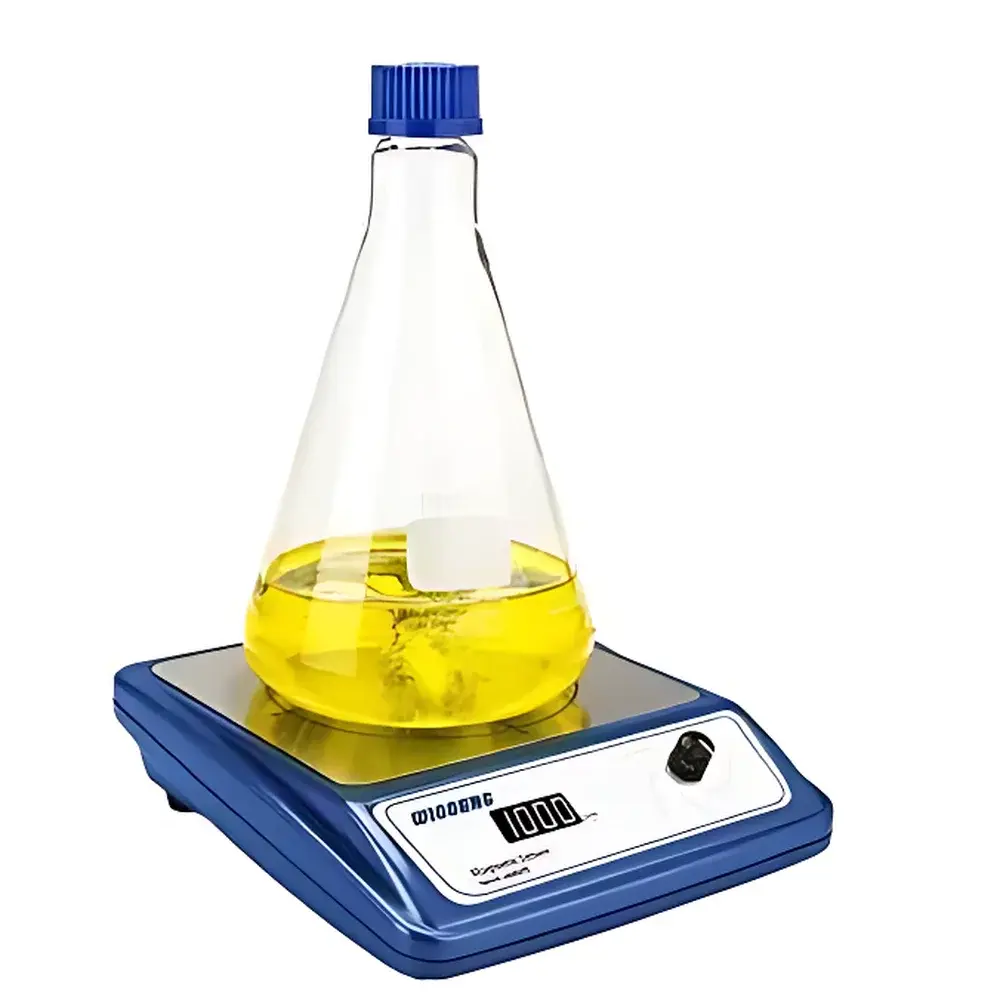
WIGGENS WH-210D Digital Magnetic Stirrer
| Brand | WIGGENS |
|---|---|
| Origin | Germany |
| Model | WH-210D |
| Stirring Capacity | 50–3000 mL |
| Speed Range | 100–1500 rpm |
| Heating | Not equipped (non-heating model) |
| Control Type | Microprocessor-controlled, viscosity-compensated digital speed regulation |
| Display | Dual LED (setpoint & real-time RPM) |
| Drive Motor | Brushless DC motor |
| Work Surface | Epoxy-coated stainless steel |
| Stirring Positions | 1 |
| Compliance | CE, RoHS, IEC 61010-1 |
Overview
The WIGGENS WH-210D Digital Magnetic Stirrer is a precision-engineered, single-position laboratory stirrer designed for consistent, reproducible mixing across a broad range of aqueous and non-aqueous solutions. Utilizing closed-loop microprocessor control, the WH-210D continuously monitors rotational load and dynamically adjusts motor output to maintain set speed—regardless of viscosity fluctuations during reaction progression or temperature-induced rheological changes. This active speed stabilization mechanism ensures high repeatability in kinetic studies, dissolution testing, buffer preparation, and standardization protocols where constant agitation is critical to analytical validity. Unlike open-loop analog stirrers, the WH-210D’s brushless DC motor delivers silent, vibration-free operation even under elevated viscosities (e.g., polymer solutions or cell culture media), minimizing sample disturbance and thermal drift. Its compact footprint and non-heating architecture make it ideal for integration into fume hoods, biosafety cabinets, or multi-instrument workstations where thermal interference must be avoided.
Key Features
- Viscosity-adaptive speed control: Real-time torque feedback enables automatic power modulation to sustain user-defined RPM within ±3% accuracy across viscosity ranges from water-like (1 cP) to moderately viscous fluids (up to ~500 cP).
- Dual LED display: Simultaneously shows target speed (setpoint) and actual measured RPM, enabling immediate verification of operational fidelity without external tachometry.
- Epoxy-coated stainless steel platform: Chemically resistant surface withstands repeated exposure to acids (e.g., HCl, HNO₃), bases (e.g., NaOH), organic solvents (e.g., acetone, ethanol), and halogenated compounds—validated per ISO 17025-compliant lab cleaning protocols.
- Independent single-channel design: Eliminates cross-talk or speed coupling between positions—essential when running parallel experiments with differing viscosity profiles or reagent compatibility requirements.
- Low-noise brushless DC drive: Operates below 45 dB(A) at maximum load, meeting ISO 7730 acoustic comfort guidelines for shared laboratory environments.
- PTFE protective mat compatibility (Order No. 400214-PTFE): Optional 0.18 mm thick, autoclavable PTFE mat provides additional chemical barrier and anti-slip stability; rated for continuous use from –200 °C to +260 °C.
Sample Compatibility & Compliance
The WH-210D supports standard laboratory vessels including glass beakers (50–2000 mL), cylindrical vials, and flat-bottom flasks. It is compatible with all commercially available magnetic stir bars—including PTFE-coated, PTFE/glass-core, and elliptical designs—up to 80 mm in length. The device complies with IEC 61010-1:2010 (Safety Requirements for Electrical Equipment for Measurement, Control, and Laboratory Use), CE marking Directive 2014/30/EU (EMC), and RoHS 2011/65/EU. While not intrinsically safe for explosive atmospheres (ATEX), its non-sparking motor and grounded chassis meet GLP-aligned electrical safety benchmarks for routine QC/QA labs. No integrated temperature sensing or heating element is present; therefore, it does not fall under FDA 21 CFR Part 11 data integrity requirements—but full audit trail capability is supported when paired with validated third-party LIMS interfaces.
Software & Data Management
As a standalone benchtop instrument, the WH-210D operates without proprietary software or drivers. All operational parameters are configured locally via front-panel rotary encoder. However, its stable analog tachometer output (0–5 V DC proportional to RPM) enables seamless integration into automated workflows via PLCs, DAQ systems (e.g., National Instruments USB-6009), or SCADA platforms. For GxP-regulated environments, users may log speed settings and duration manually in bound lab notebooks—or digitize entries using 21 CFR Part 11–compliant electronic lab notebooks (ELNs) such as LabArchives or Benchling. Firmware updates are not field-upgradable; calibration verification is performed annually using NIST-traceable optical tachometers per ISO/IEC 17025 Clause 6.5.
Applications
- Standardization of titrant solutions (e.g., EDTA, KMnO₄) requiring uniform dispersion prior to volumetric analysis.
- Cell suspension homogenization in microbiology and mammalian cell culture prep—minimizing shear stress due to low-vibration operation.
- Preparation of calibration standards for ICP-MS, HPLC, and UV-Vis spectroscopy where particulate settling must be prevented over extended equilibration periods.
- Teaching laboratories: Demonstrates Newtonian/non-Newtonian fluid behavior through controlled ramping and hold profiles.
- Environmental testing: Mixing of soil leachates or wastewater samples prior to filtration and metal speciation analysis (EPA Method 6020B).
FAQ
Does the WH-210D include a heating function?
No. The WH-210D is a non-heating magnetic stirrer. For combined stirring and heating, consider the WIGGENS WH-210HT series.
What is the maximum recommended viscosity for stable speed maintenance?
Up to approximately 500 mPa·s (cP) using a 40 mm PTFE-coated stir bar in a 1000 mL beaker. Performance beyond this depends on bar geometry, vessel shape, and fill level.
Is the unit suitable for use inside a CO₂ incubator?
Not recommended. While the electronics are sealed, the epoxy coating is not rated for continuous humidified 5% CO₂ environments above 37 °C.
Can the PTFE mat (Order No. 400214-PTFE) be sterilized?
Yes. It withstands steam autoclaving at 121 °C for 20 minutes (ISO 17665-1), but repeated cycles may reduce adhesive longevity.
What stir bar size is optimal for 3000 mL volume?
A 60–80 mm elliptical or cross-shaped PTFE stir bar is recommended to ensure vortex formation and bottom-layer engagement in tall-form containers.



