
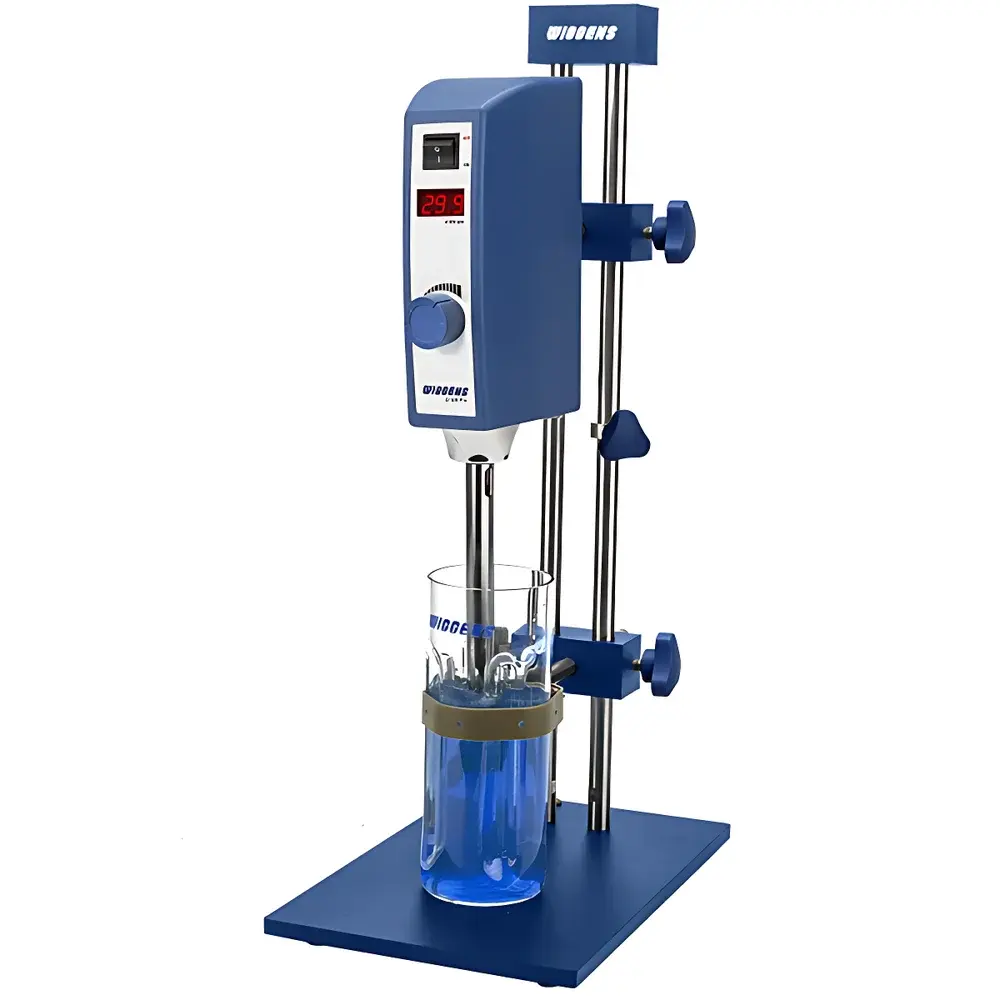
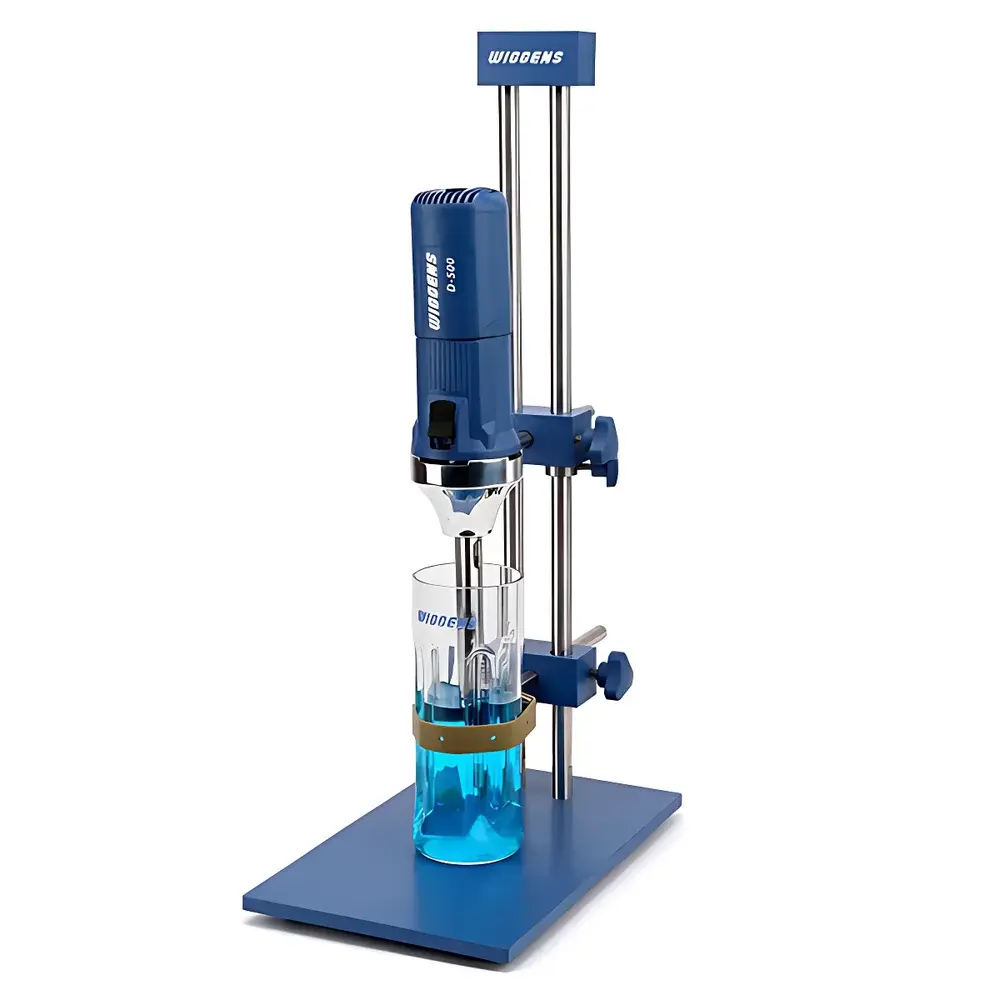
WIGGENS D-500 Pro High-Shear Digital Disperser
| Brand | WIGGENS |
|---|---|
| Origin | Germany |
| Model | D-500 Pro |
| Speed Range | 500–30,000 rpm |
| Display | LED digital speed readout |
| Power | 500 W |
| Max. Viscosity | 10,000 cP |
| Tip Speed | ≤34.9 m/s |
| Rotor Diameter | Ø4–Ø23 mm |
| Processing Volume | 10–40,000 mL |
| Noise Level | 66 dB (2,500 rpm), 72 dB (30,000 rpm) |
| Input Voltage | 220 V / 50 Hz |
| Operating Temperature | 0–40 °C |
| Relative Humidity | ≤80 % RH |
| IP Rating | IP20 |
| Weight | 1.8 kg (host only) |
| Dimensions (L×W×H) | 157 × 76 × 236 mm (host only) |
| Rotor Material | ASTM A276 Type 316L stainless steel |
| Safety Features | Overload protection, soft-start circuitry, safety interlock switch |
Overview
The WIGGENS D-500 Pro High-Shear Digital Disperser is an engineered solution for laboratory-scale dispersion, emulsification, homogenization, and particle size reduction across diverse sample matrices. Based on rotor-stator hydrodynamic shear principles, the instrument generates intense localized turbulence and cavitation through high tip-speed rotation—enabling efficient deagglomeration of nanoparticles, stabilization of oil-in-water or water-in-oil emulsions, and uniform suspension of pigments, polymers, and colloidal systems. Designed and manufactured in Germany, the D-500 Pro integrates precision engineering with ergonomic portability, supporting both benchtop and handheld operation modes. Its microprocessor-controlled motor delivers stable rotational output across the full 500–30,000 rpm range, ensuring reproducible energy input critical for method transfer and regulatory compliance in QC/QA environments.
Key Features
- LED digital speed display and flywheel-type rotary encoder for precise, repeatable speed setting with ±1% accuracy at setpoint
- Quick-release rotor coupling system enabling tool-free disassembly and cleaning—reducing cross-contamination risk between samples
- 316L stainless steel rotor-stator assemblies conforming to ASTM A276 and EN 10088-1 standards, offering corrosion resistance in acidic, alkaline, and organic solvent media
- Three-tier safety architecture: electronic overload detection, controlled soft-start ramp (0–3 s acceleration profile), and physical safety interlock switch disabling operation when rotor guard is disengaged
- Low-inertia motor design optimized for rapid speed response and minimal thermal drift during extended operation
- Compact host unit (157 × 76 × 236 mm; 1.8 kg) compatible with universal lab stands, magnetic bases, or direct handheld use with optional support grips
Sample Compatibility & Compliance
The D-500 Pro accommodates viscosities up to 10,000 cP (measured in aqueous glycerol solutions per ISO 2555) and processes volumes from 10 mL to 40 L using interchangeable rotor geometries (Ø4–Ø23 mm). It supports sterilizable 316L rotors validated for autoclaving (121 °C, 20 min, saturated steam), making it suitable for aseptic cell culture media preparation and pharmaceutical excipient dispersion under GLP conditions. The device complies with IEC 61000-6-3 (EMC emission limits) and IEC 61000-6-2 (immunity requirements), and its electrical insulation meets double-insulation Class II construction per IEC 61140. While not intrinsically rated for hazardous area use, its IP20 enclosure provides protection against solid ingress per IEC 60529—intended for clean, dry indoor laboratory environments.
Software & Data Management
The D-500 Pro operates as a standalone analog-digital hybrid instrument with no embedded firmware or network interface. All operational parameters—including real-time RPM, total run time, and cumulative operating hours—are displayed locally via the front-panel LED module. For traceable process documentation, users may integrate the disperser into validated workflows via external data loggers (e.g., certified USB-based tachometer recorders compliant with FDA 21 CFR Part 11 Annex 11 audit trail requirements). Method parameters are recorded manually or via LIMS-compatible templates aligned with ISO/IEC 17025 clause 7.7 on result reporting. No proprietary software, cloud connectivity, or remote control functionality is provided—ensuring data sovereignty and minimizing cybersecurity exposure vectors common in connected lab devices.
Applications
- Preparation of nanosuspensions for drug delivery formulation development (e.g., poorly soluble APIs in PVP or HPMC matrices)
- Rapid dispersion of carbon black, TiO₂, or SiO₂ nanoparticles into polymer melts and coatings
- Emulsification of vaccine adjuvants (e.g., squalene-in-water systems) under low-foaming conditions
- Homogenization of tissue lysates for proteomic extraction—compatible with RIPA, TRIzol®, and QIAzol® reagents
- Deagglomeration of ceramic slurries prior to spray drying or tape casting in materials science labs
- QC testing of viscosity modifiers in personal care formulations (shampoos, lotions) per ASTM D2196 procedures
FAQ
What is the maximum recommended continuous operating time at 30,000 rpm?
Continuous operation at top speed is limited to 5 minutes per cycle to maintain thermal stability of the motor windings and bearing assembly. Intermittent duty cycles (e.g., 3 min on / 2 min off) are advised for prolonged high-shear applications.
Can the D-500 Pro be used with corrosive solvents such as chloroform or concentrated HCl?
While the 316L stainless steel rotor exhibits strong resistance to many organics and dilute mineral acids, direct exposure to halogenated solvents or >10% v/v HCl requires post-use passivation and validation of surface integrity per ASTM A967. Use of PTFE-coated or Hastelloy-C276 rotors is recommended for aggressive chemistries.
Is calibration certification included with the instrument?
A factory-issued speed verification certificate (traceable to PTB Germany) is supplied with each unit. Full metrological calibration per ISO/IEC 17025 requires third-party service and is not performed in-house.
How does the D-500 Pro compare to rotor-stator homogenizers rated for higher power (e.g., 1 kW units)?
The D-500 Pro prioritizes precision control and portability over raw power density. Its 500 W rating is optimized for scalability from analytical to pilot-scale batches (≤40 L), whereas higher-power units typically serve production-line integration with fixed mounting and cooling systems.
Are spare rotors and replacement parts available with documented material certifications?
Yes—each rotor batch is supplied with a Mill Test Report (MTR) per EN 10204 3.1, confirming chemical composition, mechanical properties, and heat treatment history of the 316L material.
Related Products



