
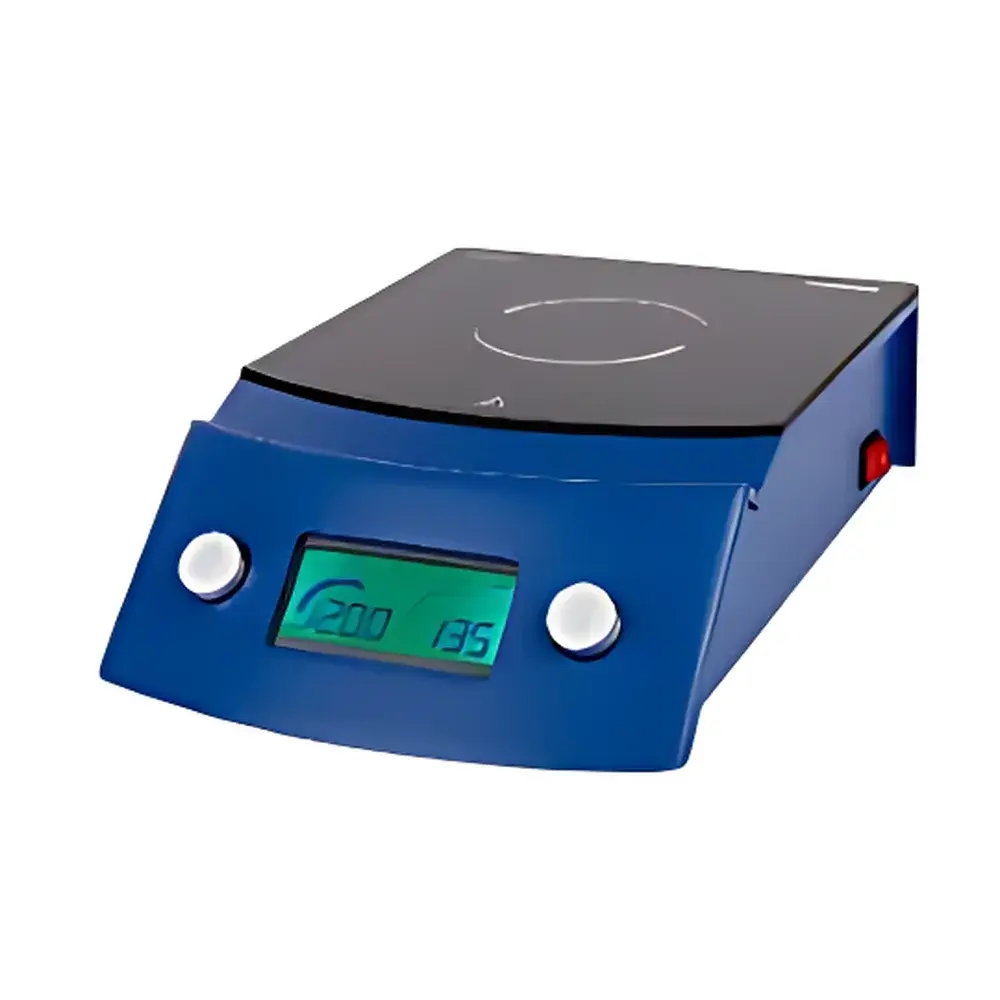
WIGGENS SLK2-T Infrared Ceramic Heating Plate
| Brand | WIGGENS |
|---|---|
| Origin | Germany |
| Model | SLK2-T |
| Heating Power | 1800 W |
| Max. Surface Temperature | 550 °C |
| Temperature Uniformity | ±1 °C |
| Plate Dimensions | 285 × 285 mm |
| Heating Zone Diameter | Ø190 mm |
| Display | TFT LCD |
| External Temperature Sensor Support | Pt100 probe compatible |
| Safety Overtemperature Range | Adjustable 50–600 °C |
| Liquid Overheat Protection Threshold | Adjustable 10–50 °C |
| Timer Range | 0–1999 min or continuous |
| Interface | RS232/RS485 |
| Weight | 4.1 kg |
| Power Supply | 220 V / 50 Hz |
Overview
The WIGGENS SLK2-T Infrared Ceramic Heating Plate is an engineered solution for precise, reproducible, and safe conductive heating in analytical, preparative, and quality control laboratories. Unlike conventional resistive hotplates, the SLK2-T employs a high-emissivity infrared ceramic (glass-ceramic) heating surface that delivers rapid thermal response and exceptional thermal stability. Its operation relies on near-infrared radiation absorption by sample containers—primarily borosilicate glass or stainless-steel vessels—followed by efficient conduction into the sample matrix. This hybrid thermal transfer mechanism minimizes ambient heat loss and improves energy efficiency while maintaining strict compliance with laboratory safety protocols. Designed for demanding sample preparation workflows—including acid digestion, solvent evaporation, reflux, and reagent preheating—the SLK2-T meets ISO/IEC 17025 calibration traceability requirements when used with external Pt100 reference sensors and supports GLP/GMP documentation via its RS232/RS485 interface.
Key Features
- High-performance glass-ceramic top plate with zero porosity, chemical resistance to strong acids (e.g., HNO₃, HCl, HF up to 40%), alkalis, and organic solvents—enabling easy decontamination and long-term durability.
- Robust thermal shock resistance: withstands abrupt temperature changes up to 700 °C without microcracking or delamination—critical for rapid cool-down/reheat cycles in multi-step digestions.
- Intuitive rotary encoder with tactile feedback for precise temperature and timer setting; large TFT display shows setpoint, real-time surface temperature, elapsed time, and operational status simultaneously.
- Dual-mode temperature control: surface-mode (open-loop) for general heating and sensor-mode (closed-loop) using optional Pt100 probes (e.g., PT100-01) for direct liquid-phase temperature regulation with ±1 °C stability under optimized conditions.
- Front-panel integrated drip channel prevents ingress of spilled liquids into control electronics—meeting IEC 61010-1 Class II insulation and IP20 environmental protection standards.
- Configurable overtemperature safeguards: independent adjustable limits for surface overheat (50–600 °C) and sample overheat (10–50 °C), each triggering audible/visual alarms and automatic power cutoff.
Sample Compatibility & Compliance
The SLK2-T accommodates standard laboratory vessels ranging from 10 mL test tubes to 2 L round-bottom flasks, provided base diameters fall within the Ø190 mm active heating zone. Compatibility extends to PTFE-coated magnetic stir bars (when used with optional stirrer modules), quartz crucibles, and ceramic digestion vessels. All materials contacting the heating surface must exhibit thermal expansion coefficients compatible with glass-ceramic substrates to avoid mechanical stress-induced failure. The unit conforms to EN 61326-1 (EMC for laboratory equipment), EN 61010-1 (safety requirements), and carries CE marking. When operated with calibrated Pt100 sensors and validated SOPs, it satisfies temperature accuracy requirements outlined in ASTM D1557 (soil compaction), USP (aseptic processing support), and ISO 11469 (polymer thermal analysis prep).
Software & Data Management
Equipped with standard RS232 and RS485 serial interfaces, the SLK2-T enables bidirectional communication with LIMS, ELN, or custom SCADA systems. ASCII-based command protocols support remote setpoint adjustment, real-time temperature logging (up to 1 Hz sampling), alarm event capture, and firmware version interrogation. Audit trail functionality—when integrated with compliant data acquisition software—supports 21 CFR Part 11 requirements through electronic signatures, user access levels, and immutable timestamped records. Optional WIGGENS LabLink™ software provides graphical trend visualization, batch export (CSV/Excel), and automated report generation aligned with ISO/IEC 17025 clause 7.7 (result reporting).
Applications
- Acid digestion of environmental samples (soils, sediments, sludges) per EPA Method 3050B and ISO 11466.
- Controlled evaporation of HPLC mobile phases and LC-MS extracts under inert atmosphere.
- Pretreatment of catalysts and nanomaterials prior to BET surface area analysis.
- Thermal conditioning of polymer melts before rheological testing (e.g., Brookfield DVNext).
- Heating of reagent solutions in titration and photometric assays requiring stable thermal baselines.
- Supporting ASTM E2932 (thermal desorption of volatile organics) and ISO 16000-6 (indoor air VOC analysis) sample prep protocols.
FAQ
Can the SLK2-T be used for closed-vessel microwave-assisted digestion?
No—it is designed exclusively for open-vessel conductive heating. Microwave digestion requires specialized pressure-rated reactors and magnetron-based energy delivery.
Is the Pt100 sensor included in the standard configuration?
Yes—the SLK2-T ships with PT100-01 sensor and PT100-05 mounting bracket as part of the standard kit.
What is the minimum measurable temperature resolution?
The TFT display resolves temperature to 0.1 °C; however, actual system repeatability is ±1 °C at steady state under controlled ambient conditions.
Does the unit support external analog input for cascade control?
No—only digital serial communication (RS232/RS485) is supported; analog voltage/current inputs are not available.
How often should calibration verification be performed?
Per ISO/IEC 17025, verify surface temperature accuracy against a NIST-traceable thermometer before each critical run or at least daily in routine QC environments.



