
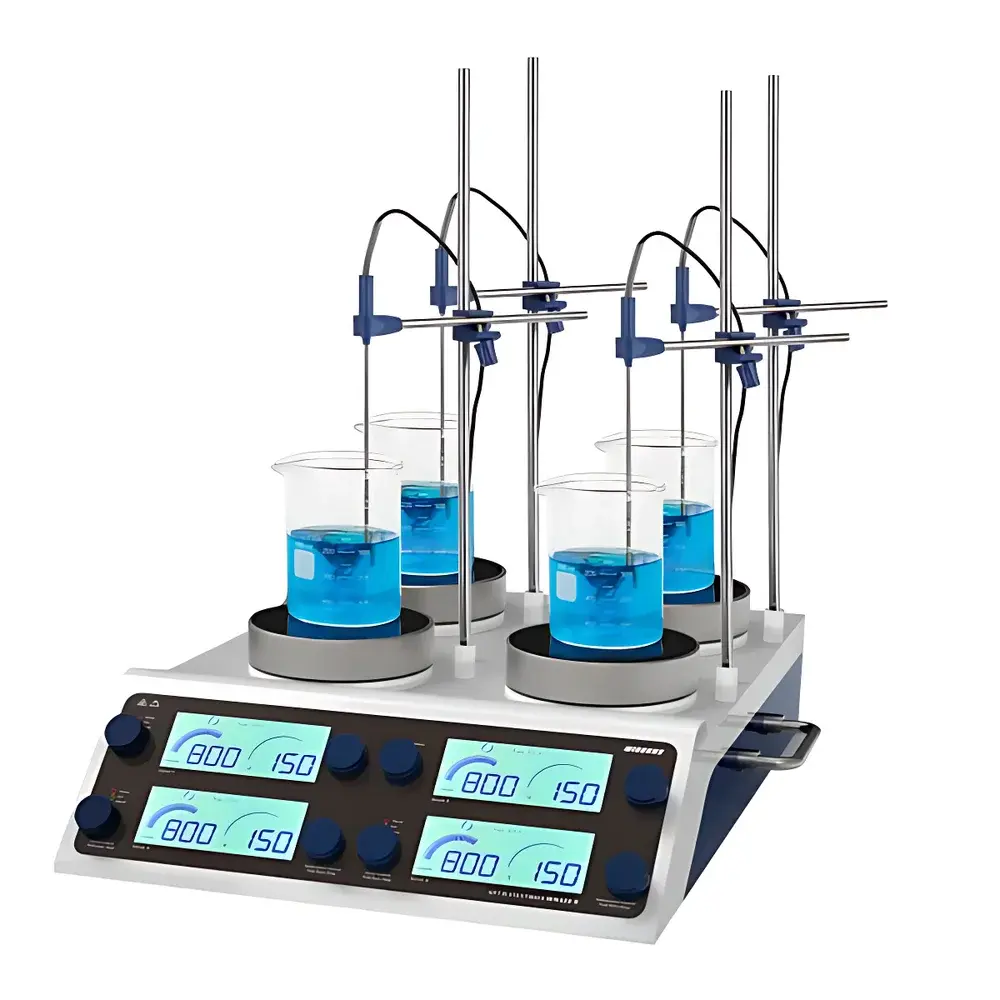
WIGGENS WH420R-D Multi-Position Heated Magnetic Stirrer
| Brand | WIGGENS |
|---|---|
| Origin | Germany |
| Model | WH420R-D |
| Instrument Type | Heated Magnetic Stirrer |
| Max. Stirring Volume | ≤20 L (H₂O) |
| Speed Range | 100–1500 rpm |
| Temperature Control Range | 50–500 °C (adjustable) |
| Heating Power | 500 W per position / 2000 W total |
| Temp. Stability (with Pt100) | ±1 °C |
| Over-Temp. Protection ΔT | 10–50 °C adjustable |
| Safety Temp. Limit | 50–500 °C adjustable |
| Panel Material | Enamel-Glass |
| Plate Diameter | Ø135 mm |
| Center-to-Center Spacing | 187 mm |
| Dimensions (W×D×H) | 388×473×138 mm |
| Weight | 15.8 kg |
| Power Supply | 220 V / 50 Hz |
| Timer | 1–999 min or continuous |
| Display & Control | Individual LCD + rotary knob per position |
| External Sensor | Pt100 compatible |
| Communication Interface | USB-A |
| Compliance | CE, RoHS, IEC 61010-1 |
Overview
The WIGGENS WH420R-D is a precision-engineered multi-position heated magnetic stirrer designed for high-throughput laboratory workflows requiring independent thermal and rotational control across multiple samples. Utilizing infrared heating elements integrated beneath a durable enamel-glass ceramic plate, the system delivers rapid, uniform heat transfer with minimal thermal lag—enabling accurate setpoint tracking even under dynamic load conditions. Each of its four independently operated positions features dedicated PID temperature regulation, real-time digital monitoring, and isolated safety cutoff logic, ensuring process integrity in applications ranging from buffer preparation and reagent synthesis to accelerated stability testing. The instrument operates on the principle of electromagnetic induction-driven rotation of PTFE-coated stir bars, coupled with closed-loop feedback control via external Pt100 sensors (optional), making it suitable for both open-vessel and sealed-reactor configurations under ambient or controlled-environment conditions.
Key Features
- Four fully independent stirring/heating stations—each with discrete LCD display, rotary speed/tuning interface, and programmable timer (1–999 min or continuous mode)
- Enamel-glass ceramic top plate rated for thermal shock resistance up to 700 °C and superior chemical inertness against acids, alkalis, and organic solvents
- Infrared heating technology ensures fast ramp rates, low surface temperature gradients, and improved energy efficiency compared to resistive coil systems
- Three user-selectable PID parameter sets optimized for distinct thermal mass scenarios: PID1 for low-thermal-inertia samples (e.g., <50 mL aqueous solutions), PID2 for standard lab volumes, and PID3 for high-mass or high-heat-capacity loads (e.g., ≥1 L viscous media)
- Dual-layer safety architecture: adjustable overtemperature protection (ΔT = 10–50 °C above setpoint) plus independently configurable safety limit (50–500 °C), compliant with IEC 61010-1 Class II requirements
- IP54-rated control panel with corrosion-resistant housing and splash-proof membrane switches for long-term reliability in wet or corrosive environments
- USB-A interface supports firmware updates and optional data logging via third-party software (no proprietary drivers required)
Sample Compatibility & Compliance
The WH420R-D accommodates vessels from 10 mL vials to 20 L carboys, provided appropriate stir bar geometry and magnetic coupling are maintained. Compatible container materials include borosilicate glass, PTFE, PP, and quartz; non-magnetic metallic vessels are not supported. The system meets CE marking requirements and conforms to IEC 61010-1 for electrical safety in laboratory equipment. Its design supports GLP-compliant operation when used with calibrated Pt100 probes and documented calibration records. While not inherently 21 CFR Part 11–compliant, audit-trail functionality can be implemented externally through validated USB-connected data acquisition systems meeting ALCOA+ principles.
Software & Data Management
No embedded operating system or cloud connectivity is included; all control remains local and deterministic. The USB-A port enables connection to host PCs for passive data capture using industry-standard serial communication protocols (virtual COM port emulation). When paired with traceable Pt100 sensors and time-stamped logging software, the device supports full temperature and speed history archiving—facilitating retrospective analysis, deviation investigation, and regulatory submission packages. Firmware updates are delivered as signed binary files with version-controlled release notes available via WIGGENS’ official support portal.
Applications
- Parallel synthesis and optimization studies in medicinal chemistry and catalysis
- Standardization of pH buffers, cell culture media, and chromatography mobile phases
- Accelerated degradation testing per ICH Q1A(R2) guidelines under controlled thermal stress
- Preparation of homogeneous suspensions for particle size analysis (e.g., ISO 13320 compliance)
- Heating/stirring of viscous polymer solutions prior to rheological characterization
- Quality control workflows in food, pharmaceutical, and environmental laboratories where multi-sample reproducibility is critical
FAQ
Can the WH420R-D be used with temperature-sensitive biological samples?
Yes—when equipped with an external Pt100 probe immersed directly in the sample, the system achieves ±1 °C stability at setpoints as low as 50 °C, minimizing thermal denaturation risk.
Is the enamel-glass plate resistant to hydrofluoric acid?
No. While highly resistant to most common laboratory reagents, enamel-glass surfaces are vulnerable to HF and strong alkaline fluorides; alternative containment strategies are recommended.
Does each position support independent timer activation?
Yes—each station has its own programmable timer, allowing staggered start/stop sequences without cross-interference.
What is the maximum recommended vessel height for stable stirring at 1500 rpm?
For optimal vortex formation and magnetic coupling, vessel height should not exceed 2.5× the internal diameter; taller geometries may require lower speeds or specialized stir bars.
Can the unit be integrated into a LIMS or ELN environment?
Direct integration is not supported natively, but ASCII-formatted output via USB enables parsing into LIMS/ELN systems using custom middleware or LabVIEW-based interfaces.



