
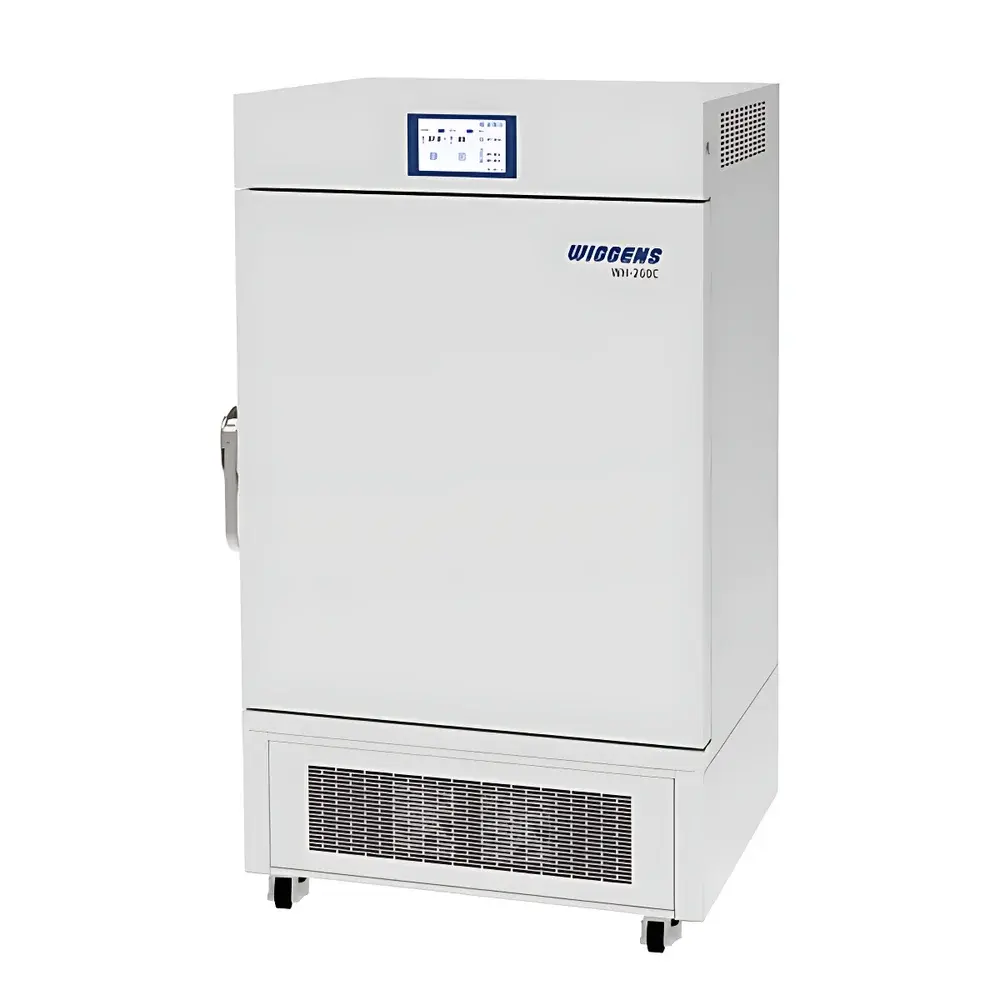
WIGGENS WH-260C Biochemical Incubator
| Brand | WIGGENS |
|---|---|
| Origin | Germany |
| Model | WH-260C |
| Heating Method | Air-jacketed |
| Cooling Method | Compressor-based |
| Air Circulation | Forced convection |
| Temperature Range | +4 to +60 °C |
| Temperature Accuracy | ±0.1 °C |
| Temperature Uniformity | < ±0.3 °C |
| Capacity | 260 L |
| External Dimensions (W×D×H) | 820 × 752 × 1485 mm |
| Internal Chamber Material | 304 Stainless Steel |
| Internal Dimensions (W×D×H) | 640 × 500 × 800 mm |
| Standard Shelving | 2 adjustable shelves (max. 9) |
| Shelf Load Capacity | 30 kg per shelf |
| Heating Power | 850 W |
| Cooling Power | 350 W |
| Total Power Consumption | 1350 W |
| Ambient Operating Temperature | 10–35 °C |
| Power Supply | 220 V, 50/60 Hz |
| Net Weight | 175 kg |
| Communication Interfaces | DB9 & RJ45 (RS485 protocol), USB port for data logging (CSV export) |
Overview
The WIGGENS WH-260C Biochemical Incubator is a precision-engineered, air-jacketed temperature-controlled chamber designed for reliable, long-term cultivation and storage of biological samples in research, pharmaceutical quality control, clinical diagnostics, and academic life science laboratories. Its dual-mode thermal management system—combining independent air-jacketed heating and compressor-based cooling—enables rapid temperature stabilization and high-fidelity setpoint maintenance across the full operational range of +4 °C to +60 °C. Unlike natural convection units, the WH-260C employs a microprocessor-controlled forced-air circulation system with optimized fan placement and baffle design to minimize thermal gradients, achieving uniformity better than ±0.3 °C throughout the 260 L stainless steel chamber. The unit conforms to core design principles outlined in ISO 13408-1 (aseptic processing environments) and supports GLP-compliant workflows through integrated audit-trail-capable data logging and configurable alarm protocols.
Key Features
- Air-jacketed heating architecture surrounding the entire inner chamber ensures rapid heat-up response and exceptional thermal stability without direct contact between heating elements and samples.
- Compressor-based refrigeration system enables precise sub-ambient temperature control down to +4 °C, supporting both mesophilic and psychrotrophic culture requirements.
- Microprocessor-driven PID temperature regulation with 0.1 °C setpoint resolution and real-time digital display; screen brightness is user-adjustable for optimal visibility under varied lab lighting conditions.
- Comprehensive safety architecture includes overtemperature cut-off, overcurrent protection, door-open detection (which automatically disables heaters and fans), and audible/visual high/low temperature alarms with event timestamping.
- Configurable autostart functionality allows users to define post-power-loss behavior—either automatic resumption of prior settings or safe shutdown—enhancing continuity in unattended overnight runs.
- Robust construction features cold-rolled steel exterior with electrostatic epoxy-polyester coating, 304 stainless steel interior (electropolished finish optional), and CFC-free, low-conductivity insulation compliant with EU RoHS and REACH directives.
- Integrated mobility system with locking casters facilitates repositioning within shared lab spaces while maintaining stable operation on level surfaces.
Sample Compatibility & Compliance
The WH-260C accommodates standard microbiological and cell culture formats—including Petri dishes, multiwell plates, flasks (up to 5 L), and roller bottles—across up to nine vertically adjustable stainless steel shelves (standard configuration: two). Each shelf supports up to 30 kg, enabling dense loading without compromising airflow integrity. Chamber geometry and airflow dynamics have been validated per ASTM E1510-22 (Standard Practice for Performance Testing of Laboratory Incubators) to ensure reproducible thermal performance under loaded conditions. The unit meets IEC 61010-1 safety requirements for laboratory equipment and supports compliance with FDA 21 CFR Part 11 when paired with validated third-party data acquisition software via its RS485 or USB interface.
Software & Data Management
Data integrity and traceability are supported through dual communication pathways: an RS485-enabled DB9/RJ45 port (compatible with Modbus RTU and custom SCADA integration) and a front-access USB port for plug-and-play data logging. When a USB drive is inserted, the incubator continuously records temperature readings at user-defined intervals (1 s to 60 min), storing time-stamped CSV files with metadata including date, setpoint, actual temperature, alarm status, and door-open events. All logged data retains immutable timestamps and can be exported for statistical process control (SPC), trend analysis, or regulatory submission. Optional firmware updates extend compatibility with LIMS interfaces and support encrypted data transfer where required by institutional IT policies.
Applications
- Microbial growth studies (e.g., E. coli, S. aureus, yeast) under controlled aerobic or ambient-atmosphere conditions.
- Enzyme activity assays and protein stability testing requiring tight thermal control across physiological and supra-physiological ranges.
- Pharmaceutical stability testing per ICH Q1A(R3) guidelines for intermediate storage of reference standards and working solutions.
- Cell line maintenance for hybridoma, CHO, or HEK293 cultures where consistent temperature avoids phenotypic drift during non-CO2 incubation.
- Biochemical reaction monitoring—including ELISA plate incubation, antigen-antibody binding kinetics, and chromogenic substrate development.
- Environmental simulation for ecotoxicology studies involving aquatic or soil microorganisms under defined thermal regimes.
FAQ
What is the minimum operating temperature of the WH-260C?
The unit maintains stable operation from +4 °C, making it suitable for low-temperature bacterial and fungal culture applications.
Does the incubator support remote monitoring via Ethernet?
Yes—the RJ45 port implements RS485 over twisted-pair wiring and can be integrated into building management systems (BMS) or LabVantage-compatible networks using appropriate protocol converters.
Can the internal shelves be removed for cleaning or large-volume vessel placement?
All shelves are fully removable and repositionable on 25 mm pitch notches; the chamber floor is seamless 304 stainless steel with no rivets or crevices.
Is the temperature uniformity specification verified under load or empty conditions?
Uniformity < ±0.3 °C is validated per ASTM E1510-22 with three thermocouples placed at geometric center and opposing corners, under 50% load (four standard shelves with 15 kg total mass).
What documentation is provided for IQ/OQ validation?
WIGGENS supplies a Factory Acceptance Test (FAT) report, calibration certificate traceable to PTB (Physikalisch-Technische Bundesanstalt), and a comprehensive User Requirement Specification (URS)-aligned validation template package upon request.



