
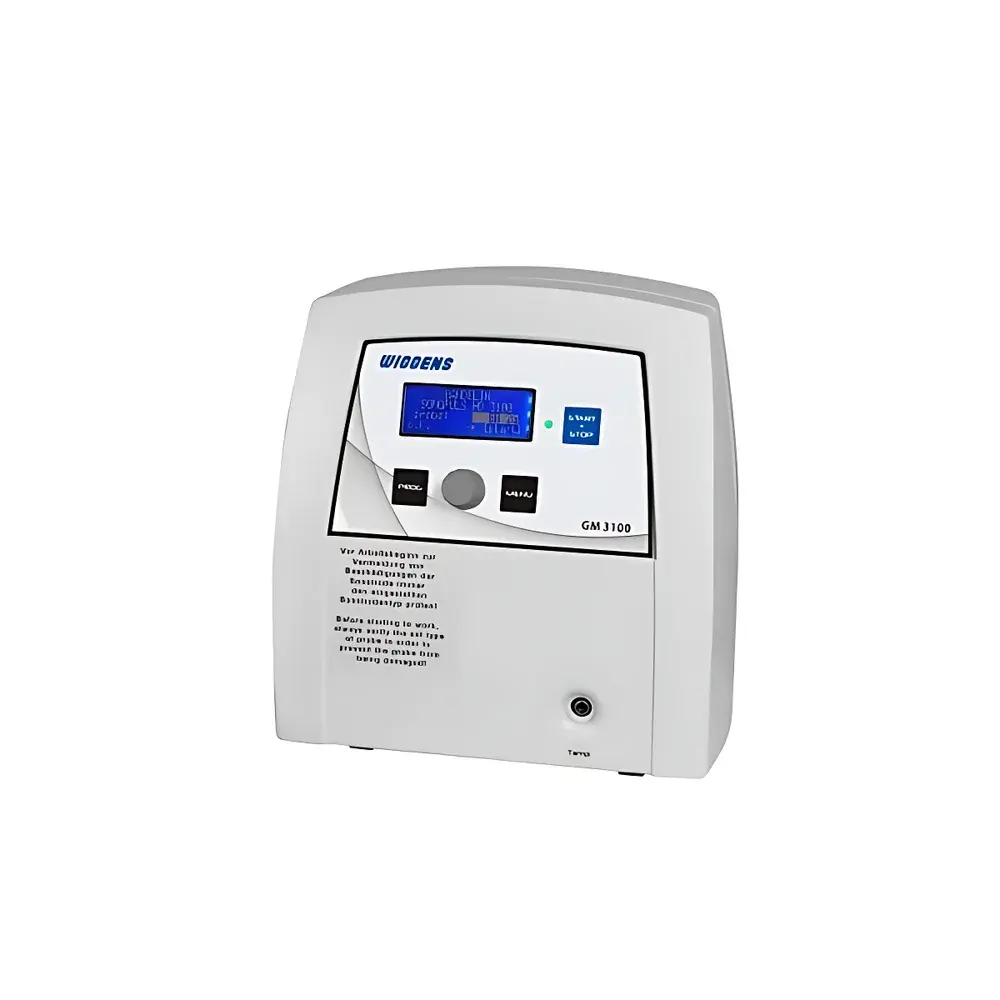
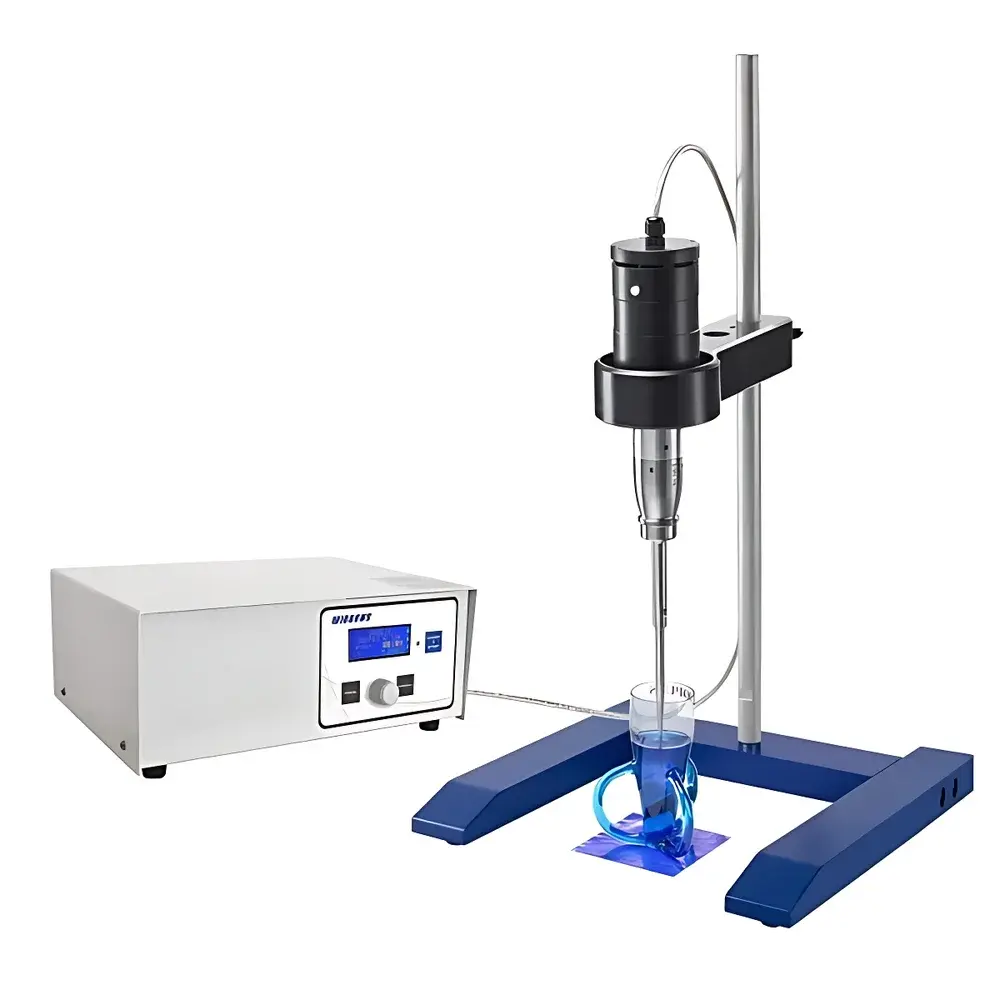
WIGGENS HD3400 Series Ultrasonic Homogenizer
| Brand | WIGGENS |
|---|---|
| Origin | Germany |
| Model | HD 3400 |
| Instrument Type | Ultrasonic Cell Disruptor |
| High-Frequency Generator | GM 3400 (400 W effective output power) |
| Transducer | UW 3400 |
| Amplitude Control | 10–100% adjustable |
| Operating Frequency | 20 kHz |
| Maximum Sample Volume | ≤2500 mL |
| Pulse Mode | ON cycle 0.2–600 s / OFF cycle 0.3–600 s |
| Timer Range | 00:00:01 to 99:59:59 (continuous or countdown) |
| Display | LCD (vibration mode, time, amplitude, energy in kJ, optional temperature monitoring 0–120 °C) |
| Data Interface | RS-232 |
| Safety Certification | CE compliant |
| Remote Control | Footswitch compatible |
| Probe Options | Titanium horns with diameters 19 mm and 25 mm (order codes 3690), standard horn set includes 2, 3, 6, 13, 19, 25 mm tips |
| Booster Horn | SH 3425 with enhanced amplitude amplification |
| Extension Probe | VS 200 T (25 mm diameter, extended length) |
Overview
The WIGGENS HD3400 Series Ultrasonic Homogenizer is a high-performance, CE-certified laboratory instrument engineered for precise and reproducible cell disruption, homogenization, emulsification, and sonochemical applications. Based on piezoelectric transduction principles, it converts 50 Hz mains electricity into stable 20 kHz ultrasonic energy via the GM 3400 high-frequency generator and UW 3400 transducer assembly. This mechanical energy is transmitted through interchangeable titanium or stainless-steel probes—ranging from 2 mm to 25 mm tip diameters—to induce controlled cavitation within liquid samples. The system operates under well-defined acoustic parameters, enabling consistent micro- and nano-scale particle size reduction (down to sub-100 nm range under optimized conditions), while maintaining biomolecular integrity during sensitive biological workflows.
Key Features
- Stable amplitude control (10–100%) ensures repeatable energy delivery across sequential runs—critical for inter-laboratory comparability and process validation.
- Programmable pulse mode with independently adjustable ON/OFF cycles (0.2–600 s each) mitigates thermal accumulation during processing of thermolabile samples such as proteins, enzymes, or primary cells.
- Integrated digital timer supports both continuous operation and precise countdown protocols up to 99 hours, 59 minutes, and 59 seconds—with automatic shutdown to prevent dry-running or probe overheating.
- LCD interface displays real-time operational parameters including amplitude (%), elapsed/remaining time, accumulated energy (kJ), and optional temperature feedback (0–120 °C) when paired with an external PT100 sensor.
- RS-232 serial interface enables bidirectional communication with external PCs or LIMS systems for automated data logging, remote parameter adjustment, and audit-trail generation—supporting GLP/GMP-aligned documentation requirements.
- Modular probe architecture accommodates diverse sample volumes: micro-volume (2–3 mm horns) for single-cell suspensions; mid-range (6–13 mm) for tissue lysates; and large-volume (19–25 mm) configurations for up to 2500 mL batch processing.
Sample Compatibility & Compliance
The HD3400 is routinely deployed for lysis of mammalian, bacterial, yeast, fungal, and spore-based cultures—particularly where membrane integrity must be selectively compromised without denaturation. Its design conforms to IEC 61000-6-3 (EMC emission standards) and IEC 61000-6-2 (immunity), and carries full CE marking per Directive 2014/30/EU (EMC) and 2014/35/EU (LVD). While not inherently FDA 21 CFR Part 11 compliant out-of-the-box, its RS-232 interface and programmable memory (9 user-defined protocols) support integration into validated environments when paired with compliant software and electronic signature frameworks. All titanium probes meet ISO 13485 material traceability standards for biomedical use.
Software & Data Management
Though the HD3400 operates autonomously via front-panel controls, its RS-232 port allows connection to third-party acquisition platforms—including LabVIEW, Python-based serial loggers, or custom LIMS modules—for timestamped recording of amplitude, duration, energy deposition, and optional temperature traces. Each stored protocol retains independent settings for amplitude, pulse timing, total runtime, and safety thresholds. Diagnostic routines report transducer impedance drift, generator thermal status, and overcurrent events—enabling predictive maintenance and root-cause analysis during routine QC audits.
Applications
- Nucleic acid and protein extraction from Gram-positive bacteria and tough-walled algae
- Preparation of nanosuspensions and liposomal formulations for drug delivery research
- Sonochemical synthesis of metal oxide nanoparticles (e.g., TiO₂, ZnO)
- Disaggregation of amyloid fibrils and inclusion bodies in recombinant expression workflows
- Routine QC homogenization of food, cosmetic, and environmental samples per ISO 6887-1 and AOAC 990.11 guidelines
- Cellular fractionation prior to organelle isolation or subproteomic analysis
FAQ
What is the maximum recommended volume for continuous processing with the 25 mm probe?
For optimal energy transfer and thermal management, continuous operation with the VS 200 T 25 mm probe is validated up to 1500 mL in jacketed vessels with active cooling; intermittent pulsing extends safe capacity to 2500 mL.
Can the HD3400 be integrated into automated liquid handling platforms?
Yes—via RS-232 command protocol and footswitch input, enabling synchronization with robotic arms, chillers, or autosamplers in unattended workflows.
Is temperature monitoring mandatory for GLP-compliant studies?
While not mandatory, real-time temperature logging (using optional PT100 probe) is strongly recommended for protocols requiring thermal consistency—especially in regulatory submissions referencing USP , ISO 17025, or OECD TG 455.
How does amplitude calibration relate to actual acoustic power output?
Amplitude setting (%) correlates linearly with displacement velocity at the probe tip; absolute power (W) is verified per ISO 20487 using calorimetric measurement—400 W effective output refers to delivered acoustic power after transducer coupling losses.
Are spare parts and probe replacements available with full material certification?
Yes—titanium probes (order code 3690), booster horns (SH 3425), and extension rods (VS 200 T) ship with EN 10204 3.1 mill certificates confirming Ti-6Al-4V composition and surface finish compliance per ASTM F136.




