
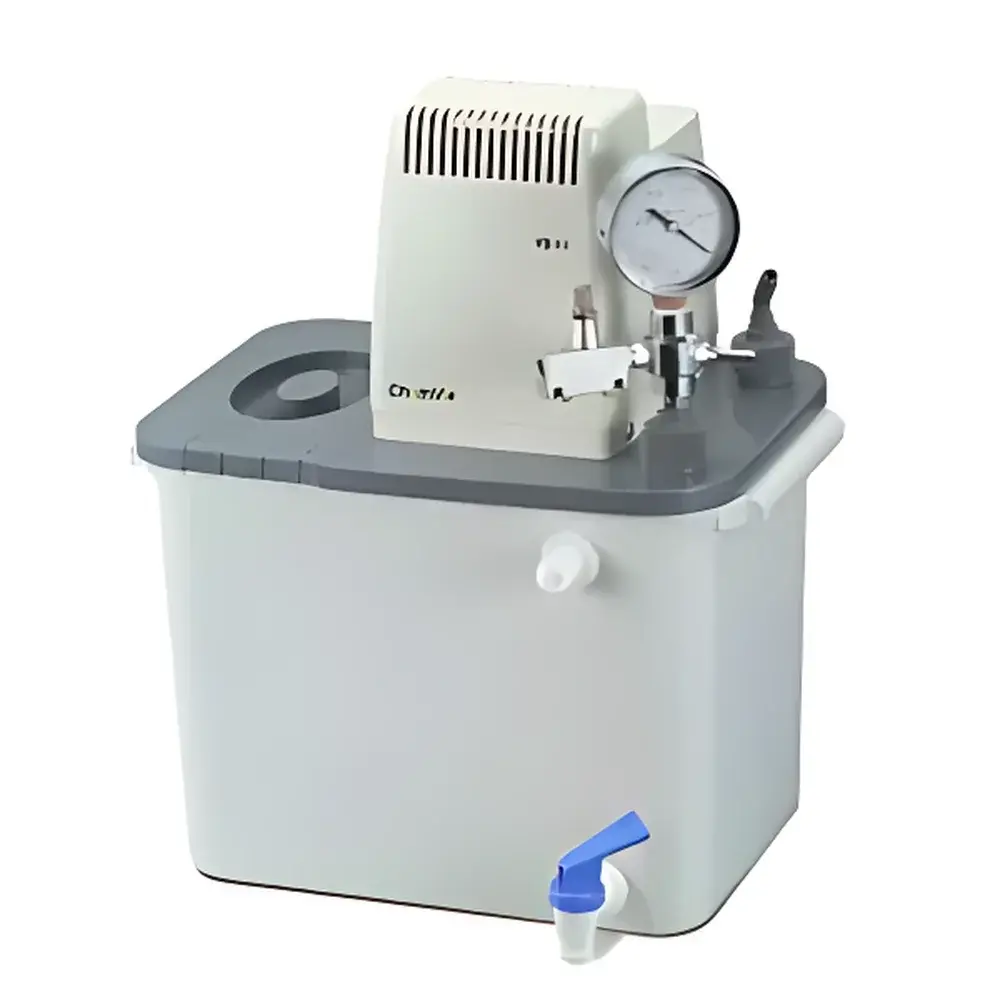
WIGGENS VE-11 Dual-Head Water Circulation Vacuum Pump
| Brand | WIGGENS |
|---|---|
| Origin | Germany |
| Model | VE-11 |
| Pump Type | Oil-Free Water Circulation Vacuum Pump |
| Suction Rate | 18 L/min × 2 |
| Ultimate Vacuum | ≤107 mbar |
| Water Reservoir Capacity | 9.5 L |
| Motor Power | 150 W |
| Weight | 5.7 kg |
| Reservoir Material | Polypropylene (PP) |
| Dimensions (Reservoir) | 298 × 210 × 227 mm |
| Overall Dimensions | 330 × 265 × 390 mm |
| Inlet Port Diameter | 9.5 mm Ø × 2 |
| Drain Port Diameter | 17 mm Ø |
| Safety Features | Built-in Check Valve, Thermal Overload Protection, Fuse |
Overview
The WIGGENS VE-11 Dual-Head Water Circulation Vacuum Pump is an oil-free, water-sealed vacuum generation system engineered for stable, low-maintenance operation in academic, pharmaceutical, and industrial laboratory environments. Unlike mechanical or diaphragm vacuum pumps, the VE-11 operates on the principle of water jet aspiration—leveraging Bernoulli’s principle to convert kinetic energy from a circulating water stream into negative pressure at the venturi nozzles. Two independent water-jet pump heads generate simultaneous vacuum streams, each delivering a consistent suction rate of 18 L/min under standard operating conditions (20 °C tap water, 1 m head). The system achieves an ultimate vacuum of ≤107 mbar (≈80 Torr), suitable for applications requiring moderate vacuum levels—typically 20–500 mmHg (27–667 mbar)—such as rotary evaporation, vacuum filtration, solvent distillation, and low-temperature drying. Its sealed polypropylene reservoir minimizes chemical degradation and eliminates corrosion risks associated with metal tanks, while integrated thermal protection and a dual-stage check valve architecture prevent backflow during power interruption—a critical safeguard for vacuum-sensitive setups.
Key Features
- Dual independent water-jet pump heads enable parallel vacuum generation with synchronized flow control and independent port isolation.
- Polypropylene (PP) reservoir (9.5 L capacity) offers exceptional resistance to acids, bases, and organic solvents—ensuring long-term integrity in aggressive chemical environments.
- Integrated check valve system prevents reverse water flow during unexpected power loss, protecting connected apparatus (e.g., rotary evaporators, filtration manifolds) from contamination or siphoning.
- Adjustable vacuum regulator allows precise manual control over operating vacuum between 20 mmHg and 74 mmHg (27–100 mbar), facilitating method optimization across diverse sample types and boiling point profiles.
- Optional cooling coil (Order No. 900701-2ET-02) can be installed directly into the reservoir to stabilize water temperature—mitigating vapor pressure rise and sustaining vacuum stability during extended operation.
- Drain valve (17 mm Ø) enables rapid, tool-free reservoir emptying for maintenance, solvent changeover, or seasonal storage.
- Thermal overload protection and certified fuse (IEC 60127-1) ensure compliance with EN 61010-1 safety requirements for laboratory electrical equipment.
Sample Compatibility & Compliance
The VE-11 is compatible with aqueous and moderately polar solvent systems commonly used in preparative chemistry workflows. Its oil-free design eliminates risk of hydrocarbon contamination—making it suitable for GLP-compliant sample preparation prior to GC, HPLC, or mass spectrometry analysis. While not intended for high-vacuum or deep-drying applications (<10 mbar), its performance aligns with ASTM D1296 (vacuum distillation of volatile solvents) and ISO 5667-3 (water sampling preservation techniques requiring gentle vacuum filtration). The PP construction meets USP Class VI biocompatibility criteria for non-implantable lab contact surfaces. Device labeling and documentation support traceability per ISO/IEC 17025:2017 Clause 7.7 (equipment records).
Software & Data Management
The VE-11 is a manually operated, analog-controlled instrument with no embedded firmware or digital interface. Vacuum regulation is achieved via a calibrated mechanical needle valve; vacuum level is monitored using a direct-reading analog gauge (0–760 mmHg scale). As such, it requires no software installation, network configuration, or cybersecurity validation. This architecture ensures deterministic behavior, immunity to firmware bugs, and full compatibility with legacy lab infrastructure—including fume hood-integrated vacuum networks and analog data loggers. For laboratories maintaining 21 CFR Part 11 compliance, manual logbook entries (including date, operator ID, vacuum setpoint, and application type) constitute the primary audit trail.
Applications
- Routine rotary evaporation: Stable vacuum delivery supports efficient solvent removal from heat-sensitive compounds at bath temperatures ≤50 °C.
- Vacuum-assisted gravity filtration: Compatible with Büchner funnels, Hirsch funnels, and membrane filtration assemblies (0.2–0.45 µm pore sizes).
- Short-path distillation: Provides reproducible vacuum levels for fractional separation of low-boiling-point fractions (e.g., terpenes, ethyl acetate, dichloromethane).
- Desiccator evacuation: Rapid initial draw-down followed by regulated hold pressure minimizes desiccant exhaustion.
- Gas sampling manifold priming: Used to evacuate headspace vials or Tedlar bags prior to static headspace analysis.
FAQ
Can the VE-11 be used with organic solvents like acetone or chloroform?
Yes—provided the solvent is miscible with water and does not exceed the chemical resistance limits of polypropylene. Avoid use with concentrated oxidizers (e.g., nitric acid), halogenated solvents above 60 °C, or strong alkalis >10 wt%.
Is the vacuum level adjustable during operation?
Yes—the front-panel vacuum regulator allows real-time adjustment without interrupting flow or requiring disassembly.
What maintenance is required?
Daily: Check water level and clarity; weekly: inspect check valves for debris; annually: replace fuse and verify thermal cutoff function per manufacturer service bulletin SB-VE11-2023.
Does the unit include a vacuum gauge?
Yes—an integrated analog Bourdon-tube gauge with 0–760 mmHg range and ±2 mmHg accuracy at ambient temperature.
Can multiple devices share one VE-11 unit?
No—each VE-11 serves two independent ports only. Daisy-chaining or manifold distribution is not recommended due to flow imbalance and vacuum instability.



