
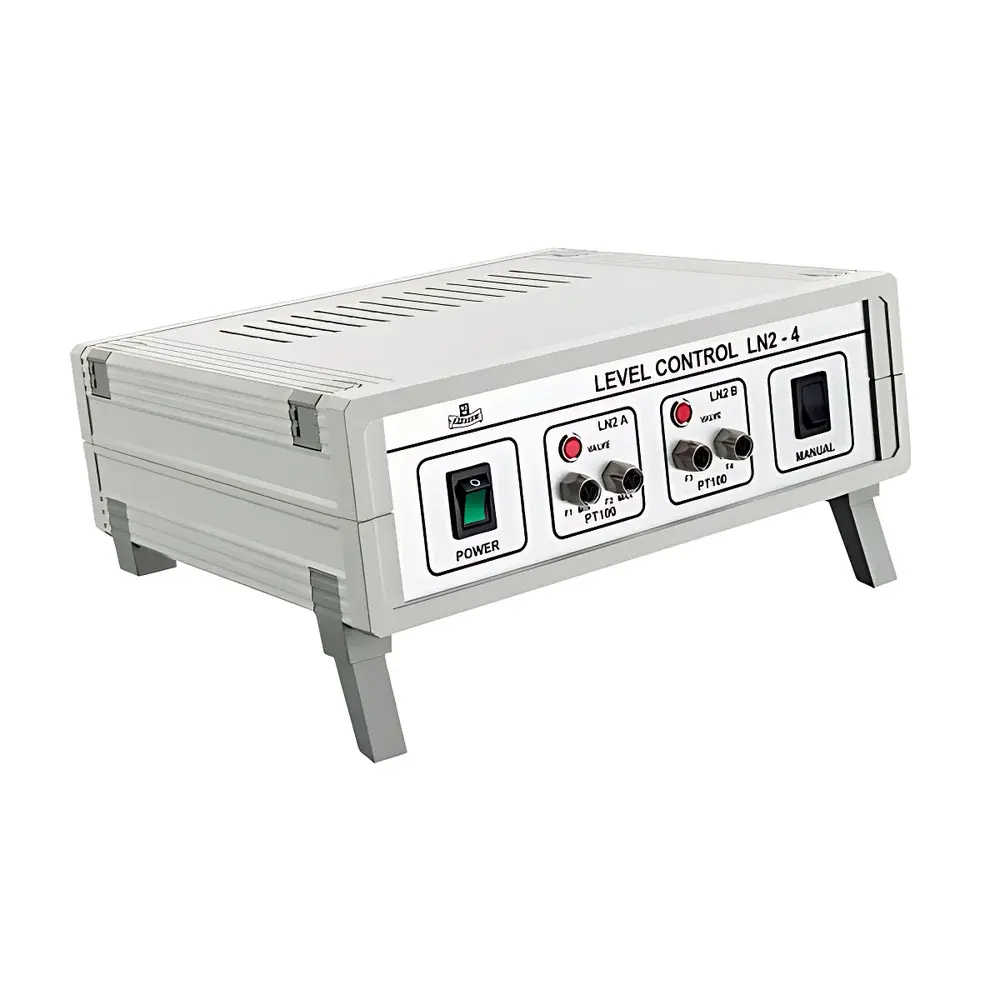
WIGGENS LN2-4 Liquid Nitrogen Level Automatic Controller
| Brand | WIGGENS |
|---|---|
| Origin | Germany |
| Model | LN2-4 |
| Temperature Sensing | 4× PT100 (Cryogenic-Optimized) |
| Control Outputs | 2× Relay (24 V DC, SPDT) |
| Communication Interfaces | RS232 & USB |
| Alarm System | Visual (LED) & Audible (Buzzer) |
| Data Logging | Internal Timestamped Event Storage |
| Sensor Compatibility | Cryo-rated PT100 with Stainless Steel Sheathing (Optional Thread/Weld Mount Adapters) |
| Electromagnetic Valve Support | 24 V DC Solenoid Valves (e.g., WIGGENS Type 1303) |
| Safety Architecture | Dual-Channel Redundancy (2× Operational + 2× Independent Safety Sensors) |
| Calibration | Single-Point Cryogenic Offset Calibration at 77 K |
Overview
The WIGGENS LN2-4 Liquid Nitrogen Level Automatic Controller is an engineered precision instrument designed for stable, hands-free maintenance of liquid nitrogen (LN₂) levels in open or semi-vented cryogenic Dewar vessels used in life science laboratories, biobanking facilities, and long-duration sample preservation systems. It operates on the principle of thermal conductivity-based level detection: cryogenically rated PT100 resistance temperature detectors (RTDs) immersed in the Dewar respond differentially to the presence or absence of liquid nitrogen — where the liquid phase yields a stable ~77 K reading, while the gas phase produces a significantly higher temperature signal. By monitoring real-time resistance shifts across multiple spatially distributed sensors, the LN2-4 interprets liquid height changes with high reproducibility and minimal hysteresis. Its control logic implements closed-loop feedback using two independent relay outputs to actuate solenoid valves in the LN₂ supply line, enabling autonomous refilling driven by tank self-pressurization (typically 0.5–1.2 bar). The system is purpose-built for integration into GLP-compliant workflows requiring uninterrupted cryostasis — particularly in applications involving cryopreserved cell lines, oocytes, stem cells, and archival tissue specimens.
Key Features
- Dual-redundant sensor architecture: Supports up to four PT100 inputs — configurable as two operational (high/low working level) and two independent safety channels (overfill/underfill alarm thresholds)
- Fail-safe relay control: Two isolated 24 V DC SPDT relays rated for continuous cryogenic valve duty cycles; contact rating: 5 A @ 250 V AC / 30 V DC
- Cryogenic hardware compatibility: All included and optional sensors feature stainless steel sheathing (AISI 316L), PTFE-insulated leads, and low-thermal-conductivity mounting adapters (threaded or welded)
- Real-time status visualization: Front-panel LED indicators for power, communication, valve state, and alarm conditions — no external display required for basic operation
- Event-driven data logging: Timestamped records of valve actuation, sensor anomalies, alarm triggers, and manual overrides stored internally (non-volatile memory); exportable via RS232 or USB to CSV-compatible software
- Configurable safety protocols: Programmable delay timers for alarm escalation, automatic valve shutoff upon critical deviation, and seamless switchover to secondary LN₂ reservoirs via auxiliary relay sequencing
Sample Compatibility & Compliance
The LN2-4 is validated for use with standard laboratory Dewars (e.g., MVE, Chart, CryoStar) ranging from 5 L to 100 L capacity, including both open-neck and pressure-relief vented configurations. It complies with IEC 61000-6-2 (immunity) and IEC 61000-6-3 (emission) for industrial environments. While not certified as medical device hardware under ISO 13485, its deterministic control logic, audit-trail-capable logging, and dual-channel safety architecture align with core principles of FDA 21 CFR Part 11 (electronic records/signatures) when deployed within validated laboratory information management systems (LIMS). Sensor calibration procedures follow ASTM E1137/E1137M for platinum resistance thermometers, with single-point offset adjustment traceable to NIST-certified reference standards at 77.36 K (liquid nitrogen triple point).
Software & Data Management
The LN2-4 includes embedded firmware supporting local configuration via front-panel push buttons and full parameter access via ASCII-command protocol over RS232 or USB virtual COM port. A Windows-compatible configuration utility (provided on secure download portal) enables advanced setup: setpoint definition, hysteresis width, alarm delay intervals, relay polarity inversion, and event log filtering. All logged entries include UTC timestamps, sensor ID tags, and state-change descriptors — facilitating retrospective analysis during internal audits or CAPA investigations. Data exports conform to ISO/IEC 17025 Annex A.2 requirements for raw measurement integrity, with no post-acquisition interpolation or smoothing applied.
Applications
- Automated replenishment of LN₂ in specimen storage Dewars during unattended overnight or weekend operation
- Integration into automated cryo-storage robotics platforms requiring precise, repeatable fill-level maintenance
- Safety-critical backup for ultra-low temperature freezers (ULTs) relying on LN₂ jacket cooling
- Control of multi-tank cascaded systems where primary and secondary LN₂ reservoirs are sequenced based on real-time level telemetry
- Compliance-supporting operation in AABB-accredited cord blood banks and ISBER-endorsed biorepositories
- Research-grade cryopreservation studies requiring documented thermal history continuity across extended freeze-thaw cycles
FAQ
What temperature range are the PT100 sensors rated for?
The standard sensors are calibrated and verified for continuous operation between 4 K and 323 K, with optimal accuracy maintained at 65–85 K for LN₂ level discrimination.
Can the LN2-4 interface with PLC-based facility management systems?
Yes — via Modbus RTU over RS232 (custom protocol mapping available upon request) or discrete dry-contact signals from its relay outputs.
Is firmware update capability supported in-field?
Yes — updates are delivered as signed binary files and installed via USB; version history and checksum verification are retained in non-volatile memory.
How is sensor drift compensated over time?
The controller supports periodic single-point recalibration at LN₂ boil-off temperature; no field recalibration of full-scale range is required due to PT100’s inherent stability below 100 K.
Does the unit meet ATEX or IECEx requirements for hazardous locations?
No — it is rated for Class I, Division 2 / Zone 2 environments only; installation must comply with NEC Article 500 and IEC 60079-14 for non-incendive circuit design.






