
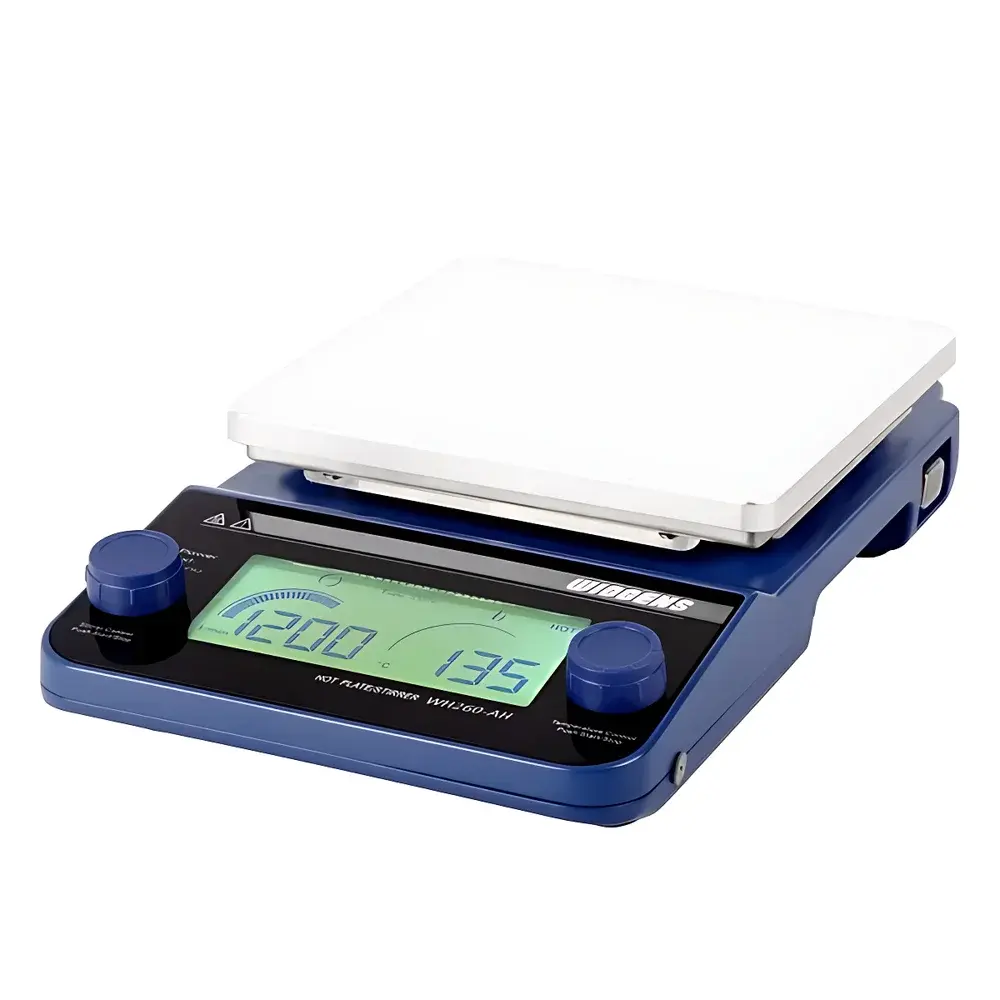
WIGGENS WH260-AH Advanced Heating Magnetic Stirrer
| Brand | WIGGENS |
|---|---|
| Origin | Germany |
| Model | WH260-AH |
| Maximum Stirring Volume | 20 L |
| Speed Range | 100–1500 rpm |
| Heating Plate Temperature | ≤380 °C |
| Sample Temperature Control Range (with Pt100) | ≤200 °C |
| Safety Cut-off Temperature Range | 50–430 °C (adjustable) |
| Over-Temperature Offset ΔT | 10–50 °C (adjustable) |
| Temperature Stability (with Pt100) | ±1 °C |
| Heating Power | 800 W |
| Display | LCD digital |
| Control Interface | Rotary knobs + menu navigation |
| Timer Function | 1–1999 min or continuous operation |
| Plate Material | Nano-coated enamel steel |
| Plate Dimensions | 180 × 180 mm |
| USB-A Interface | Yes |
| Dimensions (W×D×H) | 187 × 315 × 86 mm |
| Weight | 3.7 kg |
| Power Supply | 220 V / 50 Hz |
Overview
The WIGGENS WH260-AH Advanced Heating Magnetic Stirrer is an engineered solution for laboratories requiring precise, reproducible thermal and mechanical control during sample preparation, dissolution studies, reaction monitoring, and routine homogenization. Designed and manufactured in Germany, this unit integrates high-efficiency infrared-enhanced heating with robust magnetic stirring mechanics—operating on the principle of rotating magnetic fields to drive PTFE- or ceramic-coated stir bars within vessels. Its core architecture supports both gentle mixing of sensitive biological suspensions and vigorous agitation of viscous or high-boiling-point solvents. The system employs a Pt100 external temperature probe for closed-loop feedback control, enabling accurate regulation of sample temperature independent of plate surface conditions—a critical distinction from ambient-based heating systems. With a maximum heating plate temperature of 380 °C and sample temperature control up to 200 °C, the WH260-AH meets the operational demands of synthetic chemistry, polymer processing, and pharmaceutical formulation workflows where thermal precision and mechanical stability are non-negotiable.
Key Features
- Triple-PID algorithm selection (PID1–PID3) optimized for distinct thermal mass profiles: PID1 for low-thermal-inertia samples (e.g., <50 mL aqueous solutions), PID3 for rapid ramping of large-volume or high-heat-capacity media (e.g., 15–20 L oil baths)
- Nano-metallic enamel-coated stainless-steel heating plate offering superior corrosion resistance, uniform heat distribution, and long-term thermal stability
- Integrated anti-spill liquid channel above the control panel—designed to divert accidental splashes away from electronics without interrupting operation
- Microprocessor-based control system with non-volatile memory that retains last-used parameters (speed, temperature, timer, PID setting) across power cycles
- Programmable overtemperature protection with dual-stage safety: adjustable ΔT offset (10–50 °C above setpoint) plus independent hardware thermal cutoff (50–430 °C range)
- USB-A interface supporting firmware updates and optional data logging via compatible PC software (not included)
Sample Compatibility & Compliance
The WH260-AH accommodates standard laboratory glassware including beakers (up to 20 L), round-bottom flasks, and jacketed reactors. Its sealed enclosure design conforms to IP20 environmental rating standards, ensuring reliable performance under typical ISO 14644 Class 8 cleanroom-adjacent lab conditions. While not intrinsically rated for hazardous area use, its electrical isolation and grounded chassis comply with IEC 61010-1:2010 for laboratory electrical equipment safety. The device supports GLP-compliant workflows through deterministic parameter recall, time-stamped operation logs (when paired with external software), and traceable thermal calibration via Pt100 sensor input. It is routinely deployed in applications aligned with ASTM D1298 (density of crude oil), USP (dissolution apparatus qualification), and ISO 8573-1 (compressed air purity testing support protocols).
Software & Data Management
Although the WH260-AH operates as a standalone instrument, its USB-A port enables connectivity to Windows-based host systems for extended functionality. When used with WIGGENS’ optional LabControl Suite (v3.2+), users gain access to real-time graphing of speed, plate temperature, and sample temperature; scheduled ramp/soak profiles; and exportable CSV-formatted datasets compliant with 21 CFR Part 11 requirements when configured with electronic signature modules. Audit trails—including operator ID, parameter changes, and error events—are recorded locally and retrievable via USB transfer. All firmware updates undergo cryptographic signature verification to ensure integrity and prevent unauthorized modification.
Applications
- Chemical synthesis requiring simultaneous heating and controlled agitation under reflux or inert atmosphere
- Pharmaceutical dissolution testing per USP Apparatus II (paddle method) using calibrated water baths
- Preparation of homogeneous polymer blends, nanoparticle dispersions, and colloidal suspensions
- Environmental sample digestion (e.g., EPA Method 3050B) with regulated ramp-and-hold thermal profiles
- Quality control of industrial lubricants, adhesives, and coatings where viscosity-temperature relationships must be assessed
- Biological buffer equilibration at defined temperatures prior to chromatography or electrophoresis
FAQ
Does the WH260-AH support external temperature feedback control?
Yes—it accepts standard Pt100 RTD probes (2-, 3-, or 4-wire) for direct sample temperature measurement and closed-loop regulation.
Can multiple WH260-AH units be synchronized for parallel experiments?
No native master-slave synchronization is provided; however, identical parameter sets can be replicated manually or via batch-loaded configuration files using LabControl Suite.
Is the heating plate surface compatible with aggressive solvents such as concentrated HNO₃ or HF?
The nano-enamel coating resists mild acids and bases but is not rated for hydrofluoric acid or molten alkali metals; consult the chemical compatibility chart in the user manual before exposure.
What is the minimum recommended stir bar size for optimal coupling at 1500 rpm?
A 40 mm elliptical PTFE-coated stir bar is recommended for volumes ≥5 L at maximum speed; smaller bars may decouple under high-viscosity or turbulent conditions.
How frequently should the unit undergo metrological verification?
Annual calibration of Pt100 input and plate temperature sensors is recommended per ISO/IEC 17025 guidelines when used in regulated environments; internal diagnostics run automatically at startup.



