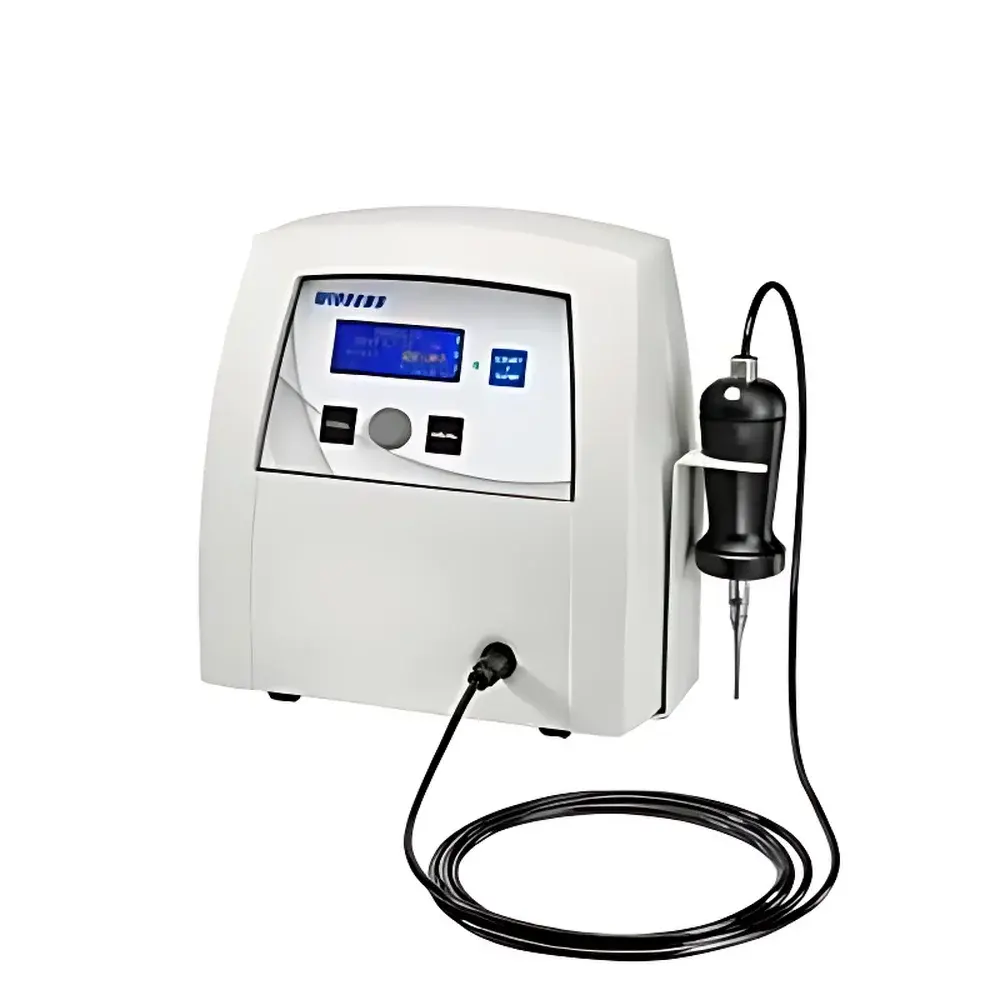
WIGGENS mini20 Ultrasonic Cell Disruptor
| Brand | WIGGENS |
|---|---|
| Origin | Germany |
| Model | mini20 |
| Instrument Type | Ultrasonic Cell Disruptor |
| Ultrasonic Power Output | 20 W |
| Operating Frequency | 30 kHz |
| Amplitude Range | 10–100% (adjustable) |
| Pulse Mode | On-time 0.1–60 s / Off-time 0.2–60 s |
| Timer Range | 0–59 min 59 s |
| Sample Volume Capacity | 0.1–25 mL |
| Probe Diameter Options | 1.5 mm, 2.0 mm, 2.5 mm |
| Dimensions (Generator) | 250 × 256 × 154 mm |
| Dimensions (Transducer) | Ø50 × 160 mm |
| Safety Cutoff | Yes |
| Display | Digital LCD with energy (kJ) and pulse status |
| Interface | RS-232 (IR port) |
| Certifications | CE compliant |
| Power Supply | 100–240 V~, 50/60 Hz |
Overview
The WIGGENS mini20 Ultrasonic Cell Disruptor is a compact, high-precision benchtop sonicator engineered for controlled mechanical lysis of biological samples via high-frequency ultrasonic cavitation. Operating at a fixed frequency of 30 kHz, the system converts electrical input into longitudinal mechanical vibrations transmitted through interchangeable titanium alloy probes. These vibrations generate transient microcavitation bubbles in liquid media; their asymmetric collapse produces localized shear forces, microstreaming, and shockwaves sufficient to disrupt cellular membranes, organelles, and microbial cell walls—without significant thermal degradation when operated under pulsed conditions. Designed specifically for low-volume applications, the mini20 delivers reproducible energy input across sample volumes ranging from 0.1 mL (e.g., single-well microplate lysates) to 25 mL (e.g., suspension cultures), making it ideal for molecular biology labs requiring scalable, non-chemical lysis protocols compatible with downstream nucleic acid extraction, protein solubilization, or nanoparticle dispersion.
Key Features
- Stable amplitude control system ensuring consistent vibrational output and inter-run reproducibility—critical for GLP-compliant sample preparation workflows.
- Digitally adjustable amplitude (10–100%) with automatic limitation based on selected probe geometry, preventing mechanical overload and probe fracture.
- Pulse mode operation with independently programmable on/off intervals (0.1–60 s each), enabling precise thermal management during processing of thermolabile samples such as enzymes, antibodies, or RNA.
- Integrated digital timer with dual-mode functionality: countdown operation or cumulative runtime logging, plus auto-shutdown to prevent dry-running or overheating.
- RS-232 infrared interface supporting remote triggering and basic parameter synchronization with external lab automation systems or PC-based logging software.
- CE-certified safety architecture including real-time fault diagnostics, overtemperature protection, and hardware-enforced amplitude limits aligned with IEC 61000-6-3 EMC standards.
Sample Compatibility & Compliance
The mini20 accommodates a broad range of biological and colloidal systems—including mammalian cells, bacteria (E. coli, Bacillus spp.), yeast, fungal spores, plant protoplasts, and liposomal suspensions—across volumes from 0.1 mL to 25 mL. Its modular probe design supports three standard tip diameters (1.5 mm, 2.0 mm, 2.5 mm), each optimized for specific energy density requirements: smaller tips deliver higher localized intensity for viscous or dense suspensions, while larger tips provide broader energy distribution for homogenization of dilute cultures. All probes are constructed from medical-grade Ti-6Al-4V alloy, resistant to corrosion and ultrasonic erosion. The instrument meets CE marking requirements for electromagnetic compatibility (EMC) and low-voltage directive compliance (2014/35/EU). While not FDA 21 CFR Part 11 validated out-of-the-box, its digital audit trail (energy input, pulse count, runtime) supports integration into GMP/GLP environments where electronic record integrity is mandated.
Software & Data Management
The mini20 features an embedded microcontroller-driven interface with a backlit LCD display showing real-time parameters: active pulse state, accumulated energy (kJ), elapsed time, and amplitude setting. Though it lacks onboard data storage or graphical user interface, the RS-232 infrared port enables serial communication for external logging via third-party terminal emulators or custom LabVIEW/Python scripts. Energy delivery is calculated in real time using calibrated transducer impedance feedback, ensuring traceable quantification of acoustic power delivered per cycle—a prerequisite for method transfer between instruments or laboratories. Users may store up to nine preset protocols (amplitude, pulse timing, duration), facilitating rapid reconfiguration for standardized assays such as plasmid prep, chromatin shearing, or nanoparticle deagglomeration.
Applications
- Molecular biology: Rapid lysis of bacterial and mammalian cells prior to DNA/RNA isolation or Western blot sample preparation.
- Proteomics: Solubilization of inclusion bodies and membrane proteins without denaturants.
- Nanotechnology: Dispersion of carbon nanotubes, graphene oxide, or metal oxide nanoparticles in aqueous or organic solvents.
- Vaccinology & virology: Inactivation and antigen release from viral particles or whole-cell vaccines.
- Food microbiology: Enumeration and recovery of stressed or VBNC-state microorganisms from complex matrices.
- Environmental analysis: Extraction of intracellular metabolites from biofilm-associated microbes in water or soil extracts.
FAQ
What is the maximum recommended continuous operating time per cycle?
The device supports up to 59 minutes and 59 seconds of continuous or pulsed operation per session, after which it automatically halts to prevent transducer overheating.
Can the mini20 be used for in situ sonication inside sealed tubes or vials?
Yes—when paired with appropriate horn adapters and cooling jackets, it supports sonication in 0.5–2 mL microcentrifuge tubes, 15–50 mL conical tubes, and standard 96-well plates (with optional multi-tip arrays).
Is calibration traceable to national standards?
Amplitude calibration is factory-performed using laser vibrometry against ISO 18437-1 reference methods; certificate of conformance is supplied with each unit.
Does the system support temperature monitoring during sonication?
No integrated temperature sensor is included; however, external PT100 probes or IR thermometers may be used in conjunction with manual pulse scheduling to maintain sample temperatures below 4 °C.
How often should the ultrasonic probe be inspected for wear?
Titanium probes should be visually inspected before each use for pitting, cracking, or tip deformation; typical service life exceeds 500 hours under nominal 20 W loading with proper cleaning and descaling.