
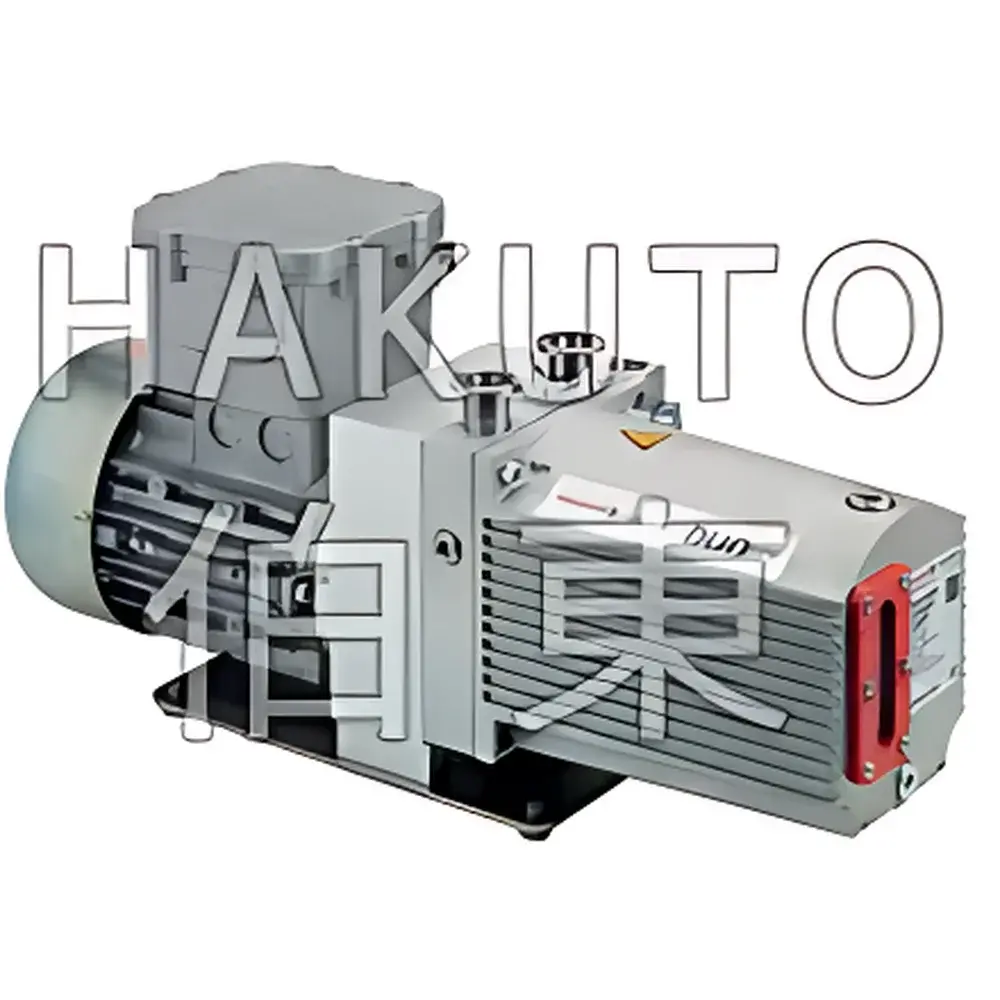
Pfeiffer Vacuum DUO 11 ATEX Explosion-Proof Dual-Stage Rotary Vane Pump
| Brand | Pfeiffer Vacuum |
|---|---|
| Origin | Germany |
| Model | DUO 11 ATEX |
| Pump Type | Oil-Lubricated Rotary Vane |
| Ultimate Pressure (Gas Ballast ON) | 3 × 10⁻² hPa |
| Ultimate Pressure (Gas Ballast OFF) | 3 × 10⁻³ hPa |
| Pumping Speed | 9 m³/h (2.5 L/s) |
| Motor Power | 300 W |
| Dimensions (L×W×H) | 440 × 146 × 219 mm |
| Weight | 15.3 kg |
| Cooling Method | Air-Cooled |
| Drive Speed | 3,000 min⁻¹ |
| Inlet Flange | DN 16 ISO-KF |
| ATEX Certification | Directive 2014/34/EU, Category 3G, Temperature Class T4, Gas Group IIC |
| Compliance | EN 60079-0, EN 60079-1, EN 60079-31 |
Overview
The Pfeiffer Vacuum DUO 11 ATEX is an intrinsically safe, dual-stage rotary vane vacuum pump engineered for continuous operation in potentially explosive atmospheres. Designed and manufactured in Germany to stringent EU safety standards, it employs a hermetically sealed magnetic coupling drive system that eliminates mechanical shaft penetration through the pump housing—thereby preventing any leakage path for hazardous process gases into the ambient environment. Its measurement principle relies on positive displacement via two counter-rotating vanes within an eccentrically mounted rotor, delivering stable, pulse-free suction across its operational range. The DUO 11 ATEX is specifically certified under ATEX Directive 2014/34/EU for use in Zone 2 (gas) environments, meeting Category 3G requirements with a maximum surface temperature of ≤135 °C (T4 classification), making it suitable for handling all Group IIC gases—including hydrogen, acetylene, and ethylene—without risk of ignition.
Key Features
- ATEX-certified explosion-proof design compliant with Directive 2014/34/EU, EN 60079-0, EN 60079-1, and EN 60079-31 for electrical equipment in explosive atmospheres
- Magnetic coupling transmission ensures zero dynamic seal failure risk and eliminates potential gas leakage paths
- Dual-stage oil-lubricated architecture enables reliable rough vacuum generation down to 3 × 10⁻³ hPa (with gas ballast closed)
- Optimized thermal management via passive air cooling; no external coolant or water supply required
- Integrated gas ballast valve for controlled admission of atmospheric air during pumping of condensable vapors—enhancing tolerance to solvent-laden or humid process streams
- Compact footprint (440 × 146 × 219 mm) and lightweight construction (15.3 kg) facilitate integration into benchtop vacuum systems, gloveboxes, and analytical instrument manifolds
- Stainless steel inlet flange (DN 16 ISO-KF) ensures compatibility with standard vacuum tubing and modular interconnects
Sample Compatibility & Compliance
The DUO 11 ATEX is intended for non-corrosive, dry, or mildly condensable gas applications where intrinsic safety is mandated by occupational health and safety regulations. It is not suitable for pumping aggressive chemicals (e.g., halogenated solvents, strong acids, or alkalis) or particulate-laden streams without upstream filtration. All materials in contact with the pumped medium conform to RoHS and REACH requirements. The pump meets essential health and safety requirements outlined in the EU Machinery Directive 2006/42/EC and carries CE marking. Its ATEX certification documentation includes full test reports from an EU Notified Body (No. 0082), verifying compliance with temperature class T4 and Group IIC gas compatibility. For laboratories operating under GLP or GMP frameworks, the DUO 11 ATEX supports audit-ready installation when paired with calibrated pressure gauges and documented maintenance logs per manufacturer-recommended intervals.
Software & Data Management
As a standalone mechanical vacuum pump, the DUO 11 ATEX operates without embedded firmware or digital control interfaces. It features a manually actuated gas ballast valve and requires no software configuration. However, its analog output signals (e.g., optional pressure switch or current loop interface kits) can be integrated into supervisory control systems (SCADA, PLC) for remote status monitoring and interlock logic. When deployed in regulated environments, users may implement electronic logbooks aligned with FDA 21 CFR Part 11 requirements to record runtime hours, maintenance events, and calibration history—ensuring traceability for quality audits.
Applications
- Rough vacuum backing for turbomolecular pumps in mass spectrometers, electron microscopes, and surface analysis tools
- Vacuum drying and degassing of pharmaceutical intermediates in ATEX-classified cleanrooms
- Process evacuation of explosion-hazardous reaction vessels and pilot-scale reactors
- Evacuation of inert-atmosphere gloveboxes used in battery material synthesis or organometallic chemistry
- Support vacuum for leak detection systems utilizing helium or hydrogen tracer gases in petrochemical R&D labs
- Continuous operation in semiconductor fabrication tool clusters requiring certified zone-2 vacuum sources
FAQ
What does “Category 3G” mean in ATEX classification?
Category 3G indicates equipment designed for use in Zone 2—areas where an explosive gas atmosphere is not likely to occur in normal operation and, if it does occur, will persist only for a short period. Such devices must remain safe under expected operating conditions and single-fault scenarios.
Can the DUO 11 ATEX be used with corrosive vapors?
No. The pump’s internal components—including vanes, rotor, and stator—are optimized for hydrocarbon-based oils and non-aggressive gases. Exposure to chlorine, fluorine, ammonia, or acidic vapors will accelerate wear and compromise sealing integrity.
Is oil change interval specified by Pfeiffer Vacuum?
Yes. Under continuous operation at ambient temperatures ≤30 °C, oil replacement is recommended every 3,000 operating hours or annually—whichever occurs first. Use only Pfeiffer-approved vacuum pump oil (e.g., FVP 100 or equivalent).
Does the pump include a built-in pressure gauge?
No. The DUO 11 ATEX is supplied without integrated vacuum measurement. Users must install a compatible analog or digital vacuum gauge (e.g., Pirani or capacitance manometer) upstream of the inlet flange for process monitoring.
What is the minimum ambient temperature for safe operation?
The pump is rated for ambient temperatures between +5 °C and +40 °C. Operation below +5 °C may increase oil viscosity and impair startup torque; above +40 °C requires supplemental ventilation to maintain surface temperature compliance with T4 limits.



