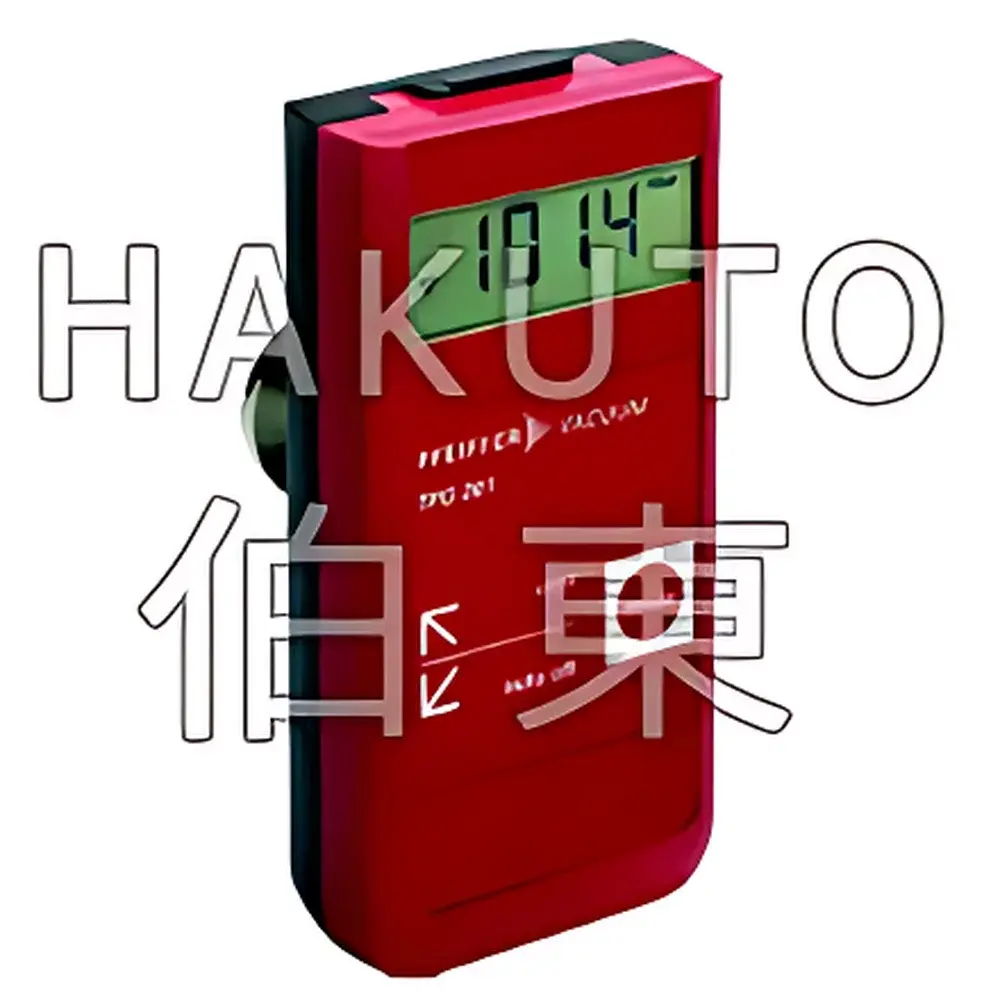
Pfeiffer Vacuum TPG 201 Handheld Pirani Vacuum Gauge
| Brand | Pfeiffer Vacuum |
|---|---|
| Origin | Germany |
| Model | TPG 201 |
| Measurement Principle | Pirani (thermal conductivity) |
| Pressure Range | 1000 to 5 × 10⁻⁴ hPa |
| Vacuum Interface | KF 16 |
| Operating Temperature | 5 to 40 °C |
| Accuracy | ±30 % at 10–100 hPa |
| Display | Integrated LCD |
| Power Supply | Rechargeable battery or external stabilized DC supply |
| Weight | 0.195 kg |
| Housing Material | Corrosion-resistant stainless steel |
| Heating Option | Available for low-outgassing and UHV-compatible operation |
Overview
The Pfeiffer Vacuum TPG 201 is a compact, battery-powered handheld vacuum gauge engineered for reliable and portable measurement of rough and medium vacuum in industrial, laboratory, and service environments. Based on the well-established Pirani principle—thermal conductivity dependence of gases—the TPG 201 delivers stable, real-time pressure readings across a wide dynamic range from atmospheric pressure down to 5 × 10⁻⁴ hPa. Its robust stainless-steel housing, KF 16 vacuum interface, and optional heater configuration ensure compatibility with demanding applications including low-outgassing systems and ultra-high vacuum (UHV)-adjacent setups. Unlike active gauges requiring continuous power from external sources, the TPG 201 operates independently via integrated rechargeable batteries—enabling field diagnostics, pump commissioning, leak-check verification, and routine maintenance without dependency on fixed infrastructure.
Key Features
- True handheld operation with integrated LCD display for immediate local pressure readout—no external controller required
- Pirani sensor technology offering high reproducibility and long-term stability under varying gas compositions (N₂-equivalent calibration)
- KF 16 flange interface compliant with ISO-K standard, enabling rapid connection to vacuum chambers, pumps, and manifolds
- Corrosion-resistant 316L stainless-steel body rated for chemical exposure in semiconductor, coating, and analytical instrumentation environments
- Optional heating module (TPG 201-H variant) minimizes condensation and surface adsorption effects, extending operational reliability below 10⁻³ hPa
- USB interface supporting data logging and post-processing via DokuStar software—enabling timestamped measurement export in CSV format
- Power flexibility: operates on internal Li-ion battery pack (up to 100 hours typical runtime) or external stabilized DC input (12 V)
Sample Compatibility & Compliance
The TPG 201 is suitable for use with common process gases (N₂, O₂, Ar, He, air) and inert atmospheres. While calibrated for nitrogen, its Pirani response exhibits predictable deviation factors for other gases—documented in Pfeiffer’s technical reference manual for traceability and correction. The device complies with CE marking requirements per EU Directive 2014/30/EU (EMC) and 2014/35/EU (LVD). It meets environmental operating conditions specified in IEC 60068-2-1 (cold), IEC 60068-2-2 (dry heat), and IEC 60068-2-6 (vibration). For regulated industries—including pharmaceutical manufacturing and medical device R&D—the TPG 201 supports audit-ready documentation when used with DokuStar’s configurable logging parameters (user ID, session notes, auto-timestamping), aligning with GLP and GMP data integrity expectations.
Software & Data Management
DokuStar software (Windows-based, USB-connected) provides full control over measurement logging intervals (1 s to 60 min), alarm thresholds, and unit selection (hPa, mbar, Pa, Torr). All acquired datasets include embedded metadata: serial number, firmware version, sensor ID, ambient temperature, and battery status. Exported files are ASCII-encoded CSV with UTF-8 encoding—ensuring compatibility with LIMS platforms, MATLAB, Python pandas, and statistical analysis tools. Audit trail functionality records user-initiated actions (e.g., zero calibration, unit change, memory clear), satisfying FDA 21 CFR Part 11 requirements when deployed with organizational electronic signature policies.
Applications
- Routine maintenance and troubleshooting of rotary vane, diaphragm, and scroll vacuum pumps
- Commissioning and performance validation of vacuum chambers in thin-film deposition, electron microscopy, and mass spectrometry systems
- Replacement of aging mechanical Bourdon tube gauges where digital accuracy, portability, and data traceability are required
- Field verification of vacuum integrity during installation or repair of HVAC chillers, transformer tanks, and power insulators
- Teaching laboratories and undergraduate physics courses demonstrating gas kinetics and vacuum fundamentals
- Quality assurance workflows in packaging, sterilization, and vacuum drying processes requiring documented pressure profiles
FAQ
What is the recommended recalibration interval for the TPG 201?
Pfeiffer recommends annual recalibration against a certified reference standard under controlled N₂ atmosphere. Field zeroing (at atmospheric pressure) should be performed before each measurement series.
Can the TPG 201 be used in oxygen-rich or hydrogen environments?
Yes—but with documented correction factors applied per Pfeiffer’s Gas Sensitivity Table (Publication No. 700-102). Hydrogen measurements require +100 % correction; helium requires −25 %.
Is the USB interface compatible with modern Windows OS versions?
Yes—DokuStar v4.3+ supports Windows 10 and 11 (64-bit); driver installation is automatic via Windows Update or included INF package.
Does the TPG 201 support analog output or relay control?
No—this model is strictly digital readout and data logging only. For analog interfaces or switching functions, consider the TPG 300 series controllers.
How does the optional heater affect measurement stability?
The heater maintains sensor temperature at ~100 °C, reducing water vapor condensation and minimizing drift during extended low-pressure operation—particularly beneficial below 10⁻³ hPa in humid ambient conditions.