
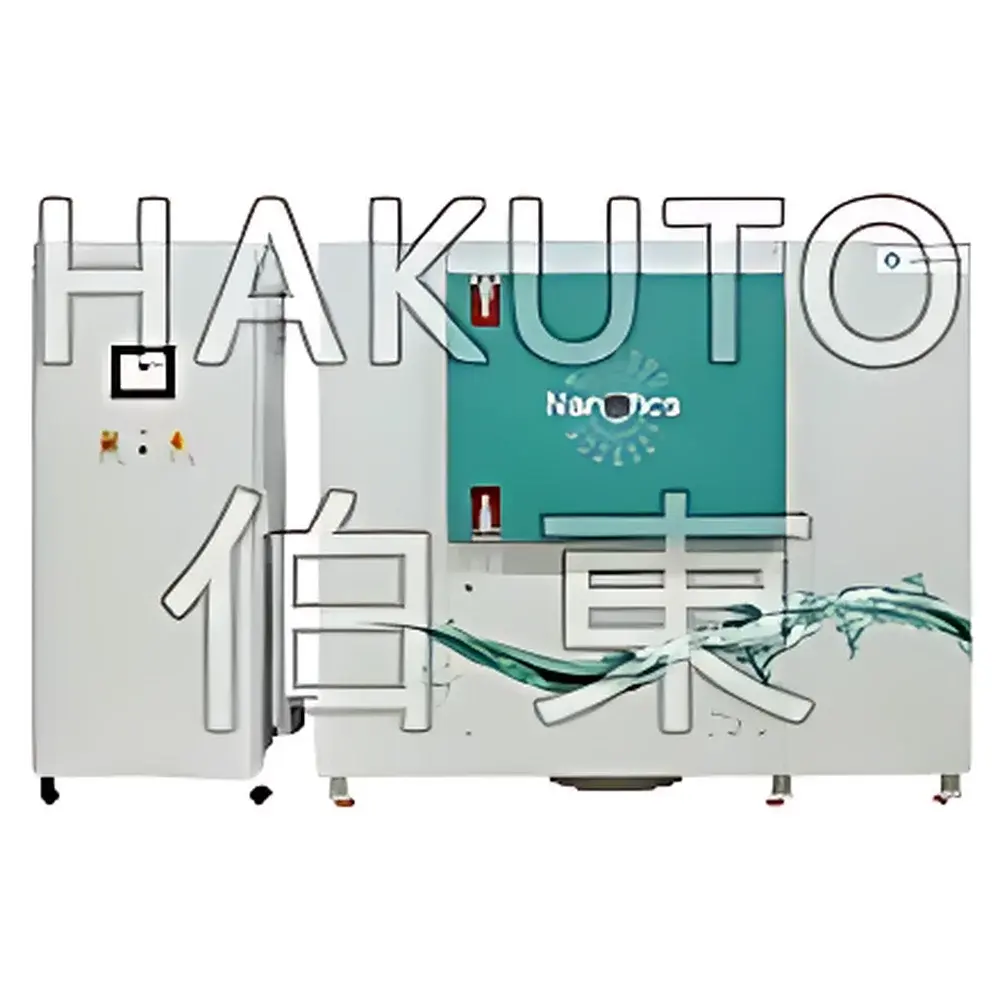
Europlasma CD-1000-PLC Plasma Surface Treater
| Brand | Europlasma |
|---|---|
| Origin | Belgium |
| Model | CD-1000-PLC |
| Chamber Volume | 490 L |
| Chamber Dimensions | 1000 × 700 × 700 mm |
| Chamber Material | Anodized Aluminum |
| Operating Gases | Ar, O₂ |
| Control System | PLC-based Automated Process Control |
| Vacuum Level | Down to 70 mTorr (Pirani gauge) |
| RF Generator | Custom-configurable |
| Power Supply | 380 V AC, 3-phase, 50 Hz, 40 A |
| Gas Inlet | 1/4″ (6.45 mm) with Mass Flow Controller (MFC) |
| Exhaust Port | Ø28 mm |
| Safety Compliance | CE-certified with Emergency Stop, Vacuum Pump Interlock, Thermal Overload Protection |
Overview
The Europlasma CD-1000-PLC is a high-capacity, industrial-grade low-pressure plasma surface treatment system engineered for precise, reproducible surface activation and functional nanocoating deposition under controlled vacuum conditions. Utilizing radiofrequency (RF)–driven capacitively coupled plasma (CCP) technology, the system generates highly reactive oxygen or argon plasma species at pressures as low as 70 mTorr. This enables both physical sputtering and chemical functionalization of material surfaces—without thermal damage or bulk property alteration. The process operates via controlled dissociation of feed gases (O₂, Ar), generating atomic oxygen, ozone, ions, and metastable species that interact with polymer, metallic, or ceramic substrates at depths of 1–10 nm. Critical for biomedical, microelectronics, and energy applications, the CD-1000-PLC achieves ultra-hydrophilic modification (WCA < 10°) through covalent grafting of polar functional groups—including hydroxyl (–OH), carboxyl (–COOH), carbonyl (C=O), and hydroperoxyl (–OOH)—onto substrate surfaces. Its 490 L aluminum chamber supports batch processing of complex 3D geometries, flexible films, nonwovens, and assembled PCB subcomponents while maintaining uniform plasma exposure across all surfaces.
Key Features
- Large-volume vacuum chamber (490 L) constructed from anodized aluminum for corrosion resistance and RF shielding
- Automated PLC control system with password-protected access, real-time parameter logging, and full audit trail capability compliant with GLP/GMP documentation requirements
- Integrated Pirani vacuum gauge and dry scroll vacuum pump assembly enabling rapid evacuation to ≤70 mTorr
- Dual-gas capability (O₂, Ar) with mass flow controller (MFC) for precise gas dosing and repeatable process windows
- Three standard 858 × 672 mm stainless-steel sample trays; modular tray configuration supports custom fixturing for irregular parts
- CE-certified safety architecture including emergency stop, thermal overload lockout, and vacuum interlock protection
- Optical viewport for in-situ visual monitoring of plasma ignition and uniformity
- ERP-ready interface supporting Modbus TCP or OPC UA integration for Industry 4.0 manufacturing execution systems
Sample Compatibility & Compliance
The CD-1000-PLC accommodates diverse substrates including polypropylene (PP), polyethylene (PE), PET, PTFE, silicon wafers, lithium-ion battery separators, medical-grade polycarbonate, and fully assembled electronic modules. It meets ASTM D7334–22 (Standard Practice for Surface Energy Determination of Polymeric Substrates) and ISO 8251–2 (Metallic coatings — Determination of wettability). For regulated environments, the system supports 21 CFR Part 11–compliant electronic records when paired with validated software extensions. All plasma treatments are halogen-free—fully aligned with IPC-4101J (specification for base materials) and RoHS 3/REACH Annex XIV restrictions on fluorinated precursors. Surface aging studies confirm stable hydrophilicity (WCA < 42° after 30 days), exceeding typical air-plasma decay profiles per ISO 15197–2 annexes.
Software & Data Management
The embedded PLC controller records time-stamped operational data—including chamber pressure, RF power delivery, gas flow rates, treatment duration, and temperature gradients—at 1 Hz resolution. Exportable CSV logs support traceability for ISO 9001 internal audits and FDA pre-submission reviews. Optional HMI upgrade adds graphical recipe management, multistep process sequencing (e.g., sequential O₂ activation → Ar sputter cleaning → nanocoating), and deviation alerting. All user actions—including parameter edits and login events—are timestamped and immutable, satisfying ALCOA+ principles for data integrity. Remote diagnostics via secure VPN enable predictive maintenance scheduling without onsite technician dispatch.
Applications
- Biomedical device manufacturing: Activation of cell culture flasks, microfluidic chips, and implantable polymer scaffolds to enhance protein adsorption and cellular adhesion
- Lithium-ion battery production: Hydrophilic modification of polyolefin separators to improve electrolyte wettability and ionic conductivity
- PCB and flex circuit fabrication: Removal of organic residues prior to solder mask application and enhancement of copper pad wettability for lead-free reflow
- Technical textiles: Uniform hydrophilic finishing of nonwovens for wound dressings and filtration membranes without surfactant migration
- Consumer electronics: Halogen-free waterproofing (IPX2–IPX8) of housings and connectors using Nanofics® plasma polymerization
- Micro-optics and sensor packaging: Surface cleaning and activation of glass, quartz, and ceramic substrates prior to thin-film deposition
FAQ
What is the typical treatment time required to achieve WCA < 10° on polypropylene?
For standard PP films (25–50 µm thickness), a 15-minute O₂ plasma exposure at 100–150 W RF power and 100–200 mTorr pressure yields consistent WCA < 10°, verified by sessile drop analysis per ASTM D7334.
Can the system be integrated into an automated production line?
Yes—the PLC interface supports discrete I/O signals, Modbus TCP, and Ethernet/IP protocols for synchronization with conveyor systems, robotic loaders, and MES platforms.
Is post-treatment storage under inert atmosphere necessary to preserve hydrophilicity?
No. While ambient humidity accelerates functional group reorientation, aging tests show WCA remains below 42° for ≥30 days under standard lab conditions (23°C, 50% RH), eliminating need for nitrogen purging.
Does the system support deposition of functional nanocoatings beyond surface activation?
Yes—when configured with precursor injection manifolds, the CD-1000-PLC enables PlasmaGuard® halogen-free hydrophobic, oleophobic, and anti-corrosion coatings via plasma-enhanced chemical vapor deposition (PECVD) mode.
What maintenance intervals are recommended for the RF generator and vacuum pump?
RF matching network calibration is advised every 1,000 operating hours; dry scroll pump oil replacement occurs every 6 months or 3,000 hours—whichever comes first—per manufacturer service bulletins.
Related Products



