
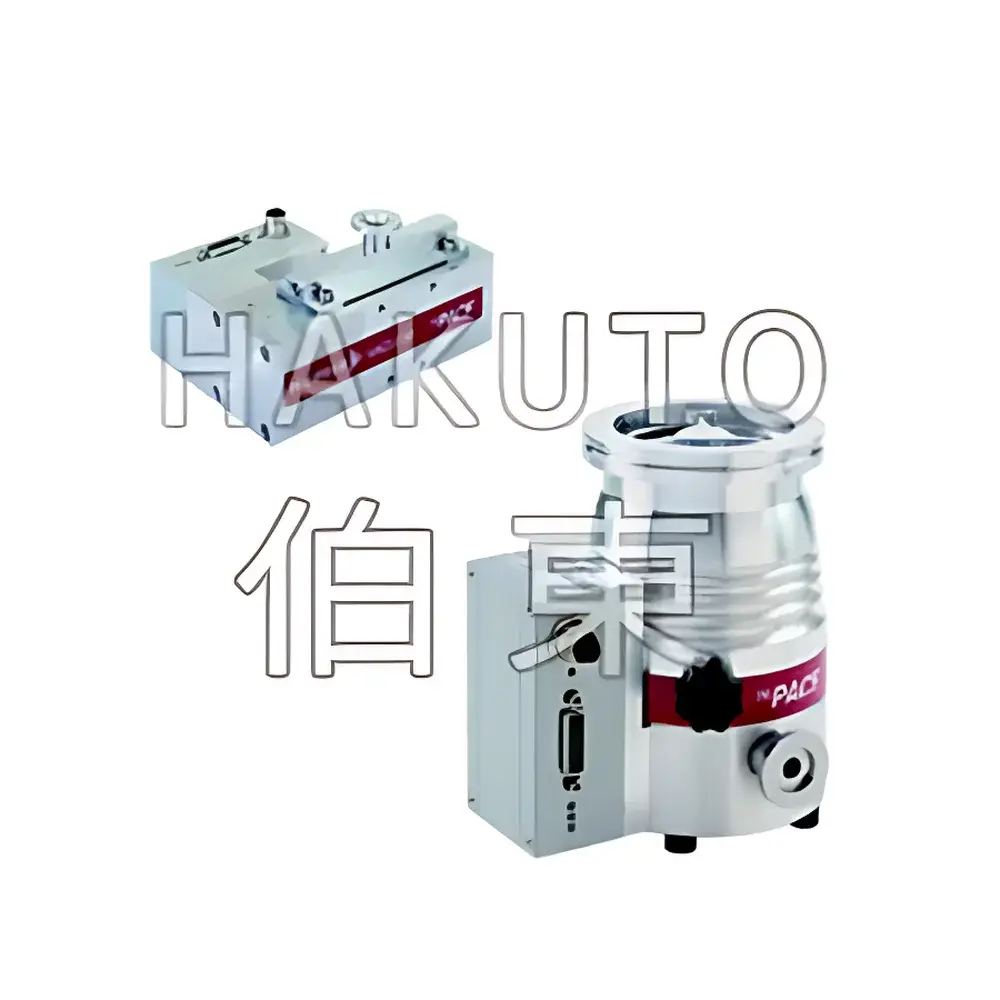
Pfeiffer Vacuum HiPace® 10–300 Turbo Molecular Pump
| Brand | Pfeiffer Vacuum |
|---|---|
| Origin | Germany |
| Pump Type | Oil-Free Turbo Molecular Pump |
| Bearing System | Hybrid (Ceramic Ball + Magnetic Assist) |
| Speed | Up to 90,000 rpm |
| Ultimate Pressure | < 1 × 10⁻⁷ hPa (N₂) |
| Compression Ratio (N₂) | > 1 × 10¹¹ |
| Pumping Speed Range | 10–260 L/s (N₂) |
| Cooling | Integrated Water Cooling |
| Inlet Flange | DN 25–100 (model-dependent) |
| Protection Class | IP54 |
| Certifications | SEMI S2, UL 61010-1, CE |
| Control Interface | Profibus, DeviceNet, or E74 (via TC 110 or TC 400 controller) |
| Mounting | Omnidirectional (0–360°) |
Overview
The Pfeiffer Vacuum HiPace® 10–300 series represents a family of high-performance, oil-free turbo molecular pumps engineered for demanding ultra-high vacuum (UHV) and high-vacuum (HV) applications. Based on the proven principles of momentum transfer via high-speed rotating titanium blades, these pumps operate at rotational speeds up to 90,000 rpm to achieve exceptional gas compression ratios—exceeding 1 × 10¹¹ for nitrogen—and ultimate pressures as low as 100,000 operational hours demonstrated under typical load conditions). Its integrated water-cooling system ensures thermal stability during continuous operation, while the compact, modular design supports space-constrained installations in analytical instrumentation, semiconductor process tools, and research-grade vacuum chambers.
Key Features
- Oil-free operation ensures contamination-free vacuum environments—critical for surface science, electron microscopy, and mass spectrometry.
- Hybrid bearing system (ceramic rolling elements + magnetic stabilization) enables omnidirectional mounting (0–360°), eliminating orientation constraints in complex vacuum layouts.
- Integrated water-cooling circuit maintains consistent rotor temperature across variable duty cycles, minimizing thermal drift and improving long-term pumping reproducibility.
- IP54-rated enclosure provides protection against dust ingress and low-pressure water jets—validated for industrial cleanroom and factory-floor deployment.
- Dual-controller compatibility: TC 110 (compact, cost-optimized) and TC 400 (full-featured, with analog/digital I/O, Ethernet, and advanced diagnostics).
- Standard fieldbus interfaces—including Profibus DP, DeviceNet, and E74—enable seamless integration into automated vacuum systems compliant with SEMI E10 and ISO/IEC 61131-3 control architectures.
- Optional corrosion-resistant variants (HiPace C series) feature nickel-alloy blade coatings and fluoropolymer-sealed electronics for handling aggressive process gases (e.g., Cl₂, NF₃, HBr) in plasma etch and CVD tools.
Sample Compatibility & Compliance
The HiPace® 10–300 is compatible with inert, reactive, and mildly corrosive process gases when configured with appropriate materials (e.g., stainless steel 316L housing, TiAlN-coated rotors). It meets international safety and electromagnetic compatibility standards including UL 61010-1 (electrical safety), EN 61326-1 (EMC), and SEMI S2-0218 (safety guidelines for semiconductor manufacturing equipment). For regulated environments—such as pharmaceutical QC labs or medical device manufacturing—the pump’s controller firmware supports audit-trail-capable operation when paired with TC 400 and validated software (compliant with FDA 21 CFR Part 11 requirements for electronic records and signatures). All models are CE-marked and conform to the EU Machinery Directive 2006/42/EC and Low Voltage Directive 2014/35/EU.
Software & Data Management
Pfeiffer Vacuum’s proprietary PumpControl software (v5.x+) provides real-time monitoring of rotational speed, bearing temperature, inlet pressure, power consumption, and error logs. When connected via TC 400 controller, the system supports Modbus TCP and OPC UA protocols for integration into SCADA and MES platforms. PumpControl includes configurable alarm thresholds, automatic shutdown sequences for overtemperature or overpressure events, and exportable CSV log files for GLP/GMP documentation. Firmware updates are performed via secure USB or Ethernet connection, with version rollback capability and cryptographic signature verification to ensure integrity. Remote diagnostics—enabled through optional Pfeiffer Cloud Connect modules—allow authorized service engineers to perform predictive maintenance analysis without physical access.
Applications
- Analytical Instrumentation: Primary UHV pumping stage for electron microscopes (SEM, TEM), time-of-flight and quadrupole mass spectrometers, and surface analysis tools (XPS, AES).
- Semiconductor Manufacturing: Load-lock and process chamber pumping in etch, PVD, and ALD systems; compatible with cluster tool architectures requiring fast pump-down and high reliability.
- Optical Coating & Thin-Film Deposition: Enables high-purity, low-defect thin-film growth for anti-reflective, IR-filter, and display-grade coatings.
- Vacuum Metallurgy: Supports sintering, brazing, and zone-refining processes where hydrocarbon-free vacuum is essential to prevent carbon contamination.
- Fundamental Research: Used in particle accelerator beamlines, fusion plasma diagnostics (e.g., ITER diagnostic ports), and quantum optics experiments requiring base pressures below 10⁻⁸ mbar.
- Leak Detection: Paired with helium leak detectors (e.g., Pfeiffer ASM 340) in automotive fuel system validation, airbag inflator testing, and hermetic packaging QA.
FAQ
What vacuum backing pump is recommended for the HiPace® 10–300 series?
A dry scroll pump (e.g., Pfeiffer DuoLine series) or two-stage rotary vane pump (e.g., Pfeiffer MVP series) is required to maintain foreline pressure below 10–20 hPa during operation. Dry pumps are preferred for hydrocarbon-sensitive applications.
Can HiPace® pumps be operated vertically or inverted?
Yes—hybrid bearing design permits full 360° mounting orientation without performance degradation or lubrication concerns.
Is firmware validation support available for GxP-regulated environments?
Yes. Pfeiffer provides IQ/OQ documentation packages and firmware validation reports aligned with ASTM E2500 and Annex 11 guidelines upon request.
How does the TC 400 controller differ from the TC 110 in terms of functionality?
TC 400 offers Ethernet connectivity, programmable logic functions, analog input/output channels, and full compliance with FDA 21 CFR Part 11 audit trail requirements—whereas TC 110 provides basic start/stop control and status monitoring via digital I/O.
Are HiPace® pumps suitable for use with oxygen or ozone-rich atmospheres?
Standard models are not rated for pure O₂ or ozone service. For such applications, consult Pfeiffer’s HiPace O₂-certified variants, which include oxygen-compatible materials and explosion-proof certification (ATEX/IECEx).



