
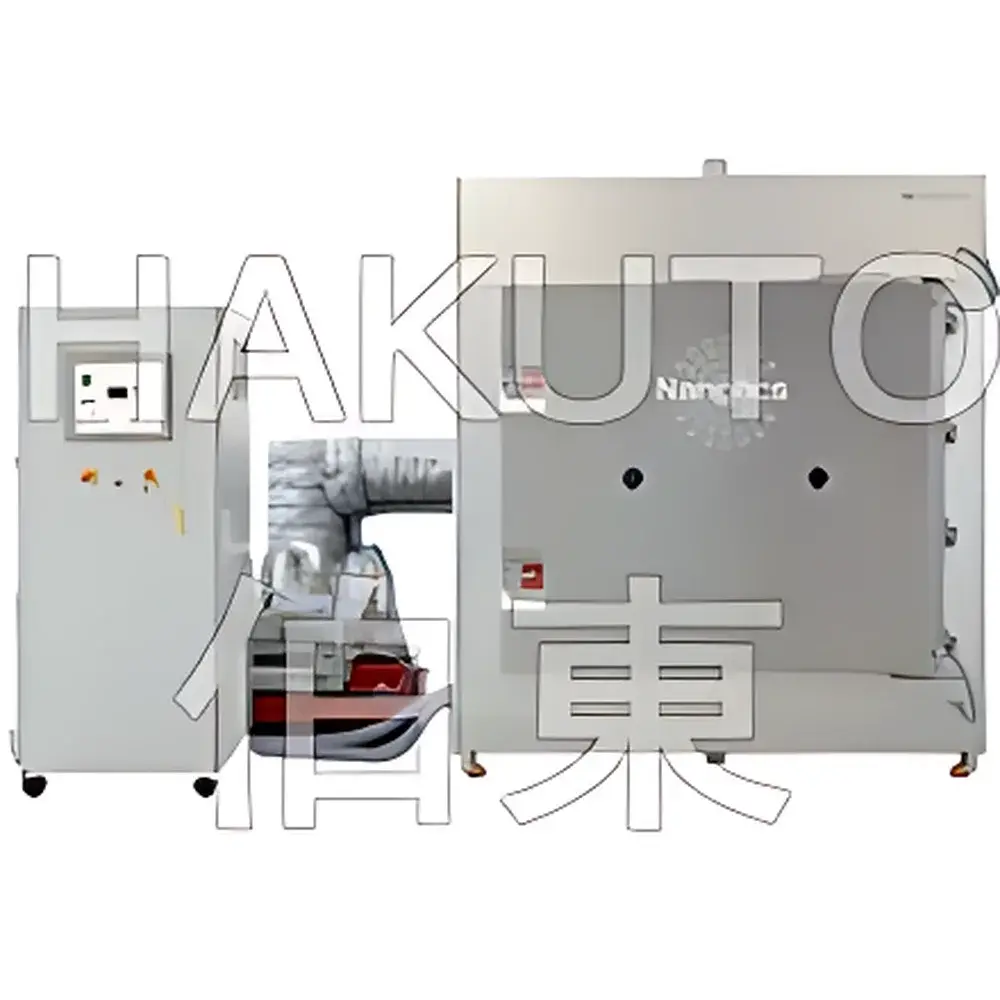
PlasmaGuard CD1836 Non-Halogen Plasma Surface Treatment System
| Brand | Europlasma |
|---|---|
| Origin | Belgium |
| Model | CD1836 |
| RF Power | 5 kW |
| Chamber Dimensions | 1600 × 1350 × 850 mm |
| Chamber Volume | 1836 L |
| Chamber Material | Anodized Aluminum |
| Process Gases | O₂, Ar, and other non-halogenated process gases |
| Control System | Fully Automated PLC-Based Interface |
| Vacuum System | Dry Scroll Pump with Pirani Gauge |
| Electrical Supply | 380 V AC, 3-Phase, 50 Hz, 63 A |
| Certifications | CE Compliant |
| Safety Features | Emergency Stop, Vacuum Interlock, Thermal Overload Protection |
Overview
The PlasmaGuard CD1836 is a high-capacity, non-halogen plasma surface treatment system engineered for industrial-scale functionalization of sensitive substrates without introducing halogenated chemistries. Developed by Europlasma (Belgium), it employs low-pressure radiofrequency (RF) plasma generated at 13.56 MHz — a standard frequency compliant with international electromagnetic compatibility (EMC) regulations — to activate, clean, and deposit ultra-thin hydrophobic nanocoatings via plasma-enhanced chemical vapor deposition (PE-CVD). Unlike conventional fluorocarbon-based plasma processes, the CD1836 utilizes oxygen and argon as primary process gases, enabling environmentally compliant, RoHS- and REACH-compliant surface modification. Its 1836-liter aluminum chamber supports batch processing of large-format or high-volume components, making it suitable for pre-coating operations in electronics manufacturing, medical device assembly, and technical textile production where halogen-free certification is mandatory.
Key Features
- Non-halogen plasma process architecture optimized for O₂/Ar-based chemistry — eliminates perfluorinated compounds (PFCs) and avoids regulatory restrictions associated with fluorinated precursors.
- Robust anodized aluminum reaction chamber (1600 × 1350 × 850 mm) with integrated viewing window and four standardized loading slots (each accommodating multiple 285 × 756 mm trays).
- 5 kW RF generator with real-time impedance matching, enabling stable plasma ignition and uniform power coupling across variable load geometries.
- Automated PLC control system with password-protected access, supporting recipe-driven operation, parameter logging, and audit-ready execution traces.
- Dry scroll vacuum pump system with Pirani gauge feedback, achieving base pressures ≤5 × 10⁻² mbar and repeatable process ramp profiles (pump-down time, gas fill rate, pressure stabilization).
- Comprehensive safety architecture including emergency stop circuitry, vacuum interlock, thermal cut-off sensors, and CE-marked electrical integration per EN 61000-6-2/6-4 and EN 61000-3-12.
Sample Compatibility & Compliance
The CD1836 accommodates heterogeneous substrates ranging from rigid PCB assemblies and flexible printed electronics to porous nonwovens and elastomeric medical tubing. Its inert aluminum chamber minimizes metal ion contamination risks critical for semiconductor-adjacent applications and ISO 13485-certified medical device manufacturing. The system complies with key industry frameworks: ASTM F2529-21 (standard guide for plasma surface modification of polymeric biomaterials), ISO 14644-1 Class 8 cleanroom compatibility (when operated under controlled ambient conditions), and EU Directive 2011/65/EU (RoHS 2) for restricted substances. All process parameters—including gas flow rates (MFC-controlled), chamber pressure, RF forward/reflected power, and treatment duration—are programmable and traceable to support GLP/GMP documentation requirements.
Software & Data Management
The embedded HMI interface provides intuitive navigation through predefined process templates and allows custom protocol creation with up to 20 user-defined steps per recipe. Real-time monitoring includes vacuum pressure, chamber temperature, RF voltage/current, gas flow stability, and elapsed treatment time. All operational data are timestamped and stored locally on an industrial-grade SD card; optional Ethernet connectivity enables secure export to external LIMS or MES platforms. Audit trails meet FDA 21 CFR Part 11 criteria for electronic records and signatures when paired with role-based user authentication and change-log functionality.
Applications
- Conformal waterproofing of wearable electronics (e.g., TWS earbuds, fitness trackers) without compromising signal integrity or tactile response.
- Surface activation and nanocoating of lithium-ion battery separators and current collectors to enhance electrolyte wettability and interfacial adhesion.
- Hydrophobic finishing of spunbond/meltblown nonwovens used in surgical gowns, N95 respirators, and outdoor performance textiles.
- PCB-level moisture barrier deposition prior to conformal coating or potting—reducing delamination risk under thermal cycling and humidity stress.
- Pretreatment of polymer catheters, endoscopic sheaths, and diagnostic sensor housings to improve biocompatibility and reduce protein adsorption.
FAQ
Does the CD1836 support nitrogen or air as process gases?
Yes — while optimized for O₂ and Ar, the system’s MFC and gas manifold configuration allow safe integration of N₂ or synthetic air upon validation of plasma stability and coating performance.
What is the typical coating thickness achieved with this system?
Coating thickness is sub-100 nm and highly dependent on precursor chemistry, exposure time, and substrate morphology; precise quantification requires post-treatment ellipsometry or XPS analysis.
Can the system be integrated into an automated production line?
Yes — the PLC interface supports Modbus TCP and discrete I/O signals for seamless synchronization with conveyor systems, robotic loaders, and upstream/downstream inspection stations.
Is remote diagnostics supported?
Remote maintenance access is available via secured VPN connection, subject to customer network policy and Europlasma service agreement terms.
What maintenance intervals are recommended for the RF generator and vacuum pump?
RF generator requires annual calibration; dry scroll pump oil replacement every 3,000 operating hours or per manufacturer specifications — logbook entries are automatically generated and exportable.



