
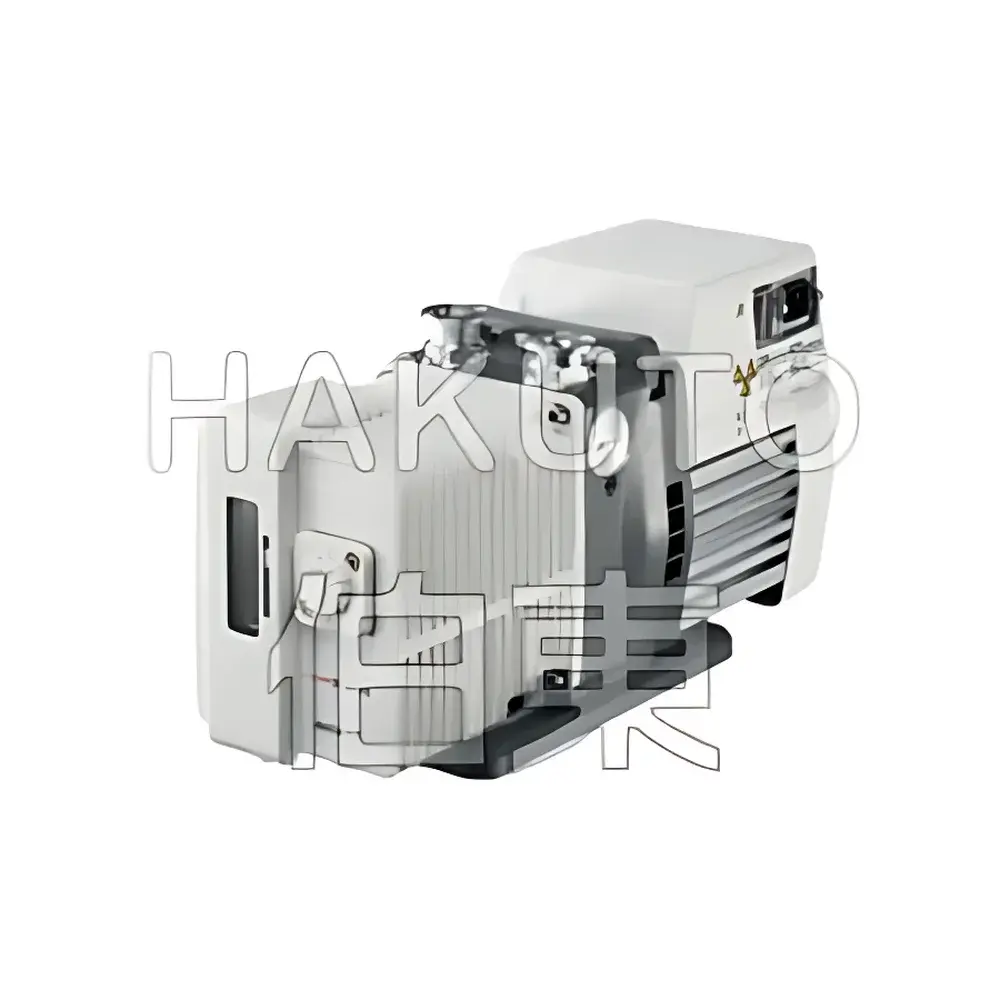
Pfeiffer Vacuum Pascal 2010 Dual-Stage Rotary Vane Vacuum Pump
| Brand | Pfeiffer Vacuum |
|---|---|
| Origin | Germany |
| Pump Type | Oil-Lubricated Dual-Stage Rotary Vane |
| Ultimate Pressure (with gas ballast) | 1×10⁻² hPa |
| Ultimate Pressure (without gas ballast) | 5×10⁻⁴ hPa |
| Pumping Speed (50 Hz) | 9 m³/h |
| Pumping Speed (60 Hz) | 10.5 m³/h |
| Inlet Flange | DN 25 ISO-KF |
| Motor Power (50 Hz) | 0.45 kW |
| Motor Speed (50 Hz) | 1500 rpm |
| Cooling | Air-cooled |
| Protection Class | IP 43 |
| Oil Capacity | 0.95 L |
| Weight | 26 kg |
Overview
The Pfeiffer Vacuum Pascal 2010 is a dual-stage, oil-lubricated rotary vane vacuum pump engineered for reliable and stable operation in medium-vacuum applications ranging from 10⁰ to 10⁻⁴ hPa. Based on decades of industrial design refinement and over 500,000 units deployed globally, the Pascal series delivers proven mechanical robustness, low vibration, and high process reproducibility—critical for integration into analytical instrumentation, R&D vacuum systems, and production environments requiring consistent base pressure and gas throughput. Its two-stage compression architecture enables deeper ultimate vacuum compared to single-stage variants while maintaining compatibility with standard laboratory power grids (50/60 Hz) and offering full interchangeability of inlet/outlet orientation (horizontal or vertical mounting). The pump operates using mineral oil lubrication and incorporates an integrated gas ballast valve to handle condensable vapors—enabling sustained performance during vacuum drying, coating processes, and residual gas analysis.
Key Features
- Dual-stage rotary vane design achieving ultimate pressure of 5×10⁻⁴ hPa without gas ballast and 1×10⁻² hPa with gas ballast—validated per ISO 21360-1 and DIN 28416 standards
- Stable pumping speed of 9 m³/h at 50 Hz (10.5 m³/h at 60 Hz), optimized for continuous duty cycles in analytical and industrial vacuum systems
- Universal motor configuration supporting global voltage/frequency standards (220–240 V / 50 Hz or 100–120 V / 60 Hz) without external frequency converters
- Modular DN 25 ISO-KF inlet and outlet flanges with adjustable angular positioning—facilitating flexible system integration in confined spaces
- Air-cooled thermal management with IP 43-rated enclosure—suitable for ambient temperatures up to +40 °C and relative humidity ≤80% non-condensing
- Low-noise operation (≤49 dB(A) for I-variant configurations), meeting ISO 3744 acoustic emission requirements for laboratory environments
- Gas ballast system compliant with ISO 21360 Annex C for controlled admission of atmospheric air to prevent condensation of water vapor or solvents in the oil circuit
Sample Compatibility & Compliance
The Pascal 2010 is compatible with non-corrosive, non-reactive gases and vapors typical in electron microscopy, thin-film deposition, vacuum drying, and space simulation chambers. It is not intended for use with halogenated, acidic, or highly oxidizing process gases unless equipped with optional corrosion-resistant variants (e.g., Pascal C1/C2 models using PFPE oil). The pump conforms to EU Machinery Directive 2006/42/EC, EMC Directive 2014/30/EU, and RoHS 2011/65/EU. All factory-assembled units undergo functional testing per Pfeiffer’s internal QA protocol aligned with ISO 9001:2015, including leak rate verification (<1×10⁻⁶ hPa·L/s helium), oil contamination screening, and torque validation of rotor assembly. Documentation supports GLP/GMP traceability when paired with certified calibration services.
Software & Data Management
While the Pascal 2010 operates as a standalone mechanical pump without embedded digital controls, its analog interface allows seamless integration into supervisory control systems via optional accessories: a 0–10 V analog pressure feedback module (for closed-loop vacuum regulation), digital I/O relay outputs for status monitoring (running, overheating, oil level), and RS-485 Modbus RTU interface kits (sold separately). When deployed in regulated environments—including pharmaceutical QC labs or medical device manufacturing—the pump may be documented within instrument qualification protocols (IQ/OQ/PQ) under FDA 21 CFR Part 11 guidelines, provided third-party data loggers capture operational timestamps, runtime hours, and thermal event logs. Pfeiffer provides full technical documentation packages—including exploded diagrams, maintenance schedules, and oil change SOPs—in English, German, and Chinese.
Applications
- Electron microscopy (SEM, TEM) backing pumps for turbomolecular or ion getter pumps
- Residual gas analysis (RGA) systems requiring stable foreline pressure and low hydrocarbon backstreaming
- Optical and magnetic thin-film coating systems (e.g., sputtering, evaporation) where repeatable chamber conditioning is critical
- Vacuum drying ovens and freeze dryers used in biopharmaceutical sample preparation
- Hard disk drive and optical disc (CD/DVD/Blu-ray) manufacturing process chambers
- Space simulation test benches operating in low-earth-orbit equivalent pressure regimes
- Medical vacuum systems for sterilization autoclaves and aspiration units compliant with ISO 13485
FAQ
What is the recommended oil type and replacement interval?
Pfeiffer specifies mineral-based vacuum pump oil (e.g., Pfeiffer VacOil 19) with a nominal capacity of 0.95 L. Under continuous operation at ambient temperatures <30 °C and clean gas loads, oil should be replaced every 3,000 operating hours or annually—whichever occurs first. Oil analysis is advised for applications involving solvent vapors.
Can the Pascal 2010 be mounted vertically?
Yes. The inlet and exhaust flanges are rotationally adjustable ±90°, enabling vertical, horizontal, or angled installation without compromising oil retention or cooling efficiency.
Is the pump suitable for use with corrosive gases?
Standard Pascal 2010 units are not corrosion-resistant. For chlorine, HF, or other aggressive media, specify the Pascal C1 (stainless steel internals) or C2 (PFPE oil + fluoropolymer seals) variant at time of order.
Does it meet FDA or ISO 13485 requirements for medical device manufacturing?
The pump itself is not certified as a medical device, but its design, materials, and documentation support inclusion in ISO 13485-compliant vacuum subsystems when validated per user-defined PQ protocols and maintained with auditable service records.
How is ultimate vacuum verified during factory testing?
Each unit undergoes a 24-hour stabilization test under nitrogen load, followed by measurement using a calibrated capacitance manometer traceable to NIST standards. Results are recorded in the individual Certificate of Conformance shipped with the pump.



