
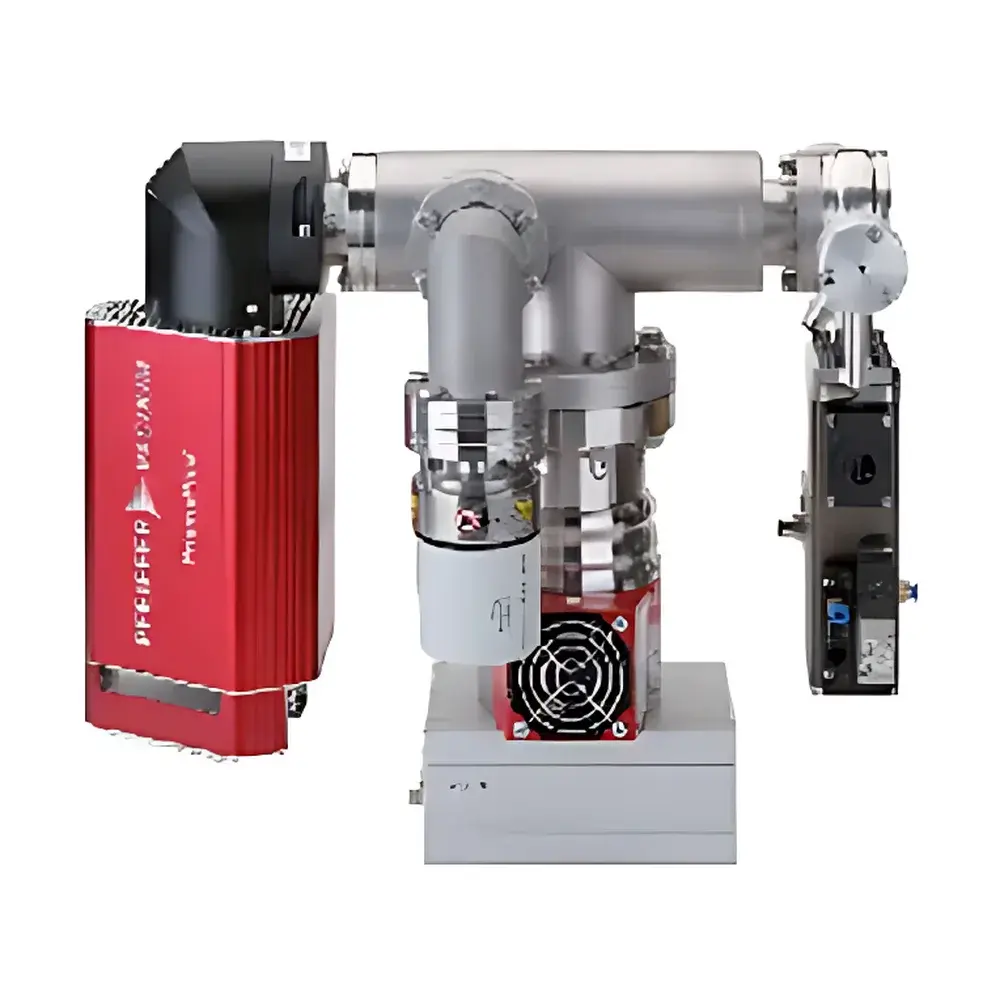
Pfeiffer HPA 220 High-Pressure Quadrupole Mass Spectrometer
| Brand | Pfeiffer Vacuum |
|---|---|
| Origin | Germany |
| Model | HPA 220 |
| Mass Range (Configurable) | 1–100 amu / 1–200 amu / 1–300 amu |
| Operating Pressure Range | 1 × 10⁻⁷ hPa to 50 hPa |
| Detection Modes | C-SEM (Min. Detectable Partial Pressure: 1 × 10⁻¹⁴ hPa) / Faraday Cup (Min. Detectable Partial Pressure: 5 × 10⁻¹² hPa) |
| Quadrupole Dimensions | 6 mm diameter × 100 mm length |
| Base Pumping System | HiPace 80 turbomolecular pump + TC 110 RS controller + MVP 020-3 rotary vane backing pump |
| Vacuum Measurement | PKR 251 full-range gauge |
| Inlet Interface | DN 40 CF flange |
| Power Supply | 115–230 V AC, 50/60 Hz |
| Weight | 15 kg |
| Software | Quadera platform with HPA Add-In module |
| Optional Accessories | Chamber heating unit, DCU 002 molecular pump controller, custom application software, additional full-range gauges |
Overview
The Pfeiffer HPA 220 is a high-pressure quadrupole mass spectrometer engineered for real-time, quantitative gas analysis in dynamic process environments where conventional vacuum-compatible mass spectrometers are operationally constrained. Unlike standard residual gas analyzers (RGAs) optimized for ultra-high vacuum (UHV) conditions (<10⁻⁶ hPa), the HPA 220 employs a robust differential pumping architecture and pressure-tolerant ion optics to maintain stable ion transmission and mass resolution across an exceptionally wide operational pressure range—from 1 × 10⁻⁷ hPa up to 50 hPa (≈37.5 Torr). This capability enables direct sampling from industrial process streams without requiring extensive external pressure reduction stages, significantly reducing system complexity and response latency. Its core analytical principle relies on radiofrequency (RF) and direct current (DC) voltages applied to a precision-machined 6 mm × 100 mm quadrupole mass filter, which selectively transmits ions based on their mass-to-charge ratio (m/z) under controlled collisional damping conditions. The instrument supports configurable mass ranges (1–100, 1–200, or 1–300 amu), making it suitable for monitoring light gases (H₂, He, N₂, O₂, CO, CO₂, CH₄), reactive species (NH₃, HCl, SiH₄), and heavier process byproducts in situ.
Key Features
- Modular, field-integratable design with standardized DN 40 CF flange interface for rapid installation into existing vacuum or pressurized process lines
- Dual detection system: High-sensitivity channeltron electron multiplier (C-SEM) for trace-level detection down to 1 × 10⁻¹⁴ hPa, and Faraday cup for stable, linear quantitative measurement of major components (detection limit: 5 × 10⁻¹² hPa)
- Integrated pumping package comprising HiPace 80 turbomolecular pump with TC 110 RS controller and MVP 020-3 rotary vane backing pump—engineered for continuous duty in demanding industrial settings
- Real-time pressure monitoring via PKR 251 full-range cold cathode gauge (1 × 10⁻⁸ hPa to 1000 hPa), enabling automatic pressure-dependent acquisition parameter adjustment
- VCU 220 valve control unit supporting manual or programmable sequencing of up to four inlet valves for multi-stream sampling or calibration gas introduction
- Quadera software platform with dedicated HPA Add-In module—providing intuitive spectral acquisition, peak identification, time-resolved trend logging, and customizable alarm thresholds
Sample Compatibility & Compliance
The HPA 220 is designed for direct analysis of process gases—including corrosive, condensable, and reactive species—without sample dilution or pre-treatment, provided inlet temperature and composition remain within material compatibility limits (e.g., stainless steel 316L wetted parts, ceramic insulators). It complies with IEC 61000-6-2 (immunity) and IEC 61000-6-4 (emissions) for industrial electromagnetic environments. While not certified as intrinsically safe, its configuration supports integration into Class 1 Div 2 or ATEX Zone 2-compliant systems when installed with appropriate barrier interfaces. Data integrity features—including audit-trail-enabled method storage, user-access level management, and timestamped raw data export—align with GLP and GMP documentation requirements. For regulated pharmaceutical or semiconductor manufacturing applications, optional software validation packages support FDA 21 CFR Part 11 compliance.
Software & Data Management
The Quadera platform provides a Windows-based graphical interface for instrument control, spectral visualization, and multivariate data handling. The HPA Add-In extends native functionality with pressure-compensated quantification algorithms, background subtraction routines, and automated peak deconvolution for overlapping m/z signals (e.g., Ar⁺ at 40 amu vs. Ca⁺ at 40 amu). All acquired spectra and process parameters are stored in vendor-neutral HDF5 format, ensuring long-term readability and interoperability with third-party analytics tools (MATLAB, Python/Pandas, LabVIEW). Remote monitoring and control are supported via TCP/IP Ethernet connection; OPC UA server integration is available upon request for seamless SCADA and MES system connectivity. Firmware updates and configuration backups are managed through secure USB or network transfer, with version-controlled change logs retained per ISO/IEC 17025 traceability standards.
Applications
- Vacuum coating processes: Real-time monitoring of sputtering gas ratios (Ar/O₂/N₂), residual moisture, and target poisoning during PVD and CVD deposition
- Semiconductor fabrication: Endpoint detection in plasma etch chambers, leak verification in cluster tools, and purge gas purity validation
- Photolithography: In-situ analysis of photoresist outgassing products (e.g., TMAH derivatives, solvent vapors) during bake and develop steps
- Heat treatment and metallurgical furnaces: Quantitative tracking of furnace atmosphere composition (H₂, N₂, CH₄, CO) and decarburization kinetics
- Research-scale catalysis and reaction engineering: Time-resolved product evolution profiling under elevated pressure conditions (up to 50 hPa)
- Leak detection support: Complementary use with helium mass spectrometers to identify non-helium-leaking species (e.g., H₂O, hydrocarbons) in complex vacuum systems
FAQ
What pressure ranges can the HPA 220 operate in without external pumping stages?
The HPA 220 maintains stable mass resolution and sensitivity from 1 × 10⁻⁷ hPa to 50 hPa using its integrated differential pumping system—no external foreline pumping or pressure-reduction capillaries are required.
Can the HPA 220 distinguish between isobaric species such as CO and N₂?
Yes, at nominal mass resolution (M/ΔM ≈ 300), the HPA 220 resolves CO⁺ (28.006 amu) and N₂⁺ (28.013 amu) with baseline separation under optimized RF/DC tuning and low-pressure operating modes.
Is the Quadera software compatible with Windows 11 and 64-bit architectures?
Yes—Quadera v4.2 and later fully support Windows 10 and 11 (64-bit), including TLS 1.2+ secure communication protocols and high-DPI display scaling.
What calibration standards are recommended for quantitative analysis?
Certified gas mixtures traceable to NIST or PTB standards are recommended; Pfeiffer provides factory calibration certificates for m/z accuracy (±0.1 amu) and relative sensitivity factors (RSFs) for common gases.
Does the HPA 220 support automated sequence programming for unattended multi-point sampling?
Yes—the VCU 220 valve control unit accepts ASCII command scripts over RS232 or Ethernet, enabling scheduled valve actuation, dwell time definition, and synchronized data acquisition across up to four independent gas sources.






