
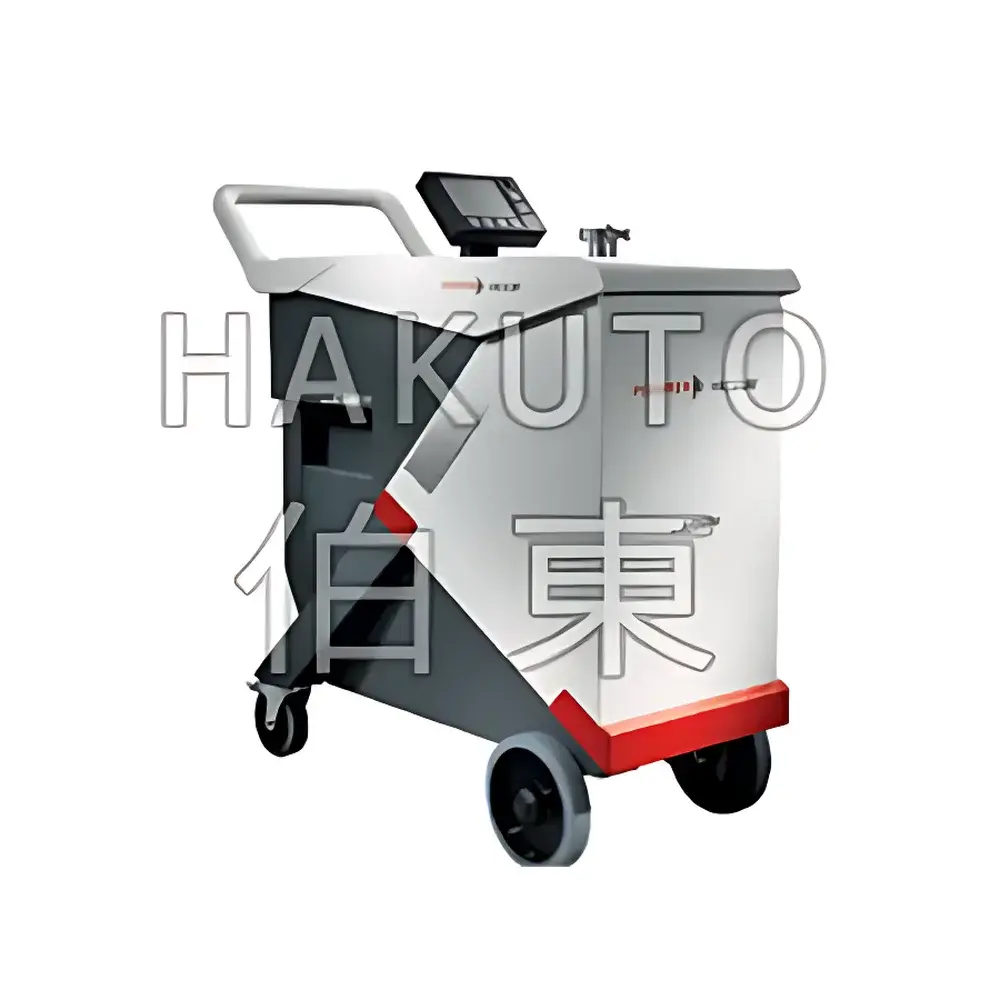
Pfeiffer Vacuum ASM 390 Helium Mass Spectrometer Leak Detector
| Brand | Pfeiffer Vacuum |
|---|---|
| Origin | France |
| Model | ASM 390, ASM 392 |
| Detection Gas | 4He, 3He, H₂ |
| Minimum Detectable Leak Rate (Vacuum Mode) | 1×10⁻¹² mbar·L/s |
| Minimum Detectable Leak Rate (Sniffer Mode) | 1×10⁻⁸ mbar·L/s |
| Helium Pumping Speed | 10 L/s (ASM 390), 25 L/s (ASM 392) |
| Forepump Speed | 35 m³/h |
| Max Inlet Pressure | 20 mbar |
| Warm-up Time (Un-calibrated, 20°C) | 2 min |
| Inlet Port | DN 40 ISO-KF |
| Response Time | < 1 s |
| Interface Options | RS-232, Digital I/O, Ethernet |
| Noise Level | ≤ 55 dB(A) |
| Weight | 125 kg (ASM 390), 130 kg (ASM 392) |
| Dimensions (L×W×H) | 1072 × 455 × 1025 mm |
| Certifications | CE, ETL, UL 61010, SEMI S2 |
Overview
The Pfeiffer Vacuum ASM 390 Helium Mass Spectrometer Leak Detector is a high-performance, mobile mass spectrometry-based leak detection system engineered for precision vacuum integrity verification in demanding industrial and R&D environments. Operating on the principle of magnetic sector mass spectrometry, the ASM 390 selectively ionizes and separates helium atoms (mass-to-charge ratio m/z = 4) from background gas molecules using a high-resolution mass filter, enabling unambiguous identification and quantification of helium tracer gas ingress. Its core architecture integrates a dry, non-contact scroll forepump and a high-speed turbomolecular pump—configured as a single-stage system in the ASM 390 and dual-stage in the ASM 392—to achieve rapid evacuation, low base pressure (<1×10⁻⁷ mbar), and exceptional helium throughput. Designed explicitly for large-component testing—including vacuum chambers, semiconductor process tools, heat exchangers, and laser subassemblies—the ASM 390 delivers trace-level sensitivity (down to 1×10⁻¹² mbar·L/s in vacuum mode) with sub-second response latency, minimizing downtime during production line validation or maintenance cycles.
Key Features
- High-sensitivity magnetic sector mass spectrometer optimized for ⁴He detection with inherent isotopic selectivity against hydrogen and water vapor interference
- Dry, oil-free pumping system comprising a maintenance-free scroll forepump (35 m³/h) and a robust turbomolecular pump (10 L/s nominal speed) ensuring clean, contamination-free operation
- Integrated touch-enabled 7-inch color display with intuitive graphical user interface; fully rotatable and tool-free removable for ergonomic positioning in confined or elevated test zones
- Mobile chassis with industrial-grade casters, reinforced frame, and balanced weight distribution (125 kg) supporting safe transport across cleanroom floors, fab aisles, and field service locations
- Compliance with international safety and electromagnetic compatibility standards: CE marking, UL 61010-1, ETL listing, and SEMI S2 guidelines for semiconductor manufacturing equipment
- Real-time signal processing firmware enabling automatic baseline compensation, drift correction, and dynamic threshold adaptation during extended leak surveys
Sample Compatibility & Compliance
The ASM 390 supports both vacuum (negative-pressure) and sniffer (positive-pressure) leak testing methodologies, accommodating a broad range of component geometries and materials—from stainless steel manifolds and welded aluminum enclosures to ceramic insulators and glass-metal seals. Its DN 40 ISO-KF inlet port interfaces seamlessly with standard vacuum flanges and custom test fixtures. The instrument meets critical regulatory expectations for quality-critical applications: data logging timestamps and operator IDs are retained in non-volatile memory, supporting GLP/GMP audit trails; optional Ethernet connectivity enables integration into centralized SCADA or MES platforms compliant with FDA 21 CFR Part 11 requirements for electronic records and signatures. All calibration procedures follow ISO 10892 and ASTM E493 protocols for helium leak testing instrumentation.
Software & Data Management
The embedded firmware provides real-time leak rate visualization, trend logging, and pass/fail classification based on user-defined thresholds. Measurement data—including raw ion current, integrated leak signal, ambient temperature, and pump status—is exportable via USB or Ethernet in CSV format for post-processing in third-party statistical analysis tools. Optional Pfeiffer Vacuum Control Software (VCU) enables remote operation, automated sequence execution (e.g., multi-point scanning), and report generation conforming to ISO/IEC 17025 documentation standards. Audit logs record all configuration changes, calibration events, and user logins with tamper-resistant timestamps—essential for regulated environments requiring full traceability.
Applications
- Semiconductor front-end manufacturing: leak verification of gas delivery manifolds, abatement systems, and CVD/PVD chamber welds (target leak rate ≤1×10⁻⁹ mbar·L/s)
- Aerospace and defense: hermeticity testing of laser cavity housings, inertial sensor modules, and cryogenic fluid lines under vacuum-mode conditions
- Flat panel display (FPD) production: validation of TFT array vacuum frames and encapsulation integrity prior to OLED deposition
- Power generation: inspection of heat exchanger tubesets (>1000 L volume) and nuclear coolant loop components per ASME Section V requirements
- Research infrastructure: commissioning of ultra-high vacuum beamlines, particle accelerator components, and fusion device diagnostics
FAQ
What detection gases does the ASM 390 support?
The ASM 390 is calibrated for helium-4 (⁴He) as the primary tracer gas, with optional firmware support for helium-3 (³He) and hydrogen (H₂) detection via mass channel reconfiguration.
Can the ASM 390 be integrated into an automated production line?
Yes—digital I/O signals (leak alarm, ready status, pump fault) and Ethernet-based TCP/IP communication allow direct interfacing with PLCs and factory automation systems.
Is periodic recalibration required to maintain specified sensitivity?
While the instrument achieves stable baseline performance after initial warm-up, annual traceable calibration against certified helium leak standards (e.g., NIST-traceable permeation devices) is recommended for ISO/IEC 17025 compliance.
How does the ASM 390 compare to older models like the ASM 380?
The ASM 390 offers improved helium pumping speed (10 L/s vs. 7 L/s), faster warm-up (<2 min vs. <4.5 min), lower acoustic emissions (≤55 dB(A)), and enhanced touchscreen ergonomics—while maintaining backward compatibility with existing ASM 380 accessories and fixtures.
Does the system support both vacuum and sniffer modes simultaneously?
No—mode selection is manual and mutually exclusive; however, switching between vacuum and sniffer configurations requires only software reconfiguration and physical hose reconnection, typically completed in under 90 seconds.




