
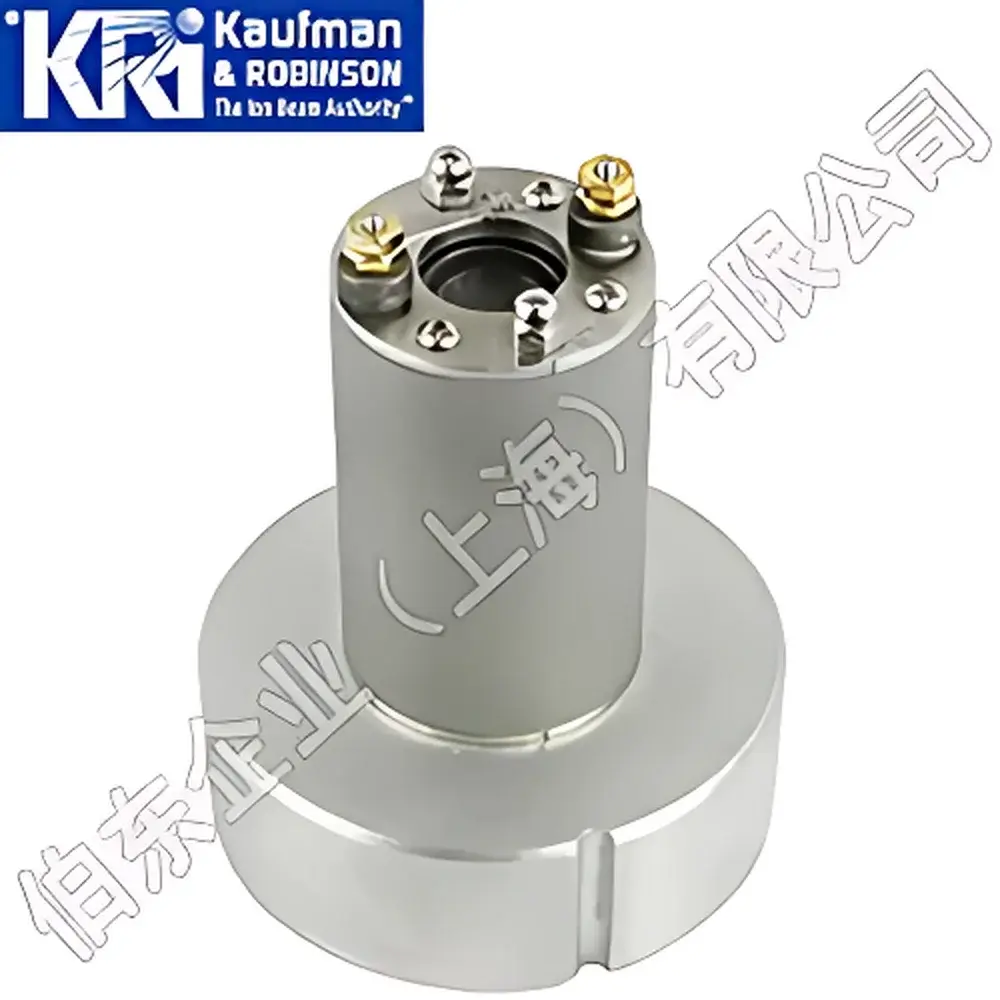
KRI Kaufman Ion Source KDC 10 for Thin-Film Deposition and Surface Preparation
| Brand | KRI (Kimball Physics / Kaufman) |
|---|---|
| Origin | USA |
| Model | KDC 10 |
| Ion Energy Range | 100–1200 eV |
| Max Ion Current | >10 mA |
| Grid Diameter | 1 cm |
| Magnetic Confinement | DC |
| Anode Voltage | 0–100 V DC |
| Gas Compatibility | Ar, O₂, N₂, Xe, or mixed inert/active gases |
| Mounting Flange | CF or ISO-K (customizable) |
| Beam Geometry | Broad, Collimated, Low-Divergence |
| Recommended Working Distance | 5–30 cm |
| Typical Applications | In-situ ion cleaning, IBAD, IBE, IBSD, surface activation, TEM/SEM sample preparation |
Overview
The KRI Kaufman Ion Source KDC 10 is a compact, gridded, magnetically confined DC ion source engineered for precision surface modification and thin-film process integration in ultra-high vacuum (UHV) and high-vacuum environments. Based on the classic Kaufman-type discharge principle—where electrons emitted from a thermionic cathode are radially confined by a permanent magnetic field to enhance ionization efficiency—the KDC 10 generates a stable, low-energy, broad-beam ion flux ideal for non-destructive substrate conditioning. Its small physical footprint (4.5″ height × 1.52″ diameter), combined with a 1 cm grid aperture and parallel beam collimation, enables seamless integration into compact deposition systems, SEM/TEM preparation chambers, and benchtop sputtering or evaporation platforms. Designed for operation at ion energies between 100 eV and 1200 eV, the KDC 10 delivers high current density (>10 mA) with minimal energy spread and low angular divergence—critical for achieving uniform etch rates, controlled surface stoichiometry, and minimal lattice damage during ion-beam-assisted deposition (IBAD) or ion-beam etching (IBE).
Key Features
- Compact gridded architecture optimized for space-constrained vacuum systems—including load-locked coaters, focused ion beam (FIB) prep stations, and hybrid PVD/CVD tools.
- DC magnetic confinement using permanent magnets ensures stable plasma ignition and long cathode lifetime without RF coupling or complex power supplies.
- Adjustable ion energy (100–1200 eV) and beam current via independent control of anode voltage and discharge current—enabling fine-tuned process windows for sensitive substrates (e.g., 2D materials, organic semiconductors).
- Multi-gas compatibility: supports Ar, O₂, N₂, Xe, and gas mixtures; compatible with mass flow controllers for reactive ion beam processes (e.g., oxide formation, nitride passivation).
- Modular neutralizer integration (KSC-1202 controller compatible) with optional filament types (Sidewinder, LFN-1000, or standard tungsten) ensures charge compensation across insulating or high-aspect-ratio samples.
- Mechanically robust construction with all-metal CF or ISO-K flange options; designed for bake-out temperatures up to 150 °C and UHV-compatible materials (oxygen-free copper, stainless steel, ceramic insulators).
Sample Compatibility & Compliance
The KDC 10 is routinely deployed in applications requiring atomic-level surface control under clean vacuum conditions (≤1×10⁻⁶ Torr base pressure). It accommodates substrates ranging from silicon wafers and III–V semiconductors to polymer films, optical crystals, and biological TEM grids. Its low-energy, wide-beam profile minimizes preferential sputtering and subsurface defect generation—making it suitable for pre-deposition cleaning of EUV mask blanks (per SEMI F72), TEM lamella polishing (ASTM E1558), and surface activation prior to ALD nucleation. The system complies with CE electromagnetic compatibility directives and meets mechanical safety requirements per ISO 12100. When integrated into GMP-regulated coating lines (e.g., ophthalmic lens AR coatings), its analog/digital I/O interface supports traceable parameter logging aligned with FDA 21 CFR Part 11 audit trail requirements.
Software & Data Management
The KDC 10 operates via analog setpoints or digital RS-232/RS-485 interface when paired with KRI’s KSC-1202 ion source controller. The controller provides real-time monitoring of discharge voltage/current, neutralizer emission, and gas flow status—data exportable via ASCII CSV for integration into LabVIEW, Python-based process orchestration, or MES platforms. Optional Ethernet-enabled firmware upgrades support Modbus TCP protocol for centralized vacuum cluster management. All operational parameters—including beam energy ramp profiles, gas sequencing logic, and interlock states—are fully scriptable and reproducible across batches, satisfying GLP documentation standards for R&D labs and pilot-scale manufacturing.
Applications
- In-situ ion cleaning: Removal of native oxides and hydrocarbon contamination from metal, semiconductor, and dielectric surfaces prior to epitaxial growth or adhesive bonding.
- Ion-beam-assisted deposition (IBAD): Real-time bombardment during e-beam evaporation or sputtering to enhance film density, adhesion, and crystallinity—particularly for YBCO superconducting tapes and TiN diffusion barriers.
- Ion-beam etching (IBE): High-selectivity, anisotropic patterning of SiO₂, Si₃N₄, and compound semiconductors with sub-5 nm root-mean-square roughness (measured via AFM).
- Surface activation & functionalization: Controlled introduction of dangling bonds or polar groups on polymers and carbon-based substrates for improved wetting or biofunctionalization.
- TEM/SEM sample preparation: Low-kV argon ion milling for artifact-free cross-sectioning of multilayer devices and soft matter composites.
FAQ
What vacuum level is required for stable KDC 10 operation?
Optimal performance requires a base pressure ≤5×10⁻⁷ Torr; minimum operating pressure during discharge is ~5×10⁻⁵ Torr with Ar flow.
Can the KDC 10 be used with reactive gases like oxygen or nitrogen?
Yes—its all-stainless-steel and alumina-ceramic construction resists oxidation and nitridation; gas line compatibility must include corrosion-resistant MFCs and valves.
Is remote process automation supported?
Fully supported via KSC-1202 controller’s analog/digital I/O and serial protocols; integration with PLCs or SCADA systems is documented in KRI Application Note AN-027.
What is the typical lifetime of the cathode filament?
Under standard Ar operation at 500 eV/5 mA, tungsten filaments last ≥1,500 hours; Sidewinder or LFN-1000 variants extend service life by 2–3× in reactive gas environments.
Does the KDC 10 require water cooling?
No—its thermal design relies on conductive heat sinking through the flange; active cooling is only recommended for continuous operation >8 hours/day at >8 mA.
Related Products



