
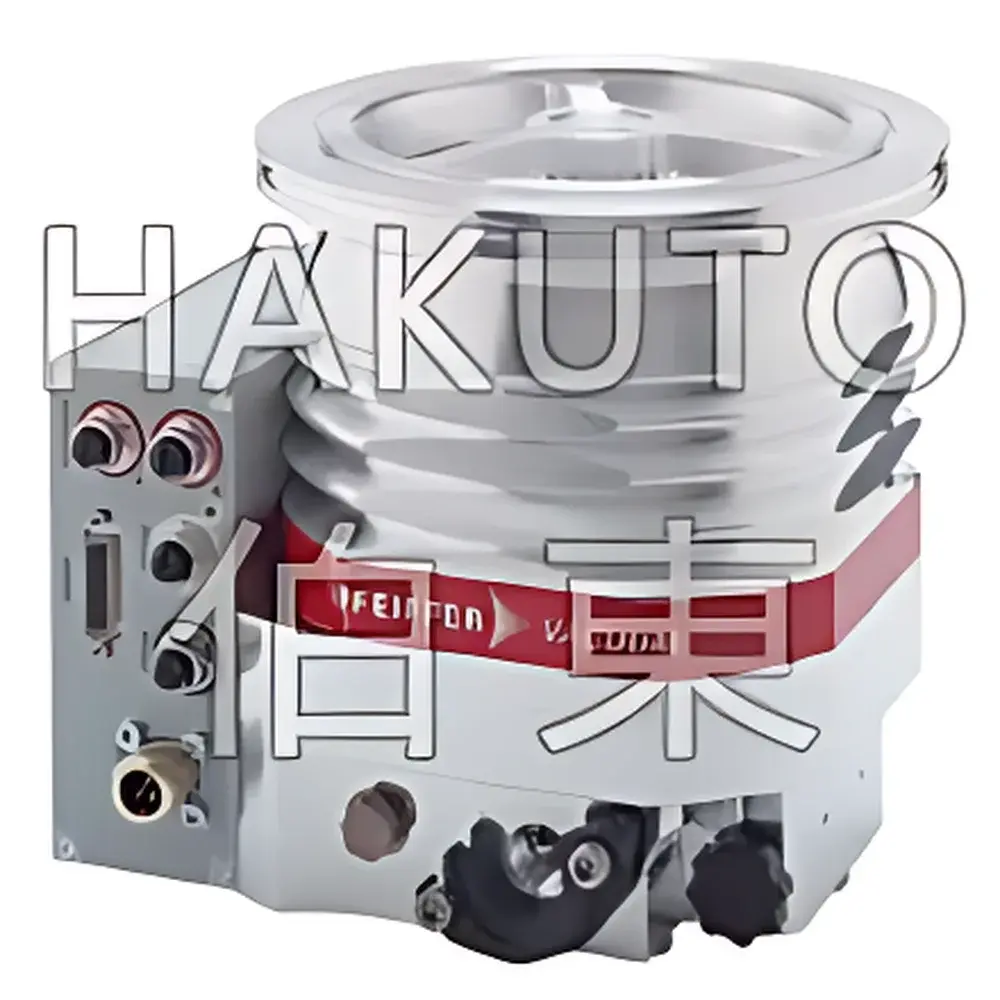
Pfeiffer Vacuum HiPace 450 Turbo Molecular Pump (Distributed by Shanghai Bohong)
| Brand | Pfeiffer Vacuum |
|---|---|
| Origin | Germany |
| Model | HiPace 450 |
| Pump Type | Oil-Free Turbo Molecular Pump |
| Nitrogen Pumping Speed | 380 L/s |
| Hydrogen Pumping Speed | 340 L/s |
| Helium Pumping Speed | 380 L/s |
| Ultimate Pressure | ≤1×10⁻¹¹ mbar (with suitable forevacuum) |
| Compression Ratio (N₂) | >10¹¹ |
| Compression Ratio (H₂) | >10⁷ |
| Max. Inlet Gas Load (N₂) | 2 mbar·L/s |
| Required Forevacuum | ≤10 mbar |
| Motor Frequency | 1100 Hz |
| Dimensions (H×D) | 187×180 mm |
| Weight | 7 kg |
| Flange | DN 160 ISO-K or CF-F |
| Controller Options | TC 110, TC 120, TC 400 |
| Compliance | SEMI S2, UL 61010-1, CSA C22.2 No. 61010-1, NEMA 12 |
Overview
The Pfeiffer Vacuum HiPace 450 is a high-performance, oil-free turbo molecular pump engineered for ultra-high vacuum (UHV) and extreme high vacuum (XHV) applications requiring exceptional pumping speed, stability, and long-term reliability. Based on the proven rotor dynamics of Pfeiffer’s multi-stage turbine design, the HiPace 450 operates via momentum transfer—accelerating gas molecules from the inlet toward the exhaust using rapidly rotating titanium-alloy blades (up to ~90,000 rpm at 1100 Hz). Its optimized blade geometry delivers superior compression ratios for light gases—including H₂ (>10⁷), He (>10⁸), and N₂ (>10¹¹)—making it especially suited for applications where hydrogen or helium partial pressures dominate, such as residual gas analysis in UHV chambers, electron microscopy sample stages, or accelerator beamlines. With a compact cylindrical form factor (187 mm height × 180 mm diameter) and mass of only 7 kg, the HiPace 450 supports flexible mounting orientations—including inverted, horizontal, or side-mounted configurations—without performance degradation, enabling integration into space-constrained vacuum systems.
Key Features
- High-speed, magnetically levitated rotor system with active balancing for vibration-free operation and extended service life
- Oil-free, clean vacuum generation—eliminates hydrocarbon backstreaming and contamination risks critical in surface science and semiconductor metrology
- DN 160 ISO-K or CF-F flange options for seamless compatibility with standard UHV components and chamber interfaces
- Integrated temperature monitoring and overpressure protection ensure safe operation under variable process loads
- Wide operational forevacuum range (≤10 mbar) allows pairing with diverse backing pumps—including diaphragm, scroll, or dry rotary vane types
- Robust mechanical architecture compliant with SEMI S2 safety standards and certified to UL 61010-1 and CSA C22.2 No. 61010-1 for laboratory and industrial environments
Sample Compatibility & Compliance
The HiPace 450 is designed for use with inert, non-corrosive, and non-condensable gases typical in analytical and research vacuum systems. It is not intended for pumping condensable vapors (e.g., solvents, oils), reactive halogenated compounds, or particulate-laden streams without upstream trapping. All variants meet NEMA 12 enclosure requirements when paired with compatible controllers (TC 110/120/400), ensuring dust resistance and protection against dripping liquids. The pump complies with electromagnetic compatibility (EMC) directives per EN 61326-1 and carries CE marking for the European Economic Area. For regulated environments—including GLP-compliant laboratories and FDA-audited R&D facilities—the TC 400 controller supports audit-trail-capable operation and configurable I/O logic aligned with 21 CFR Part 11 data integrity expectations.
Software & Data Management
Controller integration is achieved via RS-485 serial interface, supporting Modbus RTU protocol for bidirectional communication with host PLCs or vacuum system management software. The TC 110 offers basic local control and status LED feedback; the TC 120 adds analog setpoint inputs and relay outputs for interlocked sequencing; the TC 400 provides full Ethernet connectivity (TCP/IP), web-based configuration, real-time parameter logging, and programmable alarm thresholds. All controllers store operational history—including runtime hours, thermal events, and motor current profiles—for predictive maintenance planning. Firmware updates and technical documentation—including dimensional drawings, vacuum performance curves, and installation manuals—are available in English PDF format via Pfeiffer Vacuum’s official support portal.
Applications
- Mass spectrometry (MS) and residual gas analyzers (RGA), particularly time-of-flight (TOF) and quadrupole systems requiring rapid pump-down and low base pressure
- Scanning and transmission electron microscopes (SEM/TEM), where vibration sensitivity and hydrocarbon-free vacuum are essential for atomic-resolution imaging
- Surface analysis tools including XPS, AES, and LEED, demanding stable <1×10⁻¹⁰ mbar conditions during spectral acquisition
- Particle accelerator beamline sections and synchrotron front-ends, where high H₂ pumping capacity mitigates beam-gas scattering
- R&D-scale thin-film deposition (PVD, CVD) and plasma etching reactors requiring repeatable process vacuum reproducibility
- Industrial leak detection systems operating in high-throughput manufacturing QA/QC environments
FAQ
What forevacuum pump is recommended for optimal HiPace 450 performance?
A dry backing pump capable of sustaining ≤10 mbar at the HiPace 450’s exhaust—such as a scroll pump (e.g., Pfeiffer Duo 10/15) or diaphragm pump—is required. Oil-sealed rotary vane pumps may be used if equipped with a cold trap to prevent oil backstreaming.
Can the HiPace 450 be mounted vertically with the inlet facing downward?
Yes. The rotor assembly and bearing system are engineered for multi-axis orientation, including inverted mounting, without affecting pumping characteristics or service interval.
Does the HiPace 450 require periodic oil changes or consumable parts?
No. As an oil-free turbomolecular pump, it contains no lubricants in the vacuum path. Scheduled maintenance is limited to external inspection, cleaning of cooling fins, and verification of controller firmware integrity.
Is the TC 400 controller compatible with LabVIEW or Python-based vacuum system automation?
Yes. Pfeiffer provides official Modbus TCP register maps and RESTful API documentation for the TC 400, enabling native integration with LabVIEW, Python (via pymodbus or requests), MATLAB, and common SCADA platforms.
What is the typical base pressure achievable with the HiPace 450 in a well-baked stainless-steel UHV chamber?
When paired with appropriate cryo- or ion-getter pumping for active H₂ removal and operated in a baked system (<150 °C), the HiPace 450 routinely achieves base pressures below 5×10⁻¹¹ mbar, as verified by calibrated Bayard–Alpert gauges traceable to NIST standards.
Related Products



