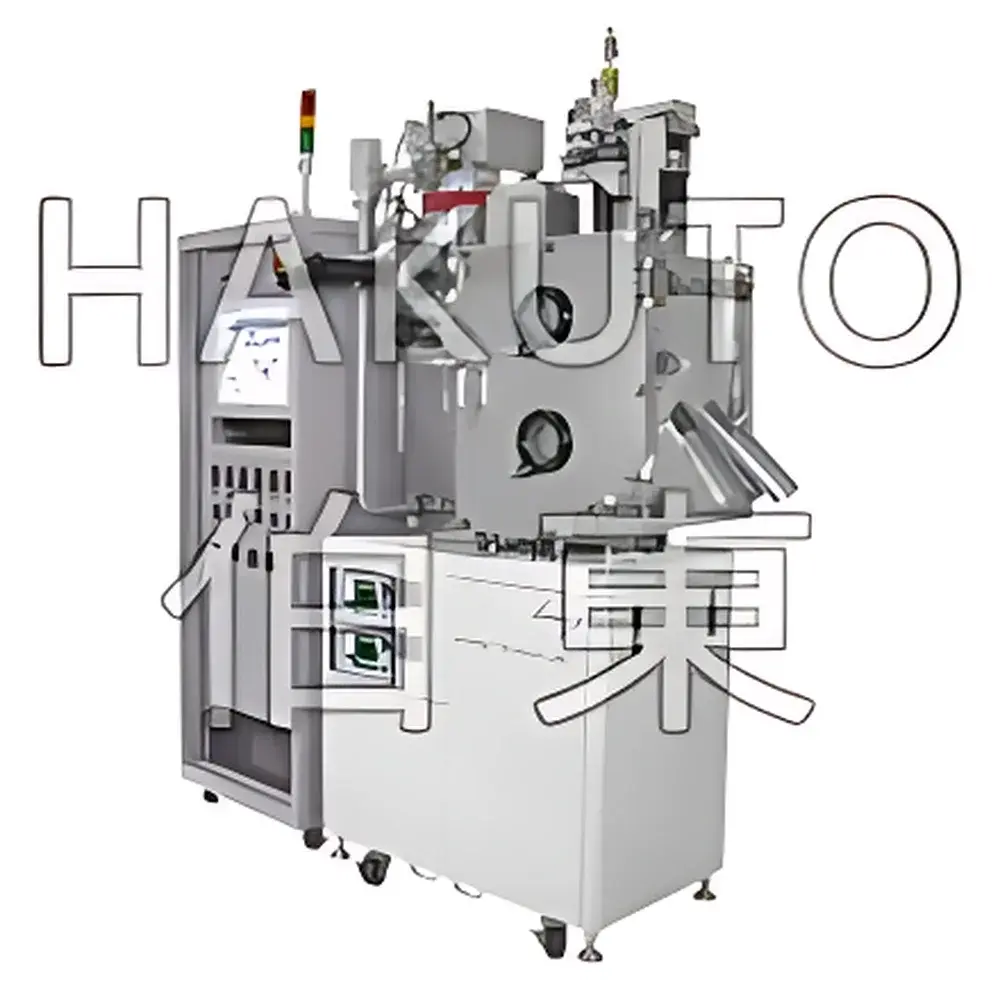
Syskey Metal Thermal Evaporation Coater
| Brand | Syskey |
|---|---|
| Origin | Taiwan |
| Model | Metal Thermal |
| Instrument Type | Thermal Evaporation Coater |
| Application Field | Solar Cells, Nanomaterials, Metal Thin Film Research |
| Substrate Size | Up to 12-inch wafer or 470 × 370 mm² glass |
| Substrate Temperature Range | Ambient to 800 °C |
| Thickness Uniformity | ±3% |
| Base Pressure | ≤1×10⁻⁸ Torr |
| Vacuum Sealing | Nickel gasket + Viton O-rings |
| Evaporation Sources | Multiple configurable boat/crucible sources (7–25 cc) |
| Substrate Manipulation | Rotatable heated stage, adjustable source-to-substrate distance, individual shutters per source |
| Optional Integration | KRI ion source (for in-situ substrate cleaning and film densification), load-lock, glovebox interface, RGA, e-beam assist |
Overview
The Syskey Metal Thermal Evaporation Coater is a high-precision physical vapor deposition (PVD) system engineered for reproducible, controlled thermal evaporation of metallic and selected inorganic thin films under ultra-high vacuum (UHV) conditions. Based on resistive heating principles—where electric current passes through refractory metal boats or crucibles to volatilize source material—the system enables stoichiometric transfer of evaporants onto substrates via line-of-sight condensation. Operating at base pressures down to 1×10⁻⁸ Torr, the coater minimizes residual gas contamination (e.g., O₂, H₂O, N₂), ensuring low impurity incorporation and high film purity—critical for optoelectronic, photovoltaic, and fundamental materials research applications. Its modular architecture supports both sequential single-source deposition and simultaneous multi-source co-evaporation, with real-time thickness monitoring via quartz crystal microbalance (QCM) and closed-loop rate control.
Key Features
- Ultra-high vacuum chamber with dual sealing: nickel gaskets for flange joints and Viton O-rings for viewports and feedthroughs, achieving stable base pressure ≤1×10⁻⁸ Torr
- Configurable multi-source evaporation module: up to six independently shuttered boat/crucible sources (7–25 cc capacity), supporting sequential, alternating, or co-deposition modes
- Heated and rotationally driven substrate stage: temperature programmable from ambient to 800 °C with ±1 °C stability; continuous or stepwise rotation improves lateral thickness uniformity to ±3% across 12-inch wafers or 470 × 370 mm² glass substrates
- Adjustable source-to-substrate distance (150–400 mm), optimized for shadowing control and flux distribution modeling
- Integrated KRI RF ion source (optional): enables in-situ Ar⁺ sputter cleaning prior to deposition and ion-assisted deposition (IAD) during growth to enhance film density, adhesion, and microstructural control
- Front-loading UHV chamber with two borosilicate viewports and motorized shuttered viewport covers for real-time visual monitoring of evaporation plume and substrate surface
- Modular pumping configuration: standard cryo-pump or turbomolecular pump + cold trap combination, compatible with optional residual gas analyzer (RGA) for process diagnostics
Sample Compatibility & Compliance
The system accommodates rigid planar substrates including silicon wafers (4–12 inch), fused silica, quartz, ITO/glass, and flexible metal foils (with appropriate thermal management). All vacuum components comply with ASTM E595 outgassing standards for space-qualified hardware. The chamber design and control firmware support GLP/GMP-aligned operation: full audit trail logging (via optional software package), user-access level management, and electronic signature capability compliant with FDA 21 CFR Part 11 requirements. Process recipes—including ramp rates, dwell times, shutter sequences, and QCM setpoints—are stored with timestamped metadata, enabling traceability for ISO 9001-certified laboratories and semiconductor pilot-line validation protocols.
Software & Data Management
The coater is operated via a dedicated Windows-based control suite featuring intuitive graphical workflow sequencing, real-time analog/digital I/O visualization, and synchronized QCM feedback loops for dynamic deposition rate regulation. All sensor data—including chamber pressure (capacitance manometer + Bayard-Alpert gauge), substrate temperature (Type K thermocouple), evaporation current/voltage, and quartz crystal frequency shift—are logged at ≥10 Hz resolution and exported in CSV/Excel-compatible formats. Optional network integration allows remote monitoring via secure HTTPS API endpoints. Data integrity safeguards include cyclic redundancy checksums, automatic backup to redundant SSD storage, and encrypted database archiving aligned with NIST SP 800-53 controls.
Applications
This thermal evaporation platform serves advanced R&D and small-batch manufacturing needs in multiple domains: fabrication of back-contact electrodes (Al, Ag, Ni, Cr) for perovskite and CIGS solar cells; seed layers and diffusion barriers (Ti, Ta, TiN) in MEMS packaging; model catalytic overlayers (Pt, Pd, Au) for surface science studies; and ultrathin metallic interconnects (<5 nm) in flexible electronics. Its compatibility with glovebox-integrated load-lock configurations enables air-sensitive material handling—essential for alkali-metal (Li, Na) or reactive transition-metal (Mn, Fe) evaporation without oxidation. Researchers in national labs and university cleanrooms routinely use this system for benchmarking film morphology (via AFM/XRD cross-correlation), interfacial reactivity (XPS depth profiling), and electrical transport properties (four-point probe sheet resistance mapping).
FAQ
What vacuum level is required for high-purity metal film deposition, and how is it maintained?
Thermal evaporation of oxygen-sensitive metals (e.g., Al, Mg, Ca) demands base pressures ≤5×10⁻⁸ Torr to limit oxide formation. This is achieved using cryogenic pumping combined with bake-out capability (150 °C, 24 h) and all-metal sealed feedthroughs.
Can the system deposit alloys or compound films?
Yes—via co-evaporation from two or more independently controlled sources, enabling precise stoichiometry tuning (e.g., NiCr, TiAl, AgInSn), provided constituent materials exhibit compatible vapor pressures within the same temperature range.
Is the system compatible with in-situ characterization tools?
Standard flanges support integration of reflection high-energy electron diffraction (RHEED), spectroscopic ellipsometry, or optical emission monitors (OEM) through CF-63 or CF-100 ports.
How is film thickness calibrated and verified?
QCM sensors are factory-calibrated against SiO₂ reference films; absolute thickness accuracy is validated post-deposition via cross-sectional TEM and XRR, with typical deviation 20 nm.
What safety certifications does the system meet?
CE marking (2014/30/EU EMC Directive, 2014/35/EU LVD Directive), UL 61010-1 third-party certification, and RoHS 2011/65/EU compliance for all electrical and vacuum subsystems.
Related Products