
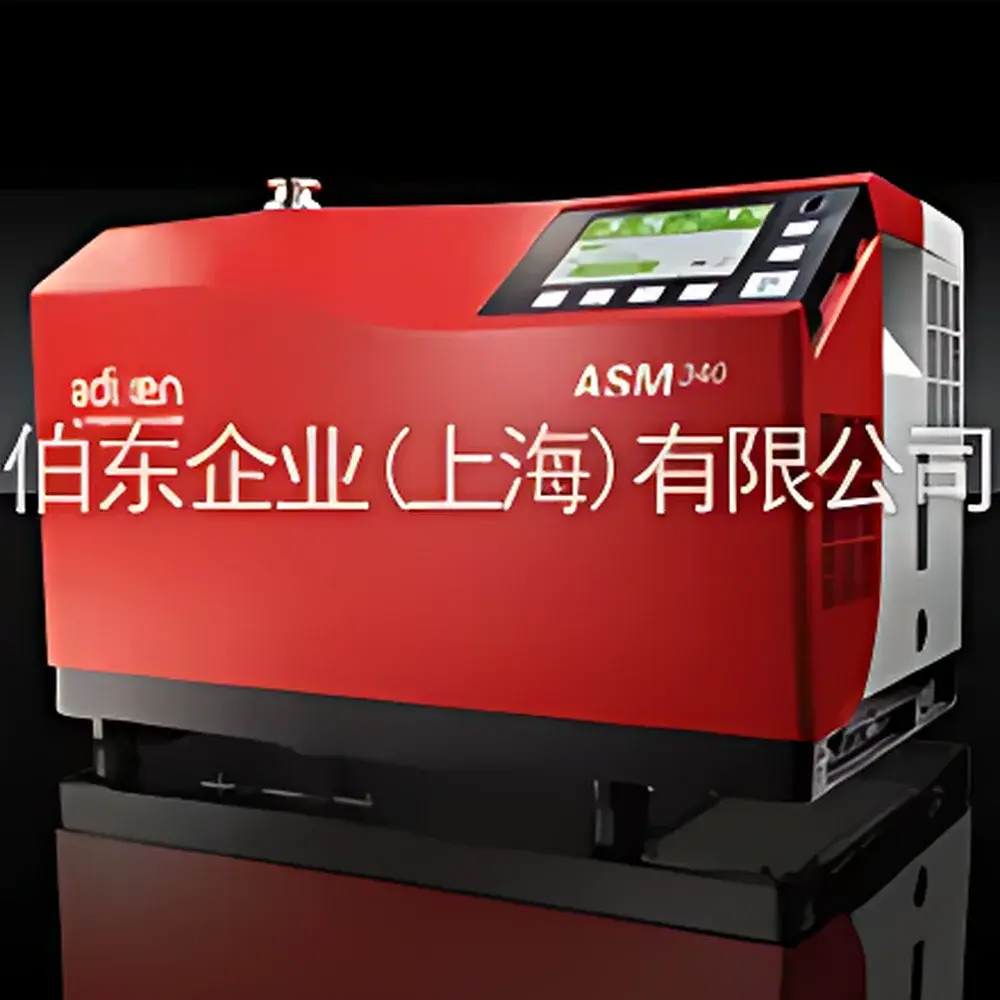
Pfeiffer Vacuum ASM 340 Helium Mass Spectrometer Leak Detector for Lithium Battery Packaging Integrity Testing
| Brand | Pfeiffer Vacuum |
|---|---|
| Origin | France |
| Model | ASM 340 |
| Application-Specific Configuration | Lithium Battery Hermeticity Testing System |
| Distribution Status | Authorized Distributor (Shanghai Bodo Vacuum Equipment Co., Ltd.) |
| Price Range | USD 13,500 – 40,500 (FOB Shanghai) |
Overview
The Pfeiffer Vacuum ASM 340 Helium Mass Spectrometer Leak Detector is an industrial-grade residual gas analyzer engineered for high-sensitivity, quantitative leak detection in hermetically sealed lithium battery cells and modules. Operating on the principle of magnetic sector mass spectrometry, the ASM 340 selectively ionizes helium atoms (mass-to-charge ratio m/z = 4) introduced into a vacuum test chamber, enabling detection limits as low as 5 × 10⁻¹² mbar·L/s under optimized conditions. Unlike broad-spectrum residual gas analyzers, the ASM 340 integrates real-time background subtraction, dynamic gain control, and multi-point calibration routines to ensure measurement stability across varying thermal and pressure transients—critical when evaluating micro-weld integrity in aluminum or stainless-steel battery casings (e.g., cylindrical 18650/21700, prismatic, and pouch formats). Its architecture conforms to ISO 20485:2017 (leak detection — vocabulary and general principles) and supports traceable compliance with IEC 62660-1 (secondary lithium cells for electric vehicles) and UL 1642 (lithium battery safety standard), where hermeticity verification is a mandatory pre-shipment requirement.
Key Features
- High-resolution magnetic sector mass filter with <1.5 amu resolution at 10% peak height, minimizing interference from hydrogen (m/z = 2) and water vapor fragments (m/z = 18)
- Dual-mode operation: Sniffer mode (helium tracer gas scanning) and vacuum mode (inside-out testing via chamber evacuation and helium backfilling)
- Integrated PLC-compatible digital I/O interface (24 V DC, opto-isolated) for seamless synchronization with automated test fixtures, robotic loaders, and MES data acquisition systems
- Auto-tuning algorithm that dynamically adjusts electron multiplier voltage and quadrupole RF/DC parameters to maintain signal-to-noise ratio during extended production runs
- Modular detector head design allowing field-replaceable ion source and collector assembly without vacuum break—reducing mean time to repair (MTTR) to <30 minutes
- Compliant with CE, UL 61010-1, and RoHS 2 directives; designed for continuous operation in Class 10,000 cleanroom environments (ISO 14644-1)
Sample Compatibility & Compliance
The ASM 340 is configured specifically for lithium battery packaging integrity validation. It accommodates standard cell geometries—including cylindrical (18650, 21700, 4680), prismatic (aluminum casing, 10–100 Ah), and laminated pouch cells—via custom-engineered test fixtures with elastomeric sealing gaskets rated to 150 °C and >10⁷ vacuum cycles. All helium introduction paths utilize stainless-steel 316L tubing with electropolished interior surfaces (Ra ≤ 0.4 µm) to prevent adsorption-induced signal lag. The system meets ASTM E493-22 (Standard Practice for Leak Detection Using the Mass Spectrometer Leak Detector in the Inside-Out Mode) and supports audit-ready documentation per FDA 21 CFR Part 11 when integrated with validated SCADA software. Calibration traceability is maintained to NIST SRM 1963 (helium permeation standard) through annual third-party certification.
Software & Data Management
The ASM 340 operates with Pfeiffer’s proprietary HiPace Control Suite v4.2, offering dual-layer data governance: real-time leak rate logging (timestamped, with operator ID and fixture ID metadata) and encrypted binary archive storage compliant with GLP/GMP Annex 11 requirements. Each test cycle generates a structured XML report containing raw ion current values, background-subtracted net helium signal, pressure ramp profiles, and pass/fail status per IEC 62660-1 Clause 7.3.2 (maximum allowable leak rate: ≤1 × 10⁻⁸ mbar·L/s for EV traction batteries). Optional OPC UA server module enables bidirectional integration with Siemens SIMATIC S7 PLCs and Rockwell FactoryTalk Historian for SPC charting (X-bar/R charts) and OEE calculation.
Applications
- Final hermeticity screening of lithium-ion and lithium-metal battery cells prior to electrolyte filling and formation cycling
- In-process weld integrity verification of laser-sealed can seams, lid welds, and terminal feedthrough joints
- Root-cause analysis of field-failure units exhibiting electrolyte dry-out or gas swelling via comparative leak mapping
- Qualification of new packaging materials (e.g., ceramic-coated aluminum foils, multilayer laminates) against baseline helium permeation rates
- Supporting DOE-compliant reliability testing (e.g., HTSL, thermal shock) by correlating leak evolution with accelerated aging metrics
FAQ
What is the minimum detectable leak rate for lithium battery cells using the ASM 340 in vacuum mode?
Typical detection limit is 1 × 10⁻¹¹ mbar·L/s for 100 mL test volume at 1 × 10⁻³ mbar base pressure, achievable within 3-second integration time.
Can the ASM 340 be integrated into existing automated production lines?
Yes—its native Modbus TCP and EtherCAT interfaces support direct linkage with Beckhoff, Yaskawa, and EPSON motion controllers without gateway hardware.
Is helium recovery supported to reduce operational cost?
The ASM 340 does not include built-in helium recycling; however, Shanghai Bodo provides certified third-party helium recovery skids compatible with its vacuum exhaust stream.
Does the system comply with automotive industry cybersecurity standards (e.g., ISO/SAE 21434)?
Firmware v4.2.1 implements TLS 1.2 encryption for remote diagnostics and disables unused network services (e.g., Telnet, FTP) by default—meeting Tier 2 OEM cybersecurity gate requirements.
What maintenance intervals are recommended for high-volume battery production?
Ion source cleaning every 6 months; electron multiplier replacement every 18 months or after 10,000 test cycles—documented in Pfeiffer’s Service Manual SM-ASM340-Rev.D.



