
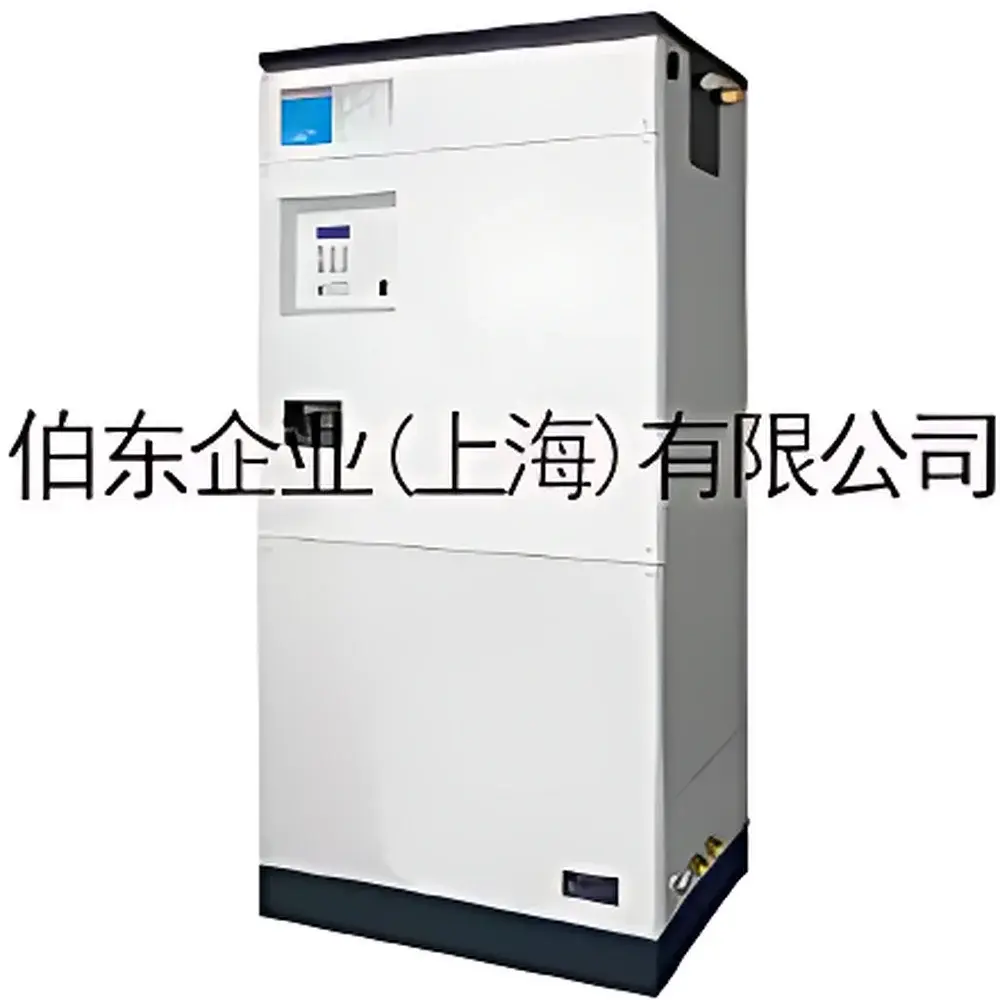
Polycold MAXCOOL 2500 L Cryogenic Water Vapor Pump
| Brand | Polycold |
|---|---|
| Origin | USA |
| Model | MAXCOOL 2500 L |
| Maximum Load | 2500 W |
| Operating Temperature Range | –120 °C to –145 °C |
| Water Vapor Pumping Speed (actual) | 140,000 L/s |
| Ultimate Vacuum | 1 × 10⁻⁹ mbar |
| Starting Pressure | ≤1 atm |
| Defrost Time | 4.0 min |
| Cold Surface Area | 1.4 m² |
| Cooling Water Flow Rate (at 13 °C ΔT) | 13.6 L/min |
| Noise Level (max) | 68 dB(A) |
| Footprint (min) | 0.403 m³ |
| Weight | 544 kg |
| Compliance | CE, UL Listed, RoHS Compliant |
Overview
The Polycold MAXCOOL 2500 L is a high-capacity cryogenic water vapor pump engineered for ultra-high vacuum (UHV) and extreme high-vacuum (XHV) environments where rapid, selective removal of water vapor is critical to process integrity. Unlike conventional cryopumps relying on closed-cycle helium refrigeration or liquid nitrogen (LN₂) immersion, the MAXCOOL 2500 L employs a proprietary two-stage cascade refrigeration system using an environmentally benign, non-toxic, fully recyclable refrigerant blend. This enables stable cold surface temperatures between –120 °C and –145 °C—optimized specifically for physisorption of H₂O molecules while minimizing condensation of permanent gases (e.g., N₂, O₂, Ar). Its design targets applications where water vapor constitutes 65–95% of residual gas load in vacuum chambers—most notably in physical vapor deposition (PVD), atomic layer deposition (ALD), and semiconductor wafer processing. With a verified water vapor pumping speed of 140,000 L/s and sustained adsorption performance down to 1 × 10⁻⁹ mbar, the MAXCOOL 2500 L reduces chamber pump-down time by up to 75% compared to LN₂-based systems and significantly lowers partial pressure of water during deposition cycles—directly improving film stoichiometry, interfacial adhesion, and multilayer uniformity.
Key Features
- Two-stage cascade refrigeration architecture delivering consistent cold surface temperatures from –120 °C to –145 °C without consumables or cryogen refills
- Cold surface area of 1.4 m² with optimized fin geometry for maximum water vapor capture cross-section and thermal stability
- Single- and dual-cryotube configurations compatible with standard ISO-KF, CF, and DN200 flanges for flexible integration into existing vacuum trains
- Integrated defrost cycle completing in ≤4.0 minutes with minimal thermal shock to adjacent components
- UL-listed and CE-marked control cabinet with real-time monitoring of refrigerant pressure, cold head temperature, cooling water flow, and compressor status
- Low-power operation (2500 W max load) with intelligent load-matching logic that modulates compressor output based on chamber outgassing rate
- Acoustically engineered enclosure limiting operational noise to ≤68 dB(A) at 1 m distance—suitable for cleanroom-adjacent installations
Sample Compatibility & Compliance
The MAXCOOL 2500 L is designed for integration with high-throughput industrial vacuum systems including turbomolecular pumps (e.g., Pfeiffer HiPace series), dry scroll pumps, roots blowers, and Kaufman-type ion sources. It does not require bake-out prior to operation and remains functional across a wide starting pressure range (≤1 atm), making it suitable for batch-mode and continuous-process tools. All refrigerant circuits comply with ASHRAE Standard 15 and EU F-Gas Regulation (EC) No 517/2014. Electrical safety conforms to UL 61010-1 and IEC 61000-6-4 (EMC). The unit supports GLP/GMP audit readiness via optional analog/digital I/O interfaces for integration with SCADA and MES platforms. While not intrinsically rated for Class I Div 1 hazardous locations, its sealed refrigerant loop and absence of ignition sources enable safe deployment in ISO Class 5–7 cleanrooms per ISO 14644-1.
Software & Data Management
The MAXCOOL 2500 L operates via a dedicated embedded controller with a 4.3-inch color touchscreen HMI. Firmware v3.2+ supports Modbus TCP and RS-485 protocols for bidirectional communication with host PLCs or vacuum system controllers. Logged parameters—including cold head temperature history, cumulative runtime, defrost count, refrigerant pressure trends, and cooling water delta-T—are timestamped and exportable as CSV files via USB or Ethernet. Optional data logging modules provide 21 CFR Part 11–compliant audit trails, including user authentication, electronic signatures, and immutable event records required for FDA-regulated semiconductor fabrication facilities. Remote diagnostics and firmware updates are supported through secure TLS-encrypted connections.
Applications
- Semiconductor manufacturing: Wafer-level PVD sputtering, ALD reactor conditioning, and etch chamber moisture control
- Optical coating: High-reflectivity mirror stacks, anti-reflective coatings, and laser-grade thin films requiring sub-ppb water partial pressure
- R&D vacuum systems: Surface science UHV chambers, molecular beam epitaxy (MBE), and synchrotron beamline end stations
- Flat-panel display production: Large-area ITO sputtering and OLED encapsulation processes
- Advanced packaging: Wafer-level underfill curing and plasma-enhanced CVD pre-treatment
FAQ
What is the primary advantage of the MAXCOOL 2500 L over liquid nitrogen (LN₂) cryopumping?
It eliminates LN₂ logistics, storage, and handling risks while delivering superior thermal stability and reproducibility—reducing water vapor partial pressure more consistently across repeated process cycles.
Can the MAXCOOL 2500 L be used alongside turbomolecular pumps?
Yes. It is routinely integrated upstream or downstream of turbomolecular pumps (e.g., Pfeiffer, Edwards, or Agilent models) to enhance water vapor removal efficiency without compromising base pressure or gas throughput.
Is the refrigerant used in the MAXCOOL 2500 L ozone-depleting or globally warming?
No. The refrigerant blend is non-ozone-depleting (ODP = 0) and has a global warming potential (GWP) <150, compliant with current EPA SNAP and EU F-Gas phase-down schedules.
Does the unit require periodic maintenance beyond cooling water filtration?
Annual inspection of refrigerant charge integrity, compressor oil analysis, and heat exchanger cleaning is recommended. No routine refrigerant replenishment is needed under normal operating conditions.
How does the MAXCOOL 2500 L support regulatory compliance in GMP environments?
With optional 21 CFR Part 11 firmware, it provides electronic recordkeeping, role-based access control, and tamper-evident audit logs—fully traceable for FDA, ISO 13485, or IATF 16949 audits.



