
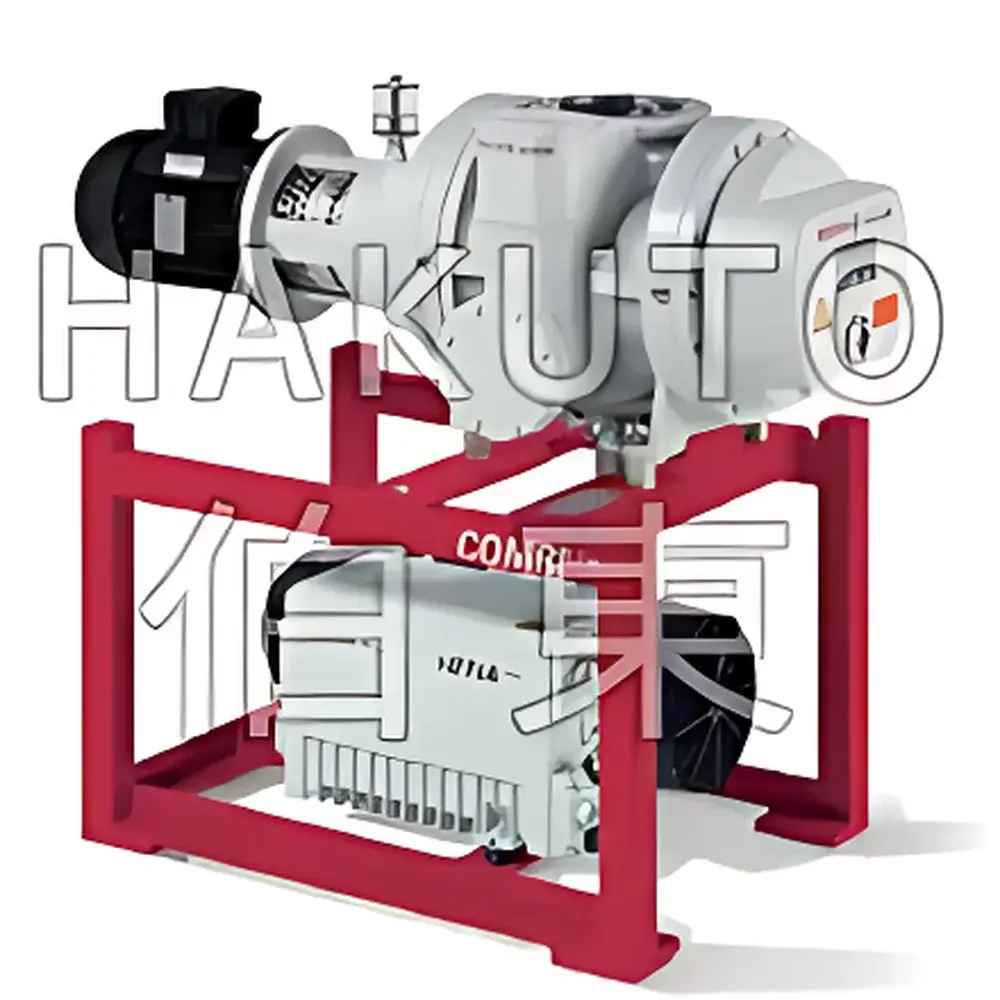
Pfeiffer CombiLine WU Series Rotary Lobe Vacuum Pump System
| Brand | Pfeiffer Vacuum |
|---|---|
| Origin | Germany |
| Pump Type | Oil-Lubricated Rotary Lobe Booster + Forevacuum Pump |
| Ultimate Pressure | ≤2 × 10⁻³ mbar (with UnoLine) / ≤8 × 10⁻³ mbar (with HenaLine) |
| Pumping Speed | 230–5000 m³/h (at 1 mbar, 50 Hz) |
| Inlet Flange | DN63 to DN250 |
| External Dimensions | Up to 1000 × 500 × 1000 mm |
| Weight | 240–2250 kg |
| Motor Power | 5–100 kW |
| Compliance | CE, ISO 9001, RoHS |
Overview
The Pfeiffer CombiLine WU Series is a modular, high-performance rotary lobe vacuum pump system engineered for demanding industrial and research-grade vacuum applications requiring rapid evacuation, high throughput, and long-term operational stability. Based on the proven Couette-flow principle of rotary lobe technology, the WU system integrates a robust Okta-series lobe booster pump with a compatible forevacuum pump—either the UnoLine or HenaLine series oil-sealed rotary vane pumps—to form a two-stage vacuum generation solution. Unlike single-stage systems, this configuration enables efficient operation across a broad pressure range—from atmospheric down to ≤2 × 10⁻³ mbar—while maintaining high volumetric efficiency at intermediate pressures (10–100 mbar), where conventional pumps exhibit significant performance drop-off. The system’s design prioritizes thermal management, mechanical rigidity, and gas-handling resilience, particularly against water vapor and process byproducts common in metallurgical and thermal processing environments.
Key Features
- Modular architecture: Interchangeable Okta lobe boosters (Okta 250 to Okta 6000) paired with either UnoLine (BA 25/50) or HenaLine (Hena 60–1000) forepumps for application-specific optimization.
- High pumping speed retention: Delivers up to 5000 m³/h at 1 mbar (50 Hz), with minimal speed decay across the 10–100 mbar operating band—critical for load-lock cycling and continuous degassing processes.
- Water vapor tolerance: Optimized rotor geometry, heated housing zones (optional), and oil formulation compatibility minimize condensation-induced wear and extend service intervals.
- Low energy consumption: Integrated motor control and geartrain efficiency yield specific power consumption as low as 0.18 kW·h/m³ at nominal speed—validated per ISO 8573-1:2010 Annex D for industrial vacuum systems.
- Robust mechanical construction: Cast-iron baseplate, precision-ground rotors with micro-polished surfaces, and backlash-free timing gears ensure vibration 15,000 hours under continuous duty.
- Service-friendly layout: Front-accessible oil reservoirs, tool-free rotor chamber inspection ports, and standardized flange interfaces (ISO-KF, ISO-F, CF) simplify maintenance and reduce downtime.
Sample Compatibility & Compliance
The CombiLine WU Series is certified for use in vacuum metallurgy, electron beam welding, vacuum heat treatment (quenching, brazing, sintering), and industrial drying/dehydration systems where chemical compatibility with hydrocarbons, oxides, and trace halogens must be maintained. All wetted materials—including rotor housings, shaft seals, and oil circuits—comply with ASTM F2214-17 (materials for vacuum service) and EU Regulation (EC) No 1935/2004 for incidental food contact where applicable. Electrical components meet IEC 60034-1 and CE Machinery Directive 2006/42/EC. Optional ATEX-certified versions (II 2G Ex d IIB T4 Gb) are available for Zone 1 hazardous area deployment. Documentation packages support GLP/GMP audit readiness, including full traceability of calibration certificates (DIN EN ISO/IEC 17025) and FAT/SAT protocols.
Software & Data Management
While the WU Series operates as a standalone hardware platform, it supports integration into centralized vacuum network monitoring via optional Pfeiffer VACOM® digital interface modules (RS485/Modbus RTU or Ethernet/IP). Real-time parameters—including inlet pressure, motor current, oil temperature, and vibration amplitude—are logged with timestamped resolution of 1 Hz. Historical datasets export to CSV or OPC UA-compatible SCADA systems. Firmware updates follow IEC 62443-3-3 security guidelines, and local HMI units provide password-protected access levels (operator, technician, administrator) aligned with FDA 21 CFR Part 11 requirements for electronic records and signatures when deployed in regulated manufacturing environments.
Applications
- Vacuum metallurgy: Continuous degassing of aluminum and magnesium melts; vacuum induction melting (VIM); electroslag remelting (ESR).
- Thermal processing: Batch and continuous vacuum furnaces for sintering, annealing, and diffusion bonding—especially where rapid pump-down (<15 min from atmosphere to 10⁻² mbar) is critical.
- Electron beam systems: Stable backing for high-voltage electron optics in welding, drilling, and additive manufacturing platforms.
- Load-lock transfer chambers: High-throughput semiconductor and thin-film coating lines requiring repeatable cycle times and minimal particle generation.
- Helium leak detection: High-speed evacuation of test chambers prior to mass spectrometer analysis, supporting ASTM E493-21 methodology.
FAQ
What forevacuum pump options are compatible with the WU series?
The WU system is designed exclusively for pairing with Pfeiffer’s UnoLine (BA 25/50) or HenaLine (Hena 60–1000) oil-sealed rotary vane pumps. Cross-brand integration is not supported due to proprietary control signal protocols and oil return circuit dependencies.
Is the WU series suitable for corrosive process gases?
Standard configurations are rated for clean, dry, non-corrosive gases. For chlorine, HF, or acidic vapors, Pfeiffer offers the WU-C variant with nickel-plated rotors, ceramic-coated housings, and fluorocarbon-compatible seals—certified per NACE MR0175/ISO 15156.
How often does the lobe pump require oil changes?
Under typical metallurgical operation (8,000 h/year), oil change intervals are 6,000 operating hours when using Pfeiffer VacOil S 100, verified by periodic FTIR spectroscopy per ISO 4406:2017 contamination class reporting.
Can the WU system operate continuously at ultimate pressure?
No. The WU series is optimized for high-speed roughing and medium-vacuum operation. Sustained operation below 10⁻² mbar requires a high-vacuum pump (e.g., turbomolecular or cryogenic) staged downstream.
Does Pfeiffer provide remote diagnostics support?
Yes. With VACOM® Connect enabled, authorized service engineers can perform real-time health assessment—including spectral vibration analysis and motor winding resistance trending—via encrypted TLS 1.3 tunnel, compliant with GDPR Article 32 data protection standards.



